This is my grandpa on the left after his successful deer hunt.
Our visits to the grandparents were always fun. My grandparents on my dad’s side were totally into farming. They had a huge farm, located not far from our farm, with many animals, and acres and acres of corn, oats, soybeans and flax. Besides my two uncles that were still living at home, Mike and Lyle, they always had hired help—as many as they needed. And grandpa was always working too. And so was grandma. She was the brains of the outfit—much more than grandpa. She kept the books, made the schedules, and I think even made sure grandpa got up in the morning to milk the cows! And then after the early chores were done, all the workers came in for breakfast, which grandma had all ready for them on the big kitchen table. Breakfast was always a big deal—eggs, bacon, pancakes, juice, milk, coffee, whatever you wanted.
I guess you could say that when we came over to visit, nothing stopped just for us. The farm work had to keep going and we understood that. Many times, us kids would just set in the living room and watch TV. That was fun for us because we didn’t have TV at our farm. I also remember walking around in the barn while the milking was going on.
Everything on Grandpas farm was so much more modern and bigger than on our farm. All the milking was by machine, and unlike our old wood barn, grandpa’s barn was made of shiny, silver-looking metal; and it was huge! And all their buildings looked modern and huge. And their tractors and machinery looked so new. And they had horses, which we didn’t have.
And they also had other properties. Besides their farm in Montevideo, they also had land in South Dakota, where they had Black Angus cattle—hundred of them. I remember riding with grandpa and my dad one day to check on them. Grandpa said he just needed to check to see if they had enough salt blocks, and also to see if there were any new calves.
I liked grandpa. He laughed at my stories (when I was about 7), and he told stories to me too. Unlike my dad, grandpa was a hunter. He hunted deer and pheasants, and even rabbits. And he always had his rifle in his pickup truck. I remember once when I was with him hunting rabbits. The way he would do it was just to shoot them out the window of his truck as we drove through the fields. I heard some stories about grandpa after he died, that he would go into town to drink, and that he had a wild side. I never knew that about him. I guess for some reason grandma and my parents wanted to hide that from us. But I still have always liked him.
There are many cries these days about our rights. Some say that every person has a right to free health care. Some of these same people have been saying for years that every woman has a right over her own body, and that she has a right to choose whether she wants an abortion or not. Well, this is a topic that we all would do well to seek God’s will on—to seek the Scriptures. With some help from an internet source (listed below), I have come up with the following biblical directives.
According to The Bible, What Rights Do We as Humans Have?
1.Since we all are created in God’s image (Gen. 1:27), we have a certain dignity, and thus, we have a right to be treated with dignity.
2.God has said to us that we should not murder (Gen. 7:6), that we should treat everyone humanely. Thus, all humans have a right to be treated humanely, especially a right not to be murdered.
3. The Ten Commandments gives prohibitions against murder, theft, coveting, adultery, and bearing false witness. Thus, we have a right not to be wrongly treated with any of these violations.
4. Immigrants have a right to be treated well (Exod. 22:21).
5. The poor have a right to be treated well (Prov. 14:31).
6. We all have a right not to be discriminated against in any way (Gal. 3:28; Col. 3:11; Ja. 2:1-4).
According to the Bible, What Rights Do We Not Have?
1.I do not have a right to sin against my own body, especially as a Christian, since my body is the Lord’s (1 Cor. 6:19-20).
2.No person has a right to sin against another person because he is a creation of God (1 Cor. 6:19-20).
According to the Bible, What Are a Woman’s Rights?
1.A woman has a right to be treated as a woman the way God designed her (Gen. 2:18; 1 Pt. 3:7).
2. A woman does not have a right to go against her natural, God given sexual desires (Rom. 1:26). This is also true for a man.
3. A woman has the right to protect her own baby inside of her, but she does not have a right to force her babies death, because God forms the baby inside of her and because the baby, in whatever stage of grows he or she is in, is a creation of God (Ps. 139:13).
4. A woman has a right to be treated well just as a man has a right to be treated well, because she is created in His image (Gen. 1:26).
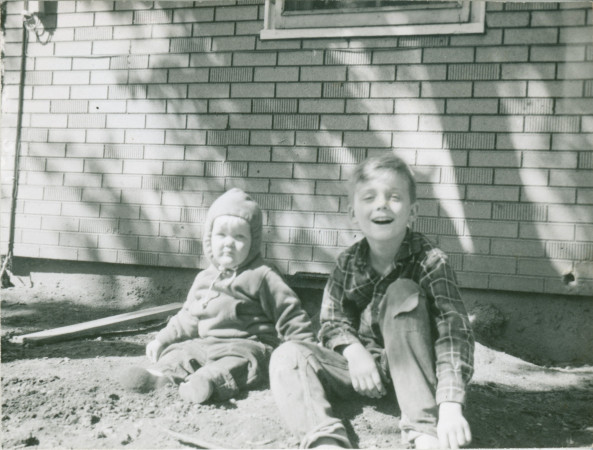
This is me on the right with my little brother Jimmy, sitting in the dirt in back of the old Delano farm house.
As I wrote previously, I lived on a farm near Montevideo, Minnesota when I was about six and seven years old, and then later when I was about ten and eleven. In between those years we lived on a small farm near Delano, Minnesota. I have no memory of school there (3rd and 4th grade), but I have plenty of other memories.
The house was quite small and rickety—much smaller and older than the large Montevideo house. The ceiling leaked, the walls creaked, and the inside of the walls were infested with mice. We would hear them all the time. Though my mom and sister hated them, me and Mark had fun killing them with mouse traps. We would get at least one a day.
Another house adventure was the attic. Dad did some repairs to the attic and to the steps leading up there, but it still looked like an attic. And that’s where us kids would sleep. It wasn’t cold up there like the Montevideo farm was; but it was musty, and we could hear the mice; and once in a while we would even see and hear bats flying back and forth over our heads while we hid under the covers. That was scary. I think my mom felt sorry for us, but my dad didn’t seem to care.
Oh, I’m sure he cared, but I know he had so much on his mind. We were not making it too well financially, and I suppose he was always thinking of any way possible to make more money to hold the farm and the family together. And I know mom wasn’t happy in that house, and any suggestions she gave dad made him angry. I don’t know if it was her idea or not, but I remember that dad worked part time at a macaroni factory in town. I remember that he brought leftover macaroni home, probably swept up from the factory floor, and fed it to the pigs. He actually made a pig slop out of it; he mixed the raw macaroni with feed and sour milk. Oh, those pigs just loved it! They would go crazy over it! In fact, when we fed them, we had to be really careful, because when they would see us heading their way with a pail of slop, they would come running and squealing. If we didn’t quickly dump it in their trough and get out of the way, they would run us over.
We had a few acres of farm land, mainly corn; and we had one or two cows, some chickens, and about 30 pigs, as I mentioned. They were penned up only about 20 yards from the house. I remember that every time my grandpa and grandma came over to visit, they would always be holding their nose—literally. They couldn’t stand the pig smell. But I didn’t mind at all. I guess you get use to it; and I really sort of liked that farm smell.
I have such vivid memories of that little farm, especially the back yard. Not too far from the back of the house, across from the pig pen was an old windmill, used to pump water. And it worked! Then not too far from the windmill there was a row of fruit trees; mainly apple trees, but also a pear tree. Mom would sometimes make apple pies from the apples. And I remember, she would also make chokecherry jam from the chokecherry trees (pictured), which were scattered all over the farm. Mom was really good at making stuff. Besides making pies and jam, she baked bread—which was always wonderful.
We had one of those old-fashioned telephones that you had to crank. And it was a party-line phone—so you had to share it with the neighbors. We didn’t have many neighbors. But I remember up the gravel road, about a quarter mile, was a farm on the right with a crab apple tree and geese walking all over in the yard. Across from that farm, on the left, was an underground house with a flat roof that was about three feet above the ground level.
Then, a little way from that house was an old farm house, more like a shack, where two old bachelors lived, and where they often sat out on their back steps. We liked hanging around them, listening to their stories and watching them whittle their sticks. And they had a distinctive smell of tobacco and beer. Yea, they were a couple of happy, carefree guys, and I remember thinking that I wanted to be just like them!
This is me on the gravel road in front of the house.
Okay, my first thought is this: If we compare this virus to the flu, it really seems like the flu is much deadlier. Last year there were34,157 flu related deaths. And no one hardly said anything. Am I missing something?
Also, what about abortion? In 2016, 623,471 deaths came as the result of abortions. And nobody has been saying anything. Or what about suicide? In 2017, 47,173 deaths from suicide occurred. And where was all the concern for that?
Oh, here’s a real winner. Everybody’s so concerned about our troops in Afghanistan. So many of our men are being killed over there. Well in the total war, 1,833 of our troops have been killed; that’s an average of about 96 deaths per year. If you compare that number to the flu last year, the flu has been 356 times deadlier that the Afghanistan war.
I’m just trying to put some perspective on this. Can anyone tell me why this coronavirus is so concerning—more than other things like I have mentioned? I mean I know it’s a big deal, but I’m just wandering why we seem to be so much more upset about this virus than other viruses, and about abortion and suicide (not to mention so many other diseases).
And here are some questions I have:
Should the government be spending so much money on this coronavirus? If God has allowed this virus to happen maybe we should just take it as His way of disciplining us. Does this make any sense to anyone? I mean, everyone will die at some time in their life.
Is this coronavirus a harbinger of things to come? If so, how can we prepare for it? How can we let this virus prepare us for things to come? What does the bible say about future viruses? Or future disasters that will cause deaths? Should we try to control them or just be ready to face them?
Will this coronavirus in some way work together for our good? Maybe God has allowed it to benefit us in some way, to draw us to Him for His help. I have heard that there are bipartisan efforts gong on. There is some unity happening. Sometimes I guess it takes a disaster like this to bring us together. Maybe God is in it all. What do you think?
I just want to say that I am super proud of President Trump and the whole Trump team the way they have responded to this virus. I think President Trump has been especially resilient the way he has faced the press. He has a great, positive attitude, and just because of that I know we will come out of this much better than anyone ever thought. I just feel that he was made for this kind of disaster. No one could handle it better.
My sources: All the data was gathered from reliable government websites.
In previous blogs I talked about my chores and the field work. But I hope I didn’t give the idea that I was working all the time. The chores were only in the morning and evening, and the field work was mainly during the harvest season. And even then, my dad didn’t always give us jobs to do. Sometimes he got so busy plowing or whatever, that he sort of forgot to give us jobs. So, we just ran off somewhere. And there was plenty of things to do. In fact, my mom didn’t mind at all that we were out playing. She just wanted us home for supper. And if we weren’t home at supper time, believe me she had a loud voice and she would call us home by name for supper—at the top of her lungs.
I think the main fun thing I remember doing is exploring, sometimes by myself and sometimes with my brother Mark. My sister was more of a bookworm and I think she preferred just reading, even if it was in the house. I liked walking along the creek that ran in a large circle around the farm. Sometimes we would see frogs and we would try to spear them with a sharp stick we made. It never bothered us that we were killing them and reducing their population. We were like fierce hunters.
Some days, when we knew that we had a few hours to kill before we had to be home for supper, we would go deep into the woods until we came to a great river. We didn’t know what river it was, but we knew it wasn’t the creek. It was too wide. I remember the imposing sound of the water. I just loved standing by its banks and feeling its strength and majesty. It gave me the shivers! Another time we encountered a few red-haired cows with long horns. And they were mean looking, so we ran out of there!
Back behind the grainery, which was not too far from the house, there were two old junk cars. One of them was a light cream color with lots of chrome on it. The other car was clearly a Ford model T, all black. We would often see rats crawling in and around the cars…cool! I remember one time we were there with our dog Brownie, and he spotted a squirrel under the cars. I’ll never forget what happened. When the squirrel tried to run away, out from under the car, Brownie, as quick as a flash, caught him between his teeth, and he was dead instantly. I couldn’t be more proud of him. What a great dog. And he was fast. One time we clocked him as he ran along side of our car. I think he got up to about 40 miles per hour!
I don’t know where I got it from, but it seems like I was always doing things to try to prove and challenge my bravery and strength—me more than my brother. Besides spearing frogs, I remember more than once trying to ride our buck sheep. It was kind of silly.
I also liked wrestling with my brother Mark. I liked it mostly, I think, because I knew I would win. Mark didn’t seem to care. I guess he just liked being with me. Now that I think back on it, he had a better spirit than me, a very sweet spirit. All I cared about was winning, being number one, being better than him. That selfish attitude has been with me for years, and now I regret it. I should have treated my brother better and now it’s too late.
This is exactly the place I was thinking of going for a walk today. It is overlooking the Mississippi river. I took this picture a year ago today. Hopefully I will see some of the same sights.
I feel like a prisoner in my own house—apartment. I woke up this morning with the reality that I was scheduled to go to work—actually, to help a friend paint a room to be used as a church office. My pastor was sort of counting on me to help out. But I feel lousy. I hope I’m not getting the coronavirus. I’m 69 years old and ripe for the virus; old people like me are really suppose to stay home. I didn’t want to do it, but I really felt that I should—that I should text the pastor and tell him that I can’t come, that I wasn’t feeling well. So, I did, and of course he understood. A couple hours later my doctor called me and asked me not to come to my appointment tomorrow if it wasn’t an emergency. I agreed to cancel, and I also talked to her about some of my medical concerns.
Now I feel like I should just obey the President and the experts and stay home. But I’m feeling better and I don’t want too. I’m antsy. Can I really stay here in my apartment for a couple months until, as they say, this coronavirus washes out? I know I can always find things to do, like what I’m doing now, writing. But I like to get out too. I have favorite eating places, coffee shops…and I want to go there. Oh, it’s tough! I don’t think there will be anything wrong with going for a little walk outside. I need the exercise. I think I feel well enough to do that, and I won’t be around anyone…I don’t think. I will pray. I will make this day a day of prayer—for myself, for the country, and for the world.
This is a very old blurry picture, but I know who everyone is. I’m on the top right, and that’s my sister on the left. My dad is on the wagon and those little kids in front are my brother Jim and Donna. They came along later.
During harvest season there was always work to be done in the fields. Baling hay was especially fun. I would usually be on the wagon receiving the hay bales as they came off the baler. It was hard work, but fun. I would grab the bales by the twine and then turn around and stack them on the wagon. Then when the wagon was full, we would unload it and pile the bales onto a huge haystack (pictured above). If stacked properly, it would keep through the winter; but much of it we would transfer by conveyor into the barn hayloft to feed the cows. Oh, the cows loved the hay!
We also grew oats. The harvesting of the oats was entirely done by a combine, but the oat stems (straw) would be bailed up just like the hay, which was used as bedding for the cows, the pigs and the sheep. And we also used it in the garden. As a kid I much preferred straw over hay because it was less itchy and softer.
The harvesting of corn is usually all done by machine, but, for a couple seasons, we ended up doing it by hand. We dreaded it, but once we got into it, it was kind of fun. I say we because the whole family got into it. Mother would drive the tractor pulling the wagon; and the rest of us, dad and us three kids, would walk along on either side of the wagon, break off the corn, pull the shuck off, and toss the corn in the wagon. Once we got the hang of it, we could pick one ear of corn in just a few seconds. We would work at it for hours at a time, up and down the rows. At the end of the day we were bushed!
Another thing I remember doing in the corn fields is walking up and down the rows and pulling these big weeds called cockleburs. We didn’t want them in the fields because they would tend to choke out the corn. I also remember picking rocks. That was done in the early spring before planting. I suppose the main reason for getting rid of the rocks was so they wouldn’t interfere with, and break any of the machines, like the disc and the planters and the combines. Come to think of it, maybe that’s why the corn picker broke!
I don’t know if this classifies as field work, but fixing the fences was a regular task. That was kind of fun because I got to work with my dad. My dad was always happier when he was working—doing something. In the evenings when he was just sitting around the house, he tended to get upset and angry, especially when my mom would pester him about certain things. Oh, they could get into it. I hated it. I hated hearing the angry arguments. But I loved seeing dad happy and in a good mood.
In the next post I’ll talk about what I did for fun—my free time.
This isn’t me, but that ‘s how I remember it. I had a pail just like that, and a stool like that. But I never had a hat like that!
Farm chores consist of those daily duties that just have to be done, like milking the cows, feeding the animals and gathering the eggs. In our farm, my dad took charge of all the duties, but he liked to keep us kids busy too. His idea was that the whole family should work the farm. We did have some hired help from time to time, but it seemed like us kids did most of the work.
As I mentioned previously, there were two periods of time when I lived at the Montevideo farm: when I was about 7 and 8, and then again when I was about 11 and 12. When I was at the younger age I don’t think I did a lot with the animals—although I’m sure I wanted to. I was more restricted to the menial, mindless tasks like weeding the garden and hauling water from the well to the house. I hated that job! It was a long way to go and the water buckets were so heavy. I don’t know why I was always stuck with that job. I guess because there was no one else.
When I was at the older age, I filled in much more with the chores. My sister, two years older, helped out some too, and so did my younger brother. The chore I liked the most was milking the cows, which had to be done twice a day: in the early morning and again in the evening at about 6. Most of the milking was done by hand; I think we did have one milk machine. My dad milked most of the cows, but I did my share of the milking too—for every three cows he milked, I probably milked one; not bad for a kid. We had about 30 cows to milk, so it took us a while. And it was a real workout, especially for your fingers and forearms.
You know, I don’t even remember what happened during the school months. Did us kids help out with the chores before and after school? Or maybe that’s when we had hired-help, or maybe mom filled in. Some things, like school were just a blur. Other things I do remember quite vividly.
Yea, I remember the dirty, stinky jobs like cleaning the gutters in the barn. That job definitely had to be done every day after the cows went out to pasture, and sometime even while they remained in the barn—when it was too cold to let them go out. We would scoop out the manure with a flat shovel into a wheel barrow, and then wheel it out the barn door. And that took some strength and skill. You had to steer it on these planks all the way to the end of the manure pile, and then dump it. And if you would go off the plank—that usually didn’t happen—it would be a disaster and a mess! Can you imagine sinking hip deep in manure, while struggling to keep the wheel barrow afloat?
Sometimes I was charged with bringing the cows home from the pasture. Usually, they would come in by themselves; but sometimes, for some reason, they just didn’t show up. So my dad would say, go find those cows!
I didn’t always like all the walking, but, at the same time it was sort of fun and adventurous: walking across the creek, up the hill and through the trees, all the while following the cow paths. If you stayed on the cow paths you would usually find the cows. Often, I would run right into them, walking slowly home. Yea, they knew their way home. They were just slow and lazy in coming…so I would hurry them along by gently swatting them with a stick.
I would also be tasked with herding the sheep, and basically just watching them. If they would get into the alfalfa fields, that’s bad news because they can get bloated and die—and that happed a couple times. And there were also cases when wild dogs or coyotes would attack and kill the lambs. All kinds of things can happen. Sheep don’t have a lot of good sense, and if one gets in trouble, other will follow. So, we had to watch them, especially when we let them roam around.
I can’t remember too much about feeding the animal; but that is, of course, the most important chore which my dad handled—but I know I help out.
Here’s one thing I vividly remember doing in the fall and winter months: I helped dad keep coal and wood in our furnace. It was a large furnace located in the basement. And since it was the only source of heat available for our two-story house, it was important that we kept it going constantly. My dad would get these old boards—I’m not sure where he got them—and we would break them up by resting them against a wall or something, and then jumping on them until they broke. And he would also chop down small trees with an ax; he also let me use the ax. Great fun! I didn’t mind the work at all. Using the ax was worth all the callouses.
When it would get especially cold, we had to work extra hard to keep the furnace going. But apparently, there are things you are not supposed to do—like overload the furnace. I guess we managed not to do that, but I heard from my dad years after we moved away, that the next resident had overloaded the furnace and the house burnt down! I never heard whether everyone got out alive or not.
My church has canceled worship services today because of the coronavirus. Many churches around the nation are doing the same thing. I was thinking that we should take this off day to pray. In fact, that was also on the President’s mind. I received a letter from Franklin Graham yesterday declaring today to be a National Day of Prayer, and I want to pass that letter on to you.
Dear Friend,
Our President has declared tomorrow, Sunday, March 15, to be a National Day of Prayer. He reminded the entire country that throughout its history, the United States has looked to God for strength and protection in times like these.
I am thankful to President Trump for recognizing the power of prayer and showing faith in the Lord to intervene on our behalf. With so much uncertainty surrounding the coronavirus at home and around the world, people are afraid. Now is the time for Christians to be strong and courageous, knowing that Almighty God is with us. As His Word instructs, we are to cast our cares upon Him, because He cares for us (1 Peter 5:7).
We need to pray for those who are sick and their families, for those who are living in fear and anxiousness, for the professionals who are providing medical care, for those working on treatments and a vaccine for COVID-19, and for our leaders to act with wisdom and courage as they make vital decisions that impact each of our lives. Please also lift up the President and our nation’s coronavirus task force headed by Vice President Mike Pence in prayer as they work closely and diligently with the myriad of issues related to this pandemic.
Some churches are not meeting in person for worship this Sunday to avoid possibly spreading the virus. But that doesn’t prevent us as the Body of Christ from coming before the Lord, kneeling in prayer, and pouring our hearts out to Him. “Let us therefore come boldly to the throne of grace, that we may obtain mercy and find grace to help in time of need” (Hebrews 4:16).
I ask that you contact your friends and family and ask them to join in prayer tomorrow, whether gathered together in person, or in their homes.
This is our tractor and barn in the background. I don’t know some of these people, but I think that’s my sister behind the tractor steering wheel. She looks to be about two or three, so that would put me at one, or maybe not even born yet.
My most pleasant childhood memories, up to about age 12, was my life on the farm. As I mentioned in a previous blog, we moved around a lot as a family, so it has been hard to keep all the memories straight in my mind, as far as how long we lived at each place. But the farm near Montevideo, Minnesota was the most memorable to me. And I think we lived there at three different times: from my birth to about age thee (which I don’t remember at all), then from age 7 to 8, and then also at a later time when I was about 11 or 12. In between those times we lived at 3 or 4 different houses. Don’t ask me why. But the farm near Montevideo was by far the best place, the best farm.
The Montevideo farm house and buildings were located in an area where, they say, use to be an Indian camp. If you were to look down from above on the area, you would see the farm house and buildings in the middle, surrounded by a winding creek. Then, beyond the creek, in a larger circle, the elevation steeply rises until it reaches the top, where it levels off into beautiful alfalfa and oat fields.
Actually, the creek only goes three-quarters of the way around, to leave room for the long narrow driveway which went out to the main gravel road. To the right, a little way down the road there is a bridge, under which the creek runs. To the left of the driveway the road sharply ascends and then branches off to the left and right to other nearby farms. (I should explain that none of the buildings, including the house are still there. I’m not sure about the driveway, but I’m pretty sure the creek remains. Yes, the last time I looked at a satellite map the creek was still in the same general area.)
The large, dirty white house was built on a small hill. The area was level in front, but lower in the back. It was a two-story house, but in spite of its size it didn’t have many rooms. The kitchen and dining area were all one room. The rest of the main floor was open with just one small adjoining room, like maybe a pantry or a sewing room.
And there was no bathroom in the house, but we had a three-hole outhouse outside; and in the wintertime we used a large pot with a toilet seat on top. We put Lysol in it to cover the stink. Nobody complained.
We also didn’t have running water. Oh, there was plenty of water, but not in the house. We had to walk down by the barn to get it from an artesian well. Hauling the water was usually my job. For a little guy, it was a big chore, especially since it was a long way to go, about 60 or 70 yards.
The second story of the house was where us kids would sleep. It was a large open area. Okay, I guess it was really the attic. The rafters were showing and nothing was painted; it was all bare wood. I suppose for a country house it was normal. Anyway, in the winter time it was cold up there, with only one small vent to let the warm air come up from below. I remember in the morning, after getting up, we would huddle around that opening to get warm.
The barn (pictured above) was a great place to hang out, especially in the morning when the cows were all in their stanchions, eating hay and being milked. Ah, to see those contented cows gave me a feeling that all was well in the world. Our dog brownie and the cats hung out there too, waiting to get some fresh cow’s milk. Everyone was happy in the barn, and busy. The cows had to be milked and fed; and later, after they went out to pasture, the gutters, full of manure, had to be cleaned out—scooped out and hauled outside. We had nothing fancy. We just wheeled it out the barn door into a wheel barrel and dumped it outside in a big pile. Later we loaded some of it up in a manure spreader and spread it around on the fields. We even used it on the garden—and boy did that work. We had the best watermelons you ever saw—until the pigs got into it. But that’s another story.
As with most farms, we had a silo adjacent to the barn, which we used mostly to store silage. When it was empty, sometimes we climbed up the ladder on the silo, even though we weren’t supposed to. I don’t think any of us ever got all the way up; it was a long way up.
Above the lower part of the barn, where the cows were milked and fed, was the hay loft. It was a great place to play. But I can’t remember playing there much; we had too much work to do—the chores! I will get to that later.
I want to tell you about the other places. Sort of across from the house was a shed we called a grainery, where oats were stored—mounds and mounds of oats. Sometimes we would jump around in there and get buried up to our waste. And sometimes we would see mice in there, crawling around in the oats. I never liked seeing mice…anywhere, except in a mouse trap.
Between the house and the barn, we planted a large vegetable garden. My dad and mom planted it, and it was my job to pull the weeds. Some days I worked at it for hours. I didn’t mind it too much, but my mom would feel sorry for me. I remember one time she said to me, “Oh, you’re such a good son, you’ll get your reward in heaven.” From that point on I started to think a lot about what heaven might be like. My mom probably wasn’t aware of it, but her words at that moment became a turning point in my life; and in just a few years I would give my life to Christ.
From the garden going toward the creek was a muddy pig pen—where I remember one time my sister jumped in and was coated with black mud from head to foot. I don’t know why she did that. And she was the smart one! Next to the pig pen was the chicken coop with chickens, and then down the hill to the left was a large rickety sheep barn. At one time we had, I think, over 500 sheep.
Well, that’s enough for this post. Next time I will tell you about the chores, mainly my chores.




 Stephen Nielsen