I have been writing a commentary on the personality of Peter and his two Epistles for a couple months now, and I just decided to make some blogs out of it. The first two chapters will be on the person of Peter from the gospels (chapter 1), and from Acts (chapter 2). I am about half way through chapter two, so these blogs will be what I have written a while ago.
The way I will be writing it is to always put the text I will be covering first, and then to comment on that text. I basically get the text from anything I find in my reading that is about Peter (with the use of a concordance). Here below is my first entry from Matthew 4:18-20).
Matthew 4:18-20
18 Now as Jesus was walking by the Sea of Galilee, He saw two brothers, Simon who was called Peter, and Andrew his brother, casting a net into the sea; for they were fishermen. 19 And He said to them, “Follow Me, and I will make you fishers of men.” 20 Immediately they left their nets and followed Him.
When Jesus first called Peter into His ministry he was involved in the fishing business with his brother Andrew. But it seems here that Jesus ministry was much more appealing to him (and his brother).
Actually, we find in the gospel of John (Jn. 1:35-42) that Andrew was John the Baptist’s disciple; and when Andrew saw Jesus being baptized by John, he ran and found his brother Peter and said to him,
“We have found the Messiah.” So, Peter came to meet Jesus and He looked at him and said, “You are Simon the son of John; you shall be called Cephas” (translated Peter).
Hence, Peter (and his brother) had earlier met Jesus and they knew who he was—the Messiah. So, this knowledge of Jesus and the earlier impression that He made on them must have been the reason why they were so quick to leave their fishing business to follow Jesus. In fact, I think Jesus made such an impression on them that they couldn’t wait to be His disciple!
The gospel of Mark (in Mk. 1:16-20) reads the same as in Matthews gospel.
The Rapture of the church is the next great event for the Christian. Nothing needs to happen before this event, and nothing will happen before this event. Many think that the Tribulation could occur next, and some even think that we are in the Tribulation. But Scripture makes clear that before the Tribulation starts the Rapture will occur.
And for those who aren’t convinced that there even is a rapture, here are two points of evidence from the Scripture that proves it.
The Rapture of the church proved by Daniel 9:24-27.
Daniel 9:24-27
“Seventy weeks have been decreed for your people and your holy city, to finish the transgression, to make an end of sin, to make atonement for iniquity, to bring in everlasting righteousness, to seal up vision and prophecy and to anoint the most holy place. 25 “So you are to know and discern that from the issuing of a decree to restore and rebuild Jerusalem until Messiah the Prince there will be seven weeks and sixty-two weeks; it will be built again, with plaza and moat, even in times of distress. 26 “Then after the sixty-two weeks the Messiah will be cut off and have nothing, and the people of the prince who is to come will destroy the city and the sanctuary. And its end will come with a flood; even to the end there will be war; desolations are determined. 27 “And he will make a firm covenant with the many for one week, but in the middle of the week he will put a stop to sacrifice and grain offering; and on the wing of abominations will come one who makes desolate, even until a complete destruction, one that is decreed, is poured out on the one who makes desolate.”
If you read this passage carefully you will see that there are a great many details to consider. And I have been careful to highlight these details in my book, Biblical Evidence of a Pretribulation Rapture—which I recommend to you.1 But in our study here we will narrow it down quite a bit. The idea that I want you to see here is that God has decreed (or determined) for His people (Israel) a period of time, with suffering, to bring them as a nation to repentance and salvation. We see this in verse twenty-four. The period is seventy weeks, which means seventy weeks of years or 490 years. These weeks are broken down in this passage into three parts: seven weeks (or forty-nine years), sixty-two weeks (or 434 years), and one week (the last seven years). The first forty-nine years is from the decree to rebuild Jerusalem (in 445 B.C.) to the closing of the Old Testament. The next 434 years is during the intertestamental period and to the first advent of Messiah, which was fulfilled at His triumphal entry in A. D. 30. The third and last seven years is during the seven-year Tribulation; that period is the period that “the people of the prince (or the antichrist) will promise to the Jews as a time of peace (v. 27).
Now you may notice that from the end of the sixty-two-week period to the beginning of the last week, there is a huge gap of time. This is where the church has fit in. This gap so far has been about 2024 years long. And please understand that the last week (which will be the Tribulation period) cannot begin until the church age is completed. So, you see what I am getting at. When God sees that it is time to end the church age and to continue again the program for Israel, He will rapture the church to heaven. But that last seven years of Tribulation doesn’t have to begin immediately—and I don’t think it will. It will not begin until the antichrist signs a covenant of peace with the Jews for seven years (v. 27).
The Rapture of the church proved by New Testament verses. There are several New Testament verses that designate the Rapture of the church. In my study I counted thirty-one such references. Here are three that are most well-known.
John 14:1-3
“Do not let your heart be troubled; believe in God, believe also in Me. 2 “In My Father’s house are many dwelling places; if it were not so, I would have told you; for I go to prepare a place for you. 3 “If I go and prepare a place for you, I will come again and receive you to Myself, that where I am, there you may be also.
In this passage verse three is the key rapture verse. When Jesus comes again to receive us to Himself, this is the Rapture. And when He takes us up to heaven He will give us our own dwelling place that He has been preparing for us.
1 Corinthians 15:51-52
Behold, I tell you a mystery; we will not all sleep, but we will all be changed, 52 in a moment, in the twinkling of an eye, at the last trumpet; for the trumpet will sound, and the dead will be raised imperishable, and we will be changed.
In this passage the rapture itself (our being taken up to heaven) is not mentioned, but it is implied. It will happen just as, or immediately after we are “changed” (when our bodies are transformed); and it will happen when we are yet alive. Some people suggest that though our transformation will happen instantly— “in the twinkling of an eye,” we may go up slowly so that people will see us go up; perhaps just as Jesus was seen by His disciples when He ascended into heaven (Acts 1:9). I don’t know if I believe that, but it is a fascinating thought.
1 Thessalonians 4:15-17
For this we say to you by the word of the Lord, that we who are alive and remain until the coming of the Lord, will not precede those who have fallen asleep. 16 For the Lord Himself will descend from heaven with a shout, with the voice of the archangel and with the trumpet of God, and the dead in Christ will rise first. 17 Then we who are alive and remain will be caught up together with them in the clouds to meet the Lord in the air, and so we shall always be with the Lord.
This passage really shows quite vividly what will happen at the rapture. Our transformation is not mentioned, but it is implied. First the dead will be transformed and taken up; then we who are alive will be transformed and taken up; and we will be “caught up together with them [with those dead who went up first] in the clouds to meet the Lord in the air…”
You know, the more I read this passage the more I think this event will not at all be secret or unseen. People may see us go up, and they may also hear a shout and a trumpet sound. I wonder.
1 Stephen Nielsen, Biblical Evidence of a Pretribulation Rapture (published by Stephen Nielsen, http://www.stephennielsen.com, 2024), pp. 17-58.
I will start with my writing. I’m writing every day. My new book project is on Heaven. So far, I’m still doing research. Also, at the same time I’m redoing a few books—mostly book covers. Oh, I also have a new publishing name: Zenyl Publishing. What do you think of the name?
John Wesley
I have about a dozen Heroes of the Faith books that I’m reading. I recently read about Martin Luther and William Tyndale. Now I’m reading John Wesley—almost finished. John was an interesting character. His parents, Samuel and Susanna, were hard working farmers, and Samuel was a preacher. All of their ten children (7 girls and 3 boys) were well educated at home. I was amazed at their very strict and early education schedule. “Every minute of every day was planned.” John in particular was very studious. From age five he started to read (from the bible). He also learned Greek, Hebrew, and Latin, along with the regular courses like math, history and music. Then in 1720, at seventeen, John went to collage in the town of Oxford in London, where he was schooled mainly in the classics.
It was during this time that he decided to become a cleric like his father. And he also began to lead a group called “The Holy Club.” Everyone in the club had to abide by a very strict and moral code.
Well, to my surprise, even as John was brilliant in his writing and preaching, and even in his holiness, he had serious doubts about his salvation. And this was revealed to him mainly because of his fears of death (during a few skirmishes with enemies). But, in God’s providence, he had certain Moravian friends who had no such fear of dying. Hence, through the private tutoring of these Moravians and by his own prayers, John came to have an assurance of his faith; and he grew into a very dynamic preacher; and even though he was often pelted with stones, nearly to death, he had no fear!
And besides his fears (which he overcame) he had another weakness. For some reason he thought he had to minister to, and tutor, every young woman that he was attracted to. And he fell in love with them all—but never could commit to any of them because of his ministry commitments. I counted six women. But the seventh one his brother Charles convinced him to marry. Well, he did marry her, but not for love; and she soon left him in a rage because of his lack of attention to her.
Well, as we know, those holy clubs developed into a movement called the Methodists; and John was its leader. I don’t know much about the Methodist church—except that they are quite liberal. I don’t think they are anything like what John intended them to be. At first I’m sure the Methodist were a godly people, and I suppose that many of our true Christian churches came from those Methodists. But if there is one thing I am grateful for it is the hymns that John and Charles wrote that are still in our hymn books.
I’ve been struggling again with my perfection thing. Lately it’s been with my latest book publishing project—with getting the book cover perfect, centered. Now I’m trying decide whether I will just leave it, or send it back to the printer and try again. I will take another day or two to make my decision. But I just hate to be delayed again. This is why I hate publishing—delay, delay, delay. My painting is somewhat the same. I mean, I am a perfectionist on that too. I don’t want to see any mistakes. Oh, I long for my perfect, redeemed body when I shall see Him face to face and be like Him.
It’s Monday—new beginnings. A day when I like to read the comic Garfield. A day to be lazy and need my coffee. Laughing helps. I also have found some help this morning reading an article in the sports section of the newspaper about how my baseball team did. I enjoy reading how our newest pitcher, Keuchel, did—so encouraging to hear his positive words as to how he went about his pitching.
I’ve been reading the book Mayflower, by Nathaniel Philbrick. There is so much in this book that I didn’t know about how or country got started. There was so much tragedy and death that I had no idea about. And most people know hardly anything about what is called King Philip’s war in 1675-1676. This war, the English against the Indians, was so very brutal—even worse than the Civil War, but thank God it was short. This was all before the better things happened—like the writing of the Constitution, etc. But overall, our country still was born of much blood and strife and prayer.
And now it seems that our country is on the edge of great disaster and ruin. Much prayer is needed. We need to turn to 2 Chron. 7:14, to find the promise of God if we will pray. We who are Christians need to pray.
Things to stay away from:
All new age rainbow stuff.
AI-Jesus. If asked about this, point them to the true Jesus in the Gospels.
I’ll start telling you about my writing. My life these days is mostly about my writing. It seems like as soon as I finish one book, I am raring to go start another one. I’m writing now a book about the Tribulation. I’m liking it so far. It is blessing me to see how everything is fitting together. And it is true that those who read and study the book of Revelation will be blessed! I think that when I get about half way through I will start blogging the book—a little at a time, to let everyone see it. I’m getting to the point in my writing that not much editing, or rewriting is needed. So, I just keep moving on. I like it better that way. No need to keep trying to perfect it.
I’ve changed churches. It’s a bigger church and it is much more according to the way I believe. But I haven’t gotten too plugged in yet. I need to do that. I may want to get into a small group if I can find one. Fellowship is so important, but for some reason I find it hard connecting with people. I’m sort of an introvert. But when I make friends, I like being with them. I find that I am energized by good friends.
Well, I should go. I’m getting new tires for my truck today! And an oil change. The Lord is good.
It turns out that I’ll be waiting two hours for my truck tires. So, I’ll write a little more as I wait. It’s so beautiful to see the leaves changing color. I think God has designed it that way—that we will have some variety in what we see and experience from season to season. This time of year is especially nice in Minnesota. It will stay in the 50’s for a while—jacket weather. I actually like it better than warm weather. It’s more refreshing.
I’m running out of books to read. I usually have a few on my shelf waiting for me—so this is uncommon. I’m thinking that I will concentrate on more bible reading while I wait for Bill O’Reilly’s next book to come out. And that—bible reading—I’m sure is a good thing and will bring new blessings and rewards.
I bought these Petunias to brighten up my apartment.
My Work
Lately I’ve been staying busy, more than I want to be. For some reason I have gotten a lot of calls for jobs this year. I’m a house painter. That’s what I have been busy with. Though I am retired, I just keep working. But I’m not complaining—too much. The main complaint this year is the terrible heat. We are having a lot of 90-degree days. Too hot to paint!
My latest book, The Tribulation
I’ve written a few books on prayer, a few books on bible prophecy, and my memoir. Now I’m back to bible prophecy. I’m just getting started on this book on the Tribulation. I’m excited to know how it will turn out. I’ve done some research, but I know I will do more as I go along. I do have an outline, so I know what the content will be, but I also know that I will have some surprises—I will learn as I go. And, as is my custom, I will blog the content as I go. That will start soon.
The News
As Christians often say, “This world is not my home, I’m just a passing through.” That has more and more been my attitude, especially since the news is so bad. I listen to the radio—probably more than I should—to get a conservative slant on things. But you know, since the Dem’s control everything, there is not much good news. And can you believe this Critical Race theory they are pushing? Terrible. And there seems to be no end to the upsurge in crime and murder. The only good news of it all is that the Rapture will be coming soon!
The 7-year Tribulation is coming soon. It is closer than we think. We must prepare for it, and Christians must warn sinners of its horrors.
So far, I’ve written three books on bible prophecy, all focused on the Rapture of the church. Now I’m excited about writing on the Tribulation, the 7-year Tribulation. Most books I’ve seen on this subject focus mainly on the judgments in Revelation: the seals, the trumpets, and the bowls; and they also go at length to try to figure out all the details of Revelation. My focus will be different. I want to pin-point my focus on what the Tribulation will be like in all of its horrors. And I will not only look at the book of Revelation, I will look at all of the bible, especially the Old Testament books. We sometimes miss those books. And sometimes we see them just as history. But they also are prophetic.
My idea is to stir people up as to what is ahead and thus to bring sinners to repentance before it is too late. I know that we as Christians will be raptured just before the Tribulation, but that does not mean that we can relax and just wait to be taken. I think we have a responsibility to warn unbelievers of what is coming. I think I will try to show how the world is leaning toward these terrible days, and that it is closer than we think. I will show the indicators of these soon coming tribulation events.
I am just now doing my research, mostly gathering Scripture from the Old Testament: from Isaiah, Jeremiah, Joel, Amos, Zephaniah, Zechariah and others. And many of those references can be cross referenced to Revelation. I’m getting a lot of help from the book Things To Come, by the late Dwight Pentecost. He has gathered a lot of material on the subject of the Tribulation. But what he has is more of an outline, and he shows many different views. My work will be more focused, and, like I said, pin-pointed toward what it will be like—the wrath of God on the earth!
I’m just starting my research, so my ideas could change along the way. Of course, I will want to show and explain the reasons, or God’s purpose for the Tribulation, and to detail as well as possible the whole doctrine of the Tribulation. As is my usual approach, it will be well organized and a teaching not just for the reader but to me. I’m sure I will get more out of it than anyone else.
This work may take a couple of years, so patience is required. Please, your prayers are very welcome and needed, that I will be persistent and patient in the work, especially in the research and study—to lay the foundation for the writing.
Almost immediately after I published Biblical Evidence of a Pre-Tribulation Rapture, I began working on my next book, After the Rapture: What Happens On Earth and In Heaven After the Rapture. I am almost finished with the book. I only have a little bit of the last chapter left and the introduction—I always leave the intro until last. I am so excited to get this book published. I think it is my best writing. It flowed off my pen more than the previous books, and without much rewriting or editing. Also, it is more controversial, and allows for more guesswork. In other words, I go beyond what the Scripture gives us. I start with the Scriptures and then I make a good, educated guess at how things will play out. I put my imagination to work.
Okay, here is a rundown of the book, chapter by chapter. I begin in just three or four pages, describing what it will be like just before the Rapture. Much of it is what is going on right now: false prophets, evil, wars, famine, and lawlessness.
I outlined the book in two parts, part one is On Earth After the Rapture, in ten chapters; and part Two is In Heaven After the Rapture, in just two chapters. I begin the first chapter by describing what I think will be the immediate effects of the Rapture. I go fast and furious through this chapter, first describing automobile and airplane accidents, but I also talk about people’s fears and panic and grief and rioting. We know all about rioting, but it will be much worse than what we are experiencing now.
In chapter two I will talk about the different theories that will emerge as to why so many people have disappeared—especially in the more Christian countries like Kenya and the United States (and a few others). Of course, this is all guesswork on my part; but some ideas have already been expressed in writing. New Agers have written much on this. Here I delve into some very bizarre things such as alien abductions and parallel dimensions.
In chapter tree I discuss the probable collapses; economic, institutional, government and moral.
In chapter four through eight I write on the rise of a new global government, a new global religion, and the Antichrist. Many, I am aware, think that these things will not happen until the Tribulation period, but I argue that they will begin to happen in the period between the Rapture and the Tribulation, which is why I think that that period could be as long as ten years. It will be a very tumultuous time, seeing so much evil; yet for some, a very exciting time seeing so many changes take place all under the banner of unity (a false unity)—a world unified government and a world unified religion.
In chapter nine I talk about the Ezekiel Invasion (from Ezekiel 38-39). Many place this war during the Tribulation, but I see it happening just before the Tribulation, and I give my reasons.
Chapter ten covers the very exciting topic of the third temple. I discuss here how all the articles are already made and ready for use. I discuss the building progress but also the obstacles of the progress.
Then in chapter eleven I begin part two on what transpires in heaven after the Rapture. Here I point out that we will first face the Bema, which is when all we who have been raptured will be judged according to our works, whether good or bad.
The last chapter is on the Marriage of the Lamb, our marriage to Christ. Many will disagree with me here, but I argue that our marriage to Christ will be patterned after the typical Jewish wedding. And the reason for their disagreement is because it will set forth a biblical proof of the Rapture.
Now in a typical Jewish wedding ritual, after the groom establishes the marriage covenant with the bride, he then returns to his father’s house to prepare a place for the bride, but promises that he will soon come again to get her and take her to be with him in his father’s house.
The key biblical passage here is John 14:2-3, where Jesus tells His disciples, “I go and prepare a place for you. And if I go and prepare a place for you, I will come again and receive you unto myself; that where I am, there ye may be also.” This passage, as you can see, follows the pattern of the Jewish wedding, and it is unmistakably, also what happens at the Rapture of the church.
Well, like I said, I am not quite finished with the book, but I will be very soon. I anticipate it to be published maybe by Christmas, 2020.
As soon as I had all my topics decided on, the next step in the process of writing my book Prayer A to Z was easy. I just took one topic (a chapter) at a time, did whatever reading and bible study I thought was sufficient for that topic, and went from there. I always highlighted important material as I read, took some notes, and then made an outline.
At first my idea was to make the chapters short—about two typed pages. I was still using the material as an insert in the church bulletin, so I didn’t want it to be too long. Eventually, after about the first ten chapters, I changed my mind about the length. I could see that there was much more I could write on each topic. So, I made a big decision to go back and re-write all that I did before moving on. Now, instead of each chapter taking only a couple days to write, it took sometimes a couple weeks—or more. But it was what I wanted and it looked better. More importantly, I was sure that it was what God wanted; and more and more I regarded the entire project as His.
I remember so clearly those early days of the writing. I didn’t have a computer yet, so I just used my typewriter, and then I managed to persuade the church secretary to go over it (retype it) using her computer. She didn’t seem to mind, and at the time, it was for the church. After a few years though she was no longer the secretary and I decided I needed to get a computer. What a difference that made.
Most writers spend hours at a time writing. Not me. I had a full-time painting business with employees, and I had to be to work by at least 8 A.M. So, I chose to write early before I went off to work, and for only about 20 minutes at the most. I would usually do my bible reading and prayer first, and then tag on the writing. It worked well that way; and since I rarely missed my morning devotions, I hardly ever missed my writing time. It became my regular morning ritual—or an extension of my devotional time. And though some days it was hard to get into, after each writing session I felt a sense of peace and accomplishment. And it helped to set a good tone for the work day.
I kept that same ritual for as long as it took me to write my first book (20 years), and even a few years after that. Now however, since I am semi-retired, things are a little different. I still have my quiet time in the morning, but I prefer to do my writing at a separate time. For my more technical writing, it is always easier to be near my computer, because I do so much of the research on the computer. But for the writing I am doing at this present time, which is my own story, I find it easier for me to go to a restraint and write while drinking my coffee. I also—as I am doing at this very moment—like to sit in my truck under the shade of a tree, with a coffee or water. I found a place at a park and ride location where there are several shade trees, and I hear the noise of the highway just 50 yards away. Some may regard that nose as annoying, but I’ve gotten used to it and is even kind of soothing—a good noise for writing.
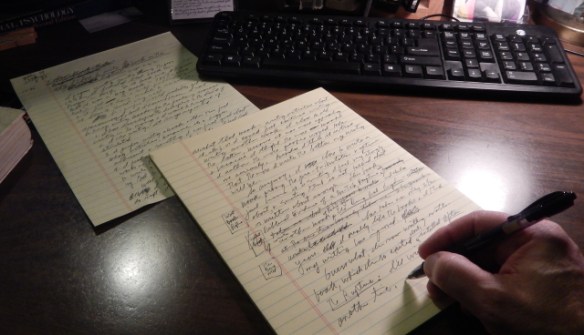
At my desk. I generally always write everything out long hand first.
My writing adventure began about 1992, while I was attending Majestic Oaks Community Church. At the beginning, I was immersing myself in many books on prayer for the purpose of prayer ministry for the church. And I was content to read just the books I had on my shelves which I had collected over the years. Later, when I was thinking about the possibility of writing a book on prayer and when I was trying to put an outline together, I found that I had to look elsewhere for more books. The place that I looked most was at the Bethel Seminary library. I wasn’t a student there, but when I told them that I needed books for a book I was writing, they agreed to get me a library card.
I remember so well when the idea came to me about writing a book. I had recently moved into a place as a renter, and I remember lazily laying on my bed day dreaming of future possibilities of a book. I admit that my first thought was that maybe I could actually make some money on a book. But then, I also thought of just using a book to bring a good teaching to people on prayer. I concluded that I could kill two birds with one stone. Why not. So, I committed it to prayer and immediately began forming an outline. From the start of my reading on prayer, I had the desire to look at prayer from every possible angle, and to read especially from all the prayer experts and great scholars. So, I continued to go with that idea in developing my outline.
First, I scanned through all the books I had and jotted down all the possible prayer topics I could write on. I came up with over 70 topics. Too many. Then I had a great idea. If I could put them all in alphabetical order, I could entitle the book, Prayer A to Z. That would give me only 26 topics, but I could always have more than one topic under the same letter. Eventually, I managed to get all my topics in alphabetical order and also narrow the count down to just over 50. Then I got another idea. If I could come up with exactly 52 topics (chapters), that would give me a great year-long study of prayer, studying one chapter a week. I settled on that idea. It was all set. Now, all I needed to do was put it together—write the book.
I have heard from more than one Christian publishing company that authors should never brag about how their book was designed by God. And I can see their point. But just between you and me, I definitely got the impression in seeing how my book came together so easily, that God had a part in it. Yes, I do feel that God wanted me to write the book and that He definitely helped me put it together.
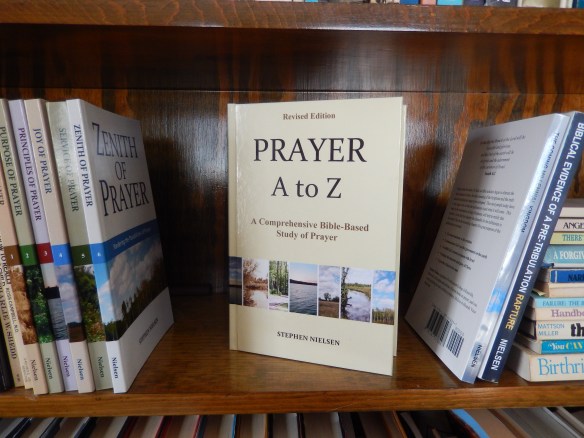
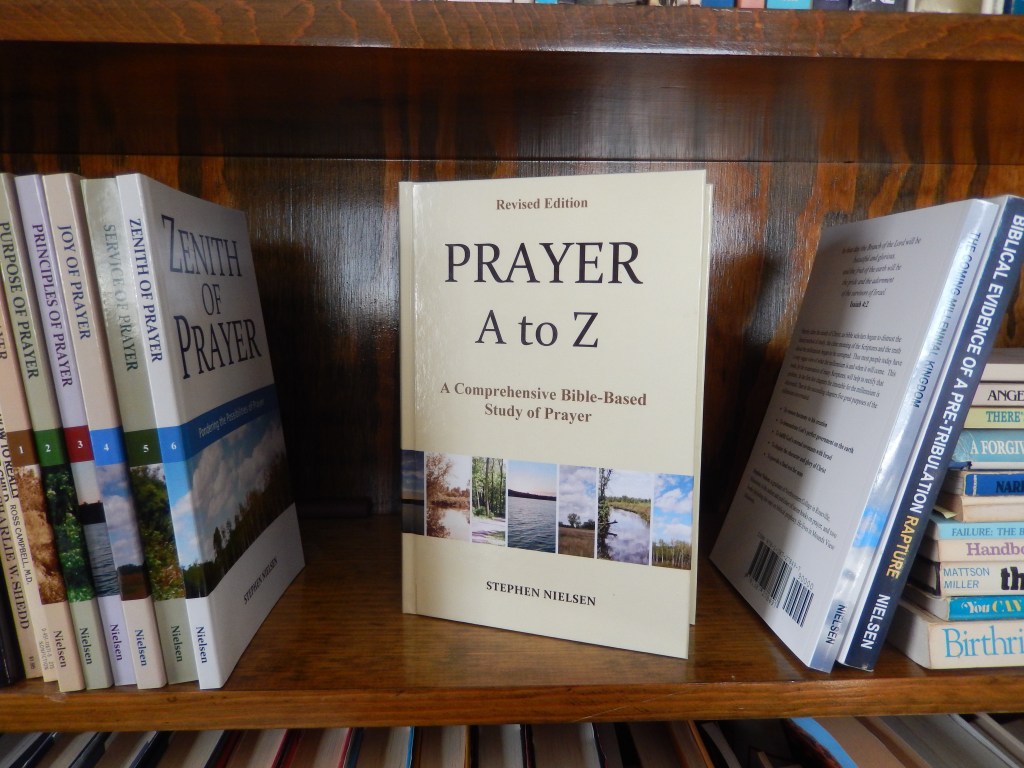
This is my first book, Prayer A to Z. It was published in 2013.




 Stephen Nielsen