It seems that the older I get the more my mind is on heaven. This is true especially if we have been diligent to walk in holiness. Then whenever you feel the pains of your old life you may be reminded that the new life is ahead.
But our assurance of heaven should not only be based on how we feel or on how we regard our holiness. We should base our assurance mainly on the promises of God. In 1 Peter 1:3-5 Peter speaks of our heavenly inheritance as a living hope.
Blessed be the God and Father of our Lord Jesus Christ, who according to His great mercy has caused us to be born again to a living hope through the resurrection of Jesus Christ from the dead, 4 to obtain an inheritance which is imperishable and undefiled and will not fade away, reserved in heaven for you, 5 who are protected by the power of God through faith for a salvation ready to be revealed in the last time.
If you have been born again into a new life, your inheritance is heaven. It is God’s promise to you.
So far, in previous posts, we have seen that we have the assurance of a heavenly inheritance; and we live now in the kingdom of God, which mysteriously is in us; Christ rules and reigns in our heart. And because we are born again spiritually we have a new life in Christ.
In 2 Corinthians 5:17 Paul writes, “Therefore if anyone is in Christ, he is a new creature; the old things passed away; behold, new things have come.”
I would like to take some time now to break this verse down. What does it mean that we as Christians are new creatures? I think it just means that we, being born again spiritually, are a new creation of God. Or we could say that we are regenerated—which means to give new life to. Here are a few verses that may shed some light on this.
In John 3:3 Jesus said to Nicodemus, “Truly, truly, I say to you, unless one is born again he cannot see the kingdom of God.” Yes, when we are born again it is only then that we can see and understand anything of God. By our new spiritual birth, we have a new understanding and a spiritual sight.
In Ephesians 2:1-5 Paul writes that we were dead to God in our sinful nature; we lived in sin. But God made us alive together with Christ. He gave us a new life.
In Titus 3:5 it says that we were saved by the washing of regeneration and renewing by the Holy Spirit. The Holy Spirit made us New creatures.
In 1 John 2:29 and 3:9 it tells us that all who practice righteousness are born of God; and all who practice sin are not born of God. Hence those who are born again and have a new regenerated life will love to do what is right; but those who do not have this new life in Christ are more prone to sin and follow their sinful nature.
The result of having this new self is that the old things of our past life are passed away—gone, and new thing have come. Now we still sin, but sin does not dominate or control us anymore. Our new nature is more dominate. We no longer live just for ourselves; we live for eternity and to please God. And we now have a spiritual mind—the mind of Christ. Let’s take some time now to list a few more things of our old life that are passed away.
Worldly values
Priorities that are worldly and selfish
Plans and ideas that are self-centered
Material thing that promote my popularity
And here are some things that have become new.
Values that are according to God’s word
Priorities that put God and others first
Belief that are in line with biblical truth
Plans and ideas that are according to what I think God would approve of
According to 2 Corinthians 5:18-20, I now have a new ministry of reconciliation and of proclaiming the gospel to others. I am now an ambassador for Christ.
Every believer when he is born again and is assured of an everlasting inheritance, is also miraculously, by the power of God, rescued from the domain of darkness and is transferred into the kingdom of God and of His Son. Paul in Colossians 1:13 writes, “For He rescued us from the domain of darkness, and transferred us to the kingdom of His beloved Son.”
This kingdom, though it is grand and glorious, is not visible; it is a spiritual kingdom and it is within us—within every believer (Lu. 17:21). Christ sits on His throne in our hearts, and He will lead us and instruct us in right living; but only if we allow Him to. Hence, all who are obedient sons of God are led by the Spirit of God (Rom. 8:14).
Now from time to time we will fall into sin; for we still have our sinful flesh. But we remain children of God who live in His kingdom, and because Christ has come into our heart and changed us—given us a new nature—we have His mind. Paul has written in 1 Corinthians 2:15-16,
But he who is spiritual appraises all things, yet he himself is appraised by no one. 16 For WHO HAS KNOWN THE MIND OF THE LORD, THAT HE WILL INSTRUCT HIM? But we have the mind of Christ.
And with our new mind and by the powerful strength of God in us and around us we are protected from the devil and all evil—but only if we use that protection. Paul, in Ephesians 6, speaks of this Christian protection as the armor of God. It is available to us if we put it on every day. It is the Christian’s daily and life-long attire.
One of the most powerful pieces of armor available to us is prayer. Paul writes that we are to “pray at all times in the Spirit” (Eph. 1:18). James also writes about prayer. He said, “If any of you lacks wisdom, let him ask of God, who gives to all generously and without reproach, and it will be given to him” (Ja. 1:5). But then he goes on to say that we must ask in faith without any doubting. And this is the key to living victoriously in the kingdom of God—having faith in God and in Christ without doubting. It is a life of trust in Him.
that for the Christian there are two avenues to heaven: one is through death and the other is through the Rapture. And since death is what we see now, we will start there.
Entrance into heaven through death. Some would say that when the body dies the soul goes into a time of sleep until Jesus comes. They call if “soul sleep.” But that is a false teaching. In 2 Corinthians 5:8 Paul tells us that to be absent from the body is to be present with the Lord. In death the body dies but the soul lives on in heaven with the Lord.
But what happens to the soul at death? Is there any need for a change to the soul? To make it pure and holy? Yes. Since the soul is the entire nature of man and is his entire personality, the soul as well as the body is sinful. When we are saved, salvation comes to our soul (Ja. 1:21), but even after our conversion, the soul is affected by sin the same as our body is. Hence, the soul of the righteous, entering heaven needs a full cleansing. According to the Westminster Confession of Faith,
The bodies of men after death return to dust, and see corruption; but their souls, (which neither die nor sleep,) having an immortal substance, immediately return to God who gave them. The souls of the righteous, being then made perfect in holiness, are received into the highest heavens, where they behold the face of God in light and glory, waiting for the full redemption of their bodies.”2
Now, there is also the question of the intermediate state, or the intermediate heaven.
The intermediate heaven.This state is the state of the soul without the body, from the time between the death of the body to the point at which the body is raised and transformed at the Rapture. There is much false teaching on this subject, such as soul sleep—as previously mentioned. And there is also the Catholic doctrine of purgatory: that after death the soul goes to a place to be purged from sins by much pain and suffering, so to be purified for heaven. But this is such a slam to God, teaching that the sufferings of Christ were not sufficient to atone for our sins, that we must add our own sufferings to His. Really, we can add nothing!
However, aside from false teaching, there are some things that we can consider a bit regarding the intermediate state. I say “a bit” because Scripture in not clear on the subject; and it gives us no definite teaching. Nonetheless, here are two passages we could examine for maybe a small bit of truth.
Luke 9:30-31. Here is the Mount of transfiguration, where while Jesus was praying (with Peter, James and John present), His face was changed and His clothing became white and gleaming. And then suddenly, Moses and Elijah appeared and they were talking to Jesus about His departure (His death). Now we know that both of these men died a long time before this; but here they stand in some kind of a glorified body. I would say that this is definitely an example of the intermediate state of heaven.
Here is what we may observe from this passage regarding what the intermediate state is.
It is having some kind of a glorified body.
It is being able to speak in a normal language. They did not use any kind of heavenly language.
It is having friendly communication with Jesus. They were talking with Jesus as a close friend; they were discussing His departure. This suggests that we may have regular communion with Jesus and will be discussing whatever is on our heart.
Revelation 6:9-11.Here is a passage revealed to us as the Lamb (Christ) broke the fifth seal during the Tribulation. It opens up to us the conversation of certain people who were martyrs for their faith. In verse ten we have a portion of that conversation—a prayer to God. They cried out to Him with a loud voice, “How long, O Lord, holy and true will You refrain from judging and avenging our blood on those who dwell on the earth?”
And then in verse eleven is the response by God. “There was given to each of them white robes and they were told that they should rest for a little while longer…”
Here is what we may observe from this passage regarding what the intermediate state is.
There will be prayer in the intermediate state. These martyred souls were waiting on God to avenge their blood and were crying out in prayer to Him. We may also conclude that there will be a sense of anticipation for God to make all things right.
They will know what is happening on earth. These martyrs seem to know what is happening on earth—that God was refraining from judging (v. 10). It may be this way for all who die before the Rapture.
They will have bodies that are able to wear clothing. They were given white robes.
They are holy and pure—cleansed from all sin. The white robes are symbolic of purity; Jesus will give them these garment to remind them of their holiness and of His shed blood for them.
We will be at rest in the Lord. They were told to rest for a while longer. This state of rest is confirmed to us in Revelation 14:13 of what this intermediate state basically is—that we will rest from our labors; the labor of keeping the commandments of God and having faith in Jesus. So, here in this state we will have glorified souls perfected in God, and we will no longer have a need to persevere in the faith. We will be at rest in the Lord and waiting for our new glorified body.
Entrance into heaven through the Rapture. When God sees that the time is right for the dead to be raised, and for their souls to be united with new bodies, and for the living to be rescued from what is to come on this earth, then He will…
descend from heaven with a shout, with the voice of the archangel and with the trumpet of God, and the dead in Christ will rise first. 17 Then we who are alive and remain will be caught up together with them in the clouds to meet the Lord in the air, and so we shall always be with the Lord (1 Thess. 4:16-17).
This passage (above) pretty much lays it out, but let me summarize it in chronological order.
1. All believers from all ages of history who have died, they will be raised up and their decayed bodies will be transformed into imperishable, new bodies (1Cor. 15:53-54).
2. And the souls of those resurrected dead will merge with their new transformed bodies, so they will at last be souls with new bodies. Hence, this will be the end of their intermediate state (as previously discussed).
3. Then those who are alive will be changed (transformed) very quickly— “in the twinkling of an eye” (1 Cor. 15:52). And they will be caught up (snatched up) together with those previously dead.
4. And then we will all meet the Lord in the air; and we will from then on, and always, be with the Lord in heaven.
2 John MacArthur, The Glory of Heaven (Wheaton, Illinois: Crossway Books, 1996), p. 71.
The first and most basic thing to nail down in order to prepare ourselves for heaven is to know how and to be assured that we will get there. If we know all about heaven—if we have studied the subject thoroughly from the Scriptures—and we fail to be assured of our entrance, then all our effort in study will be in vain. But the good news is, we can know for sure that we are going to heaven; the bible tells us how we can get there.
We Enter Heaven By Faith And The Gospel
I would like to start this section from Revelation 21:3-4, because it gives us a clear picture of what heaven will be like. Then we will travel backwards in time to the cross and show what Jesus did for us on the cross to accomplish heaven. So, in Revelation 21:3 and 4, John wrote,
And I heard a loud voice from the throne, saying, “Behold, the tabernacle of God is among men, and He will dwell among them,and they shall be His people, and God Himself will be among them, 4 and He will wipe away every tear from their eyes; and there will no longer be any death; there will no longer be any mourning, or crying, or pain; the first things have passed away.”
So, here we see the presence of God in heaven and what He will do for us. He will wipe away every tear from our eyes. And He will abolish death. And He will eliminate any mourning, or crying, or pain.
And He does that for us based on His own suffering and death on the cross. He suffered and died for our sins. Let’s look at Isaiah 53:3-6.
He was despised and forsaken of men,
A man of sorrows and acquainted with grief;
And like one from whom men hide their face
He was despised, and we did not esteem Him.
4 Surely our griefs He Himself bore,
And our sorrows He carried;
Yet we ourselves esteemed Him stricken,
Smitten of God, and afflicted.
5 But He was pierced through for our transgressions,
He was crushed for our iniquities;
The chastening for our well-being fell upon Him,
And by His scourging we are healed.
6 All of us like sheep have gone astray,
Each of us has turned to his own way;
But the Lord has caused the iniquity of us all
To fall on Him.
From this passage, we could say that Jesus was a “substitute recipient of God’s wrath on sinners.”1 And by His scourging we are healed. Everything, every blessing we see in Revelation 21:4 will come to us as our healing of sin that He worked out for us. Our having no pain, no mourning, and no crying is our healing from His cross. It is our new body which He has made for us through the cross.
Yet we must receive it by faith. We must acknowledge what He did for us on the cross. Then we must respond to it; first, seeing our sin and separation from God (Rom. 3:23; 6:23); then to see that we need His remedy for our sin—that if we believe in Him (Jn. 6:40) and ask Him, He will forgive us our sins and cleanse us of sin (1 Jn. 1:7), making us His children (Jn. 1:12). And if anyone chooses to believe in Him, He gives us a new heart and a new life. His old life is passed away and a new life is come (2 Cor. 5:17).
Now let us return to Revelation 21, and we will start reading from verse six to verse seven.
Then He said to me, “It is done. I am the Alpha and the Omega, the beginning and the end. I will give to the one who thirsts from the spring of the water of life without cost. 7 “He who overcomes will inherit these things, and I will be his God and he will be My son.
From these verses we find two key words: “thirst” and “overcomes.” Jesus says to us, first of all, that He will give the water of life to the one who thirsts. Jesus here is bringing us back to the time when He provided for us a living example on this very subject from John 4:7-14. In this story He said to a Samaritan woman who had come to a well to draw water, “Everyone who drinks from this water [from this well] will thirst again; but whoever drinks of the water that I will give him shall never thirst; but the water that I will give him will become in him a well of water springing up to eternal life.”
So here in Revelation 21:6, Jesus is saying to those in heaven, if you thirst, that is, if you desire anything from Me, I will give you living water—water of life from Me—without cost. That is our heavenly blessing.
Then in verse seven, Jesus gives us the condition for this heavenly blessing. We must be overcomers. And John clearly tells us in 1 John 5:4 what this means. He writes, “For whatever is born of God overcomes the world.” Hence, we who are Christians are overcomers, and so we will inherit the blessings of heaven. We will drink from the water of life freely whenever we thirst.
1 John MacArthur, The MacArthur Study Bible (Thomas Nelson, 2006), John MacArthur’s notes of Isaiah 53:5.
In this article we will look at Revelation 21:1-7, verse by verse.
Verse 1. After John got a good view of the great white throne judgment, God flashed this scene before his eyes. He saw a new heaven and a new earth. It appeared very different than the old ones. And one reason is because there appeared to be no seas. And what that means I’m not exactly sure, but we will discuss a few different views in chapter eight.
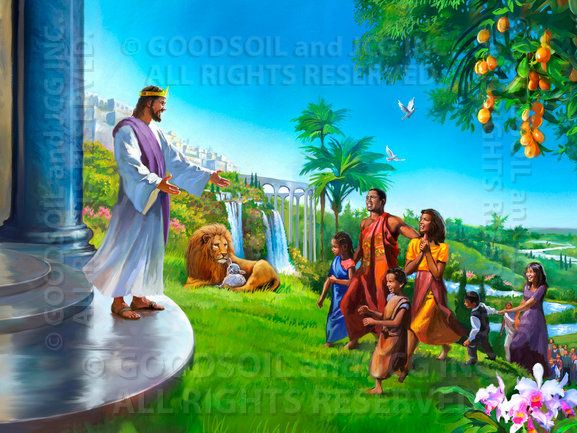
Verse 2. Next, after being in awe of the new heaven and earth, John was dazzled by a very large bright cube-shaped city descending from the heavens. This, John commented, was “as a bride adorned for her husband.” These words tell us that it is the place where the saints (the church as well as the Old Testament and Tribulation believers) have been taken to live with the Father and the Son (Jn. 14:2-4).
Verse 3. Then John heard a loud voice from the throne of God saying, “The tabernacle of God is among men” (all believers)—meaning that God now lives together with His believers. I am not sure whether this is referring to the holy city, or to all of heaven. The new Jerusalem will be the capitol city of heaven and where God’s throne is; but certainly, all of heaven and earth will be God’s abode and His presence will be everywhere.
Verse 4. This verse describes the new changes that God will bring to all believers. (1) He will wipe away every tear from their eyes; (2) there will no longer be death—for you remember (in 1 Cor. 15:26) that death was abolished; and (3) there will no longer be mourning, crying, or pain; these things have passed away.
Verse 5. And then He who sits on the throne said, “Behold, I am making all things new.” And then He said, “Write this down, for these words are trustworthy and true” (NIV). So, God wanted to make a firm point to John, and to make sure to record it—that He was making all things new, that the heavens and the earth, and the people and all things were new and different. It is nothing like the old. No sin, no tears, no death, no pain and no curse. Everything is and will continue to be very good and new.
Verse 6. Then God said to John, “It is done.” He was saying that His work of making all things new was completed. Then Jesus said, “I am the Alpha and the Omega, the beginning and the end. I will give to the one who thirsts from the spring of the water of life without cost.” So, He was saying here clearly that He is supreme overall and if anyone has any needs He will supply that need.
Verse 7. Here Jesus puts a condition on those who receive His blessing freely. It is for only those who are overcomers of sin according to their faith, which makers them sons of God. For all others, their part will be in the lake of fire (v. 8).
This great and important event takes place immediately after the destruction of heaven and earth. We will comment on it verse by verse from Revelation 20:11 to 20:15.
Verse 11. After John saw (in his vision) the devil being thrown into the lake of fire, he then immediately saw the vision of a great white throne and Him (God) sitting upon it. And the Scripture text here is written as if this throne with God upon it was all there was. That is, the earth and heaven had fled away, or we could say that it disappeared or gone into non-existence. It seems here as if John missed the great explosion of heaven and earth. His eyes saw the great white throne, and then he realized that heaven and earth were gone.
Verse 12. Then next John saw the dead (those who had died) standing (now alive) before the throne. And John here is careful to make clear that all the dead are here: great and small, which means the young and old; the rich and the poor; the big ones and the short ones, etc. And the books were opened; and another book was opened, which is the book of life. And the dead were judged according to what was written about them in the books—all their deeds (everything they ever did, good or bad, was recorded in these books).
Verse 13. God here seems to circle back to make certain that no dead is left out, even those who died at sea, or that were thrown into the sea; these were included in the number of dead. And all the places of death and hell turned in or released their dead ones to go and sand before the throne of God. Apparently, these dead beings are given new bodies suited for hell.
Verse 14. At first glance this verse was difficult to me. But when I looked back at 1 Corinthians 15:26 the meaning was made clear. At this point, that is, at the great white throne, death and hell will be abolished forever—cast into the lake of fire. And this is the second death. The first death was only physical death, but this second death is spiritual and eternal.
Take note also that this second death is only for unbelievers. It will have no power over believers. They will reign with Christ for a thousand years and then on into eternity (Rev. 20:6; 22:5).
Verse 15. Here it is made clear who will be judged. It is all those whose names are not written in the book of life.
After the devil is cast into the lake of fire (v. 10), John the apostle saw (in his vision) “a great white throne and Him who sat upon it, from whose presence earth and heaven fled away, and no place was found for them” (v. 11). Regarding this last phrase, John Macarthur commented, “John saw the contaminated universe go out of existence…The universe is ‘uncreated’ going into non-existence.”8
This destruction of the universe is also mentioned in 2 Peter 3:10, 12 as the “day of the Lord.”
But the day of the Lord will come like a thief, in which the heavens will pass away with a roar and the elements will be destroyed with intense heat, and the earth and its works will be burned up.
12 looking for and hastening the coming of the day of God, because of which the heavens will be destroyed by burning, and the elements will melt with intense heat!
Then also we will look at Matthew 24:35: “Heaven and earth will pass away, but My words will not pass away.”
There is much we could say from these verses to back up the claim that heaven and earth will indeed be destroyed, or go out of existence. Let’s examine these terms.
“Earth and heaven fled away” (Rev. 20:11). This seems to indicate that they do go out of existence.
“Heaven and earth will pass away” (Matt. 24:35). It seems that “pass away’ and “fled away” is the same thing.
“The heavens will pass away with a roar…” (2 Pt. 3:10). This sounds much like an atomic reaction.
“And the elements will be destroyed with intense heat, and the earth and its works will be burned up” (2 Pt. 3:10, 12). The elements could be atomic components from which matter is composed and held together.
Total destruction of the universe seems to be the meaning of these verses; however, many scholars look at it differently. They see just the surface of the earth being renewed by fire, or made new by fire. We will discuss both interpretations later.
8 John MacArthur, The MacArthur Study Bible (Thomas Nelson, 2006), John MacArthur’s notes of Revelation 20:11.









 Stephen Nielsen