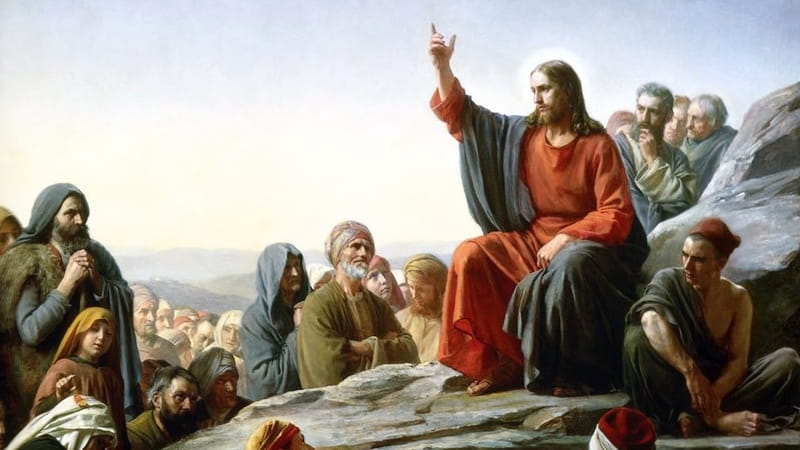
The Gospel According To Jesus

The following is a very short summary, and my comments, of the book The Gospel According to Jesus, by John MacArthur, written in 1988.

I remember that the book made quite a stir. But MacArthur was absolutely correct in what he said. And it got a lot of people thinking—about how the gospel should be presented and about salvation.

For a long time, preachers and evangelists have had a wrong view of the gospel and how to present it. Some very well-known theologians (like Lewis Sperry Chafer and Charles C. Ryrie) were saying that we should not expect new converts to begin a life of obedience to Christ right away; that they at first should receive Him as Savior and then later, when they are more mature, receive Him as Lord. They were saying that to expect converts to be disciples of Christ right away was asking too much.

And there was also a theology (according to 1 Cor. 2:15-3:3, by Chafer) that there is two classes of Christians: carnal and Spiritual. But MacArthur strongly disagrees with that. He says that carnal always refers to a non-believer. I believe this is right (but I didn’t always believe this). I know that there are levels of maturity for a believer, but he can never be carnal—living in sin; that is what carnal means. A Christian is to be Spirit-filled and be obedient to Christ; and when he is not he can and will eventually (with the help of the Holy Spirit) repent and start over.

Now let me get right to it. When a person comes to Christ a miracle takes place. He is born again. He becomes a new person. At the moment of conversion, he receives Christ for all that He is: God, Sovereign, Savior, and Lord.  

Let me back up. At first, when a person is saved he sees that he is a sinner; and so, he comes under conviction of sin; and then he repents of that sin. And then at the same time He experiences Christ calling him to a life of faith and obedience. So, he receives Christ as his Savior from sin and as his Lord (because He is Lord). Hence, when someone is saved, he is giving up his old life of sin and is born again into a new life of obedience to Christ. This is the gospel according to Jesus.

Pondering Heaven: Dreams Fulfilled

After seeing the movie Field of Dreams last night (for the one-hundredth time), I gave great thought to the question that was asked by Shoeless Joe Jackson and by Costner’s father, “Is this heaven?” Then I also watched the short slip at the end, the making of the movie, and I was surprised to hear the producer say that the lines regarding heaven could really be the theme of the movie—that the ball players who had gotten kicked out of baseball were given a second chance to come back to earth and play baseball—and that was their heaven.

I immediately pulled from my book shelf the book Heaven, by Randy Alcorn, to ponder the subject. I found that one of his chapters was entitled, “Will Our Dreams Be Fulfilled and Missed Opportunities Regained?” It seems that Alcorn thinks that heaven will be a chance for every Christian to extend or perfect what we do now; that in the New Earth we will have the chance to finish what we started now and to perfect—and even sort of grow in it. That thought excites me. Everything I always wanted to do but didn’t get a chance to do, I will get a chance to do in heaven, or on the New Earth. For instance, I think I am gifted as a teach, but haven’t had a chance to do it. In heaven I will have that chance. And I will be good at it. And the books I have written (not very well), in the New Earth those books will be wonderfully revised and many people will read them. And I will teach from those books.

Now I’m motivated to study this subject of heaven—to keep those kinds of books on my reading list, and to study it in the Bible.

What’s on my Mind? Biden, Jim Jordan, Faith …

First and foremost, on my mind is suspicion of Biden. I don’t trust him. He seems to be playing both sides. He says he is for Israel, but at the same time he is aiding Hamas and delaying Israel’s war effort. I think he is just trying to get votes from both sides. It is all political.

Second on my mind is why Jim Jordan is being stopped from being Speaker. I think he would make a very good speaker—but liberals won’t allow it. Do they know what they are doing?

Thirdly, and more personal, is my thoughts on the subject of obedience and faith. I give the credit to John MacArthur in his book, The Gospel According to Jesus. He points out that some say that obedience and faith should be regarded as separate, that obedience is works and should come after faith—something like that. But MacArthur makes the point that the two should always be together—as James points out, faith without works is dead.

And what is really coming to light for me now is that when we are disobedient to God, we are in sin; and so, this tells us that when we sin we are lacking in faith—or we are not trusting God. I know that we—even good Christians—will never be perfect in obedience and faith; but this is something we have to be constantly working on. I mean, we cannot let up in our effort to be holy and godly. And on the brighter side, when we are more obedient, God makes us happy (or joyful). And when we are obedient we have more hope and steadfastness and resilience in evil times. In short, obedience to God is the key to the victorious Christian life—because in our obedience we are trusting in Him.

Fourthly, as I trust and obey Him, I plod along with everything else. I have two books that I am editing. I am nursing a thing in my mouth called lichen planus (sort of a disease which apparently has no cure; but I am using mouth washes, aloe Vera gel and clove to try to get rid of it, or at least sooth it).

I am also reading two books; the one I mentioned by MacArthur, and a book by Bill O’Reilly, Killing the Witches. This book falls in line with the one I just read, Mayflower. The Mayflower arrived in 1620 and the witches tragedy occurred later at about 1680. I say tragedy because they were killing girls that weren’t witches at all. They were just suspected of being witches. It was much like the Catholic inquisition—burning Christians alive. Terrible!

My blogging has slowed down, but now that I am not working much, I will try to pick it up again.

The Unresponsive Heart – Matthew 13:4, 19

I sometimes wonder how some people can be so insensitive to sin, without a bit of guilt or remorse. I’m thinking about those who do sin for a living and think nothing of it. They seem to thrive in it, and the gospel has no effect on them.

I’ve been reading The Gospel According to Jesus, by John MacArthur. He has some very good incites on the parable of the soils from Matthew 13:3-9.

And He spoke many things to them in parables, saying, “Behold, the sower went out to sow; 4 and as he sowed, some seeds fell beside the road, and the birds came and ate them up. 5 “And others fell upon the rocky places, where they did not have much soil; and immediately they sprang up, because they had no depth of soil. 6 “But when the sun had risen, they were scorched; and because they had no root, they withered away. 7 “And others fell among the thorns, and the thorns came up and choked them out. 8 “And others fell on the good soil, and yielded a crop, some a hundredfold, some sixty, and some thirty. 9 “He who has ears, let him hear.”

First we need to explain that the seed represents the Word of God and the gospel; the sower is one who presents the gospel to the unbeliever; the soil is the human heart—or the people; and the birds that ate the seed is Satan.

The purpose of sowing the seed is to build the kingdom of God—to save souls for His kingdom. In the parable, Jesus describes four kinds of soils (or four kinds of people) that the seed falls on. The first three described (vs. 4-7) is soil that is not prepared correctly for the seed of the gospel to germinate. These people will not be saved. Only the fourth kind of soil—good, fertile soil—will respond to the gospel and be saved.   

In this blog we will focus on the first soil mentioned (v. 4). The sower went out to sow; and as he sowed, some of the seeds fell beside the road, and the birds came and ate them up.

This first soil is soil that is hard-packed. It is soil that is on a path that has been packed down by people constantly walking on it. The seed that lands on this path, as you can imagine, has no chance of taking root. The hard-packed soil represents people with a hard heart. Like the hard-packed soil, their heart is hard. It has been hardened by repeated sin and abuse. The Old Testament called these people “stiff-necked.” Their repeated sins and rebellion against God has made them what they are: unresponsive to the gospel (and the Word of God), unconcerned, indifferent, even hostile to the gospel. These are definitely unsaved people; because a believer will commit sins and even be rebellious, but he will not stay that way. The Holy Spirit will cause him to repent and he will be delivered.

Hence, this parable is directed to unsaved people. They need a heart change. The soil of their heart needs conditioning. The hard-hearted person has no chance of being saved unless his heart is softened. How?

By prayer and by the Word of God and by love from a kind friend.

It is a sad thing to see this person; they have no understanding of the gospel and no sorrow over their sin, because the devil has plucked all the seeds of the gospel away. They seem to be so oblivious to sin, to living a sinful life. These are the ones who march for Pride month; these are the ones who fight for abortion rights; these are the ones who sell themselves to pornography and also the ones who love viewing it; these are the ones who have no understanding of the truth and the Word of God and will call Christians and conservatives extremists. They fight for global government and for the climate change movement. Most of them will not repent and be saved. Much prayer is needed for the few who will be saved.

Jesus Is Both Savior and Lord

In the last one-hundred years there has been an effort to divide Christians into two groups: carnal and spiritual (Read 1 Cor. 2:14-3:3). And they have likewise said that many have received Christ as Savior, but not as Lord. They would be the carnal ones. They would be saved but not really committed to Christ.

And surprisingly, some have been okay with this, because they say that if they accept Him as Lord they would be guilty of human works.

But this is crazy, because that would be dividing Christ. For He is both Savior and Lord. And so, when we seek to be saved we must accept all of Him, in all that He is—Savior and Lord. He must be our Savior and our Lord. If He is not, we really haven’t accepted Him (the real Him) at all.

And, as far as being guilty of “human works,” Jesus tells us that true faith requires works (James 2:14-26); that without works faith is dead. And works is not something we do without His help. He is the worker in us. When we are saved He gives us a new life, a life that naturally does the work of God.

And by the way, if you are called a carnal Christian, you may not be a Christian at all. Because carnality is not of God. A carnal person is a person void of spirituality, or void of the Holy Spirit. So here it is: a carnal person is a pagan, not a Christian; and a Spiritual person is a Christian, because he walks by the Spirit and he does the works of God (Romans 8:9-11).

However, there will be periods in the Christian’s life when he takes the wrong road or gets off track. But that will be only temporary. God provides for him a way to get back on track—he will just need to repent of his sins and start again. And this will happen many times because we are still in our fleshly body. And God understands this—and so should we. But we endeavor to abide with Him from day to day failing along the way, but getting back up again and again. And thank God that He has provided for us constant forgiveness and cleansing (1 Jn 1:9).

We depend on His constant forgiveness and cleansing; yet we strive to abide with Him and trust Him more.

The Gospel According To Jesus

This gospel demands our commitment, our obedience, our Lordship, and our turning from sin.

The title of this blog is the title of a book written by John MacArthur, Jr. in 1988. This book, I remember created quite a stir, and it is still having an impact. I have had it on my book shelf for a while and just now decided to read it again more seriously. This time I intend to blog through it.

The theme of the book is getting the true gospel clear—from Jesus’ teaching. It is also to refute the wrong, misguided way of salvation. MacArthur strongly refutes all those who bring “another gospel,” those who “distort the gospel of Christ” (Gal. 1:6-8).

In the first chapter MacArthur confronts all evangelists who have used gospel presentations such as …

  • “Accept Jesus as personal Savior”
  • “Ask Jesus into your heart”
  • “Invite Christ into your life”
  • “Make a decision for Christ”

MacArthur says that none of this terminology is biblical. And I have to admit that I have used all of it myself! It was how I was taught, how I heard it growing up in the 60’s and 70’s.

MacArthur rightly points out that “the gospel Jesus proclaimed was a call to discipleship, a call to follow Him in submissive obedience, not just a plea to make a decision or pray a prayer.” (p. 21)

Looking back at my own point of salvation, I am thankful that my counselor did it right. He pointed me to the Scriptures and also gave me the idea that conversion was the point where I was deciding to follow Jesus and to allow Him to be in the drivers’ seat.” That I was giving Him control of my life, that I was being submissive to Him, that I was beginning a new life of submission to His will.

But MacArthur points out that many evangelists of today, when they present the gospel, give no invitation to making spiritual commitments whatsoever, or to turn from sin. They insist that this would amount to human works and have nothing to do with faith (p. 22).

So apparently, some say that conversion is just a prayer said, just making a decision for Christ, and then letting Jesus bring that Lordship issue along later. Yes, I remember this being said. But it is wrong. Jesus demands Lordship and commitment from the start. He demands a life of obedience from the start. He says, follow Me!

We must believe that genuine assurance of salvation will come from seeing the Holy Spirit’s transforming work in the life—seeing the fruit. Hence, real salvation cannot be isolated from His work in us. There must be not only justification, but also regeneration and sanctification. Yes, there must be evidence of a holy life.

Hence, we must not dismiss holiness in the life. And we should not only point to a person’s salvation experience. We should not encourage a person to base his salvation assurance on the memory of a prayer, or walking an aisle, or speaking in tongues, or some other experience.

Faith that does not result in a righteous life is dead faith. A real and growing faith must have fruit—the fruit of righteousness, the fruit of the Holy Spirit. A true Christian must be able to look back and see that he has put aside his old life and is growing to be more like Christ, that he is growing to hate the world and to love God and His word. A true Christian loves to go to church and hear the word of God preached, and to sing songs of praise to God with others. A true Christian longs for heaven and to see Jesus; and he hates sin, sin in the world and sin in himself.

More on Lewis and Clark

What an incredible journey they had! I will continue on from the last blog I wrote on this

So many times they nearly lost their lives—by Indians, grizzly bears, falling off cliffs (this happened to Lewis twice), illness, etc.

Most of the time they had plenty to eat, because of the expert hunters they had with them, who shot deer and buffalo. But some of the time, when they were in the mountains, they had little. They ate dogs and their horses. Lewis got to like dog meat, but Clark did not. They also, being always on the river, caught fish.

Both Lewis and Clark were good at healing people with natural means. When the squaw Sacagawea was sick, Lewis used barks, laudanum and sulfur water from a spring, and within a day her fever vanished. Other times they used choke cherry juice to heal. When they were among the Nez Perce and Shoshone Indians, they became so popular—many sick Indians lined up to be treated. The explorers didn’t really think too much of their power, but later when so many Indians praised them they knew they were doing some good. But truthfully, I think it was more of a mental thing—the Indians believed they had healing power, so their belief is what made the difference.  Clark loved to do tricks for the Indians (with gun powder). I think he loved the praise. Many of the Indians called him “Red Head Chief” because he had red hair and they looked up to him.

It is so sad that 80 years later American troops were given the orders to wipe out these same Indians to make room for western white settlers. Yes, the Nez Perce Indians disappeared off the face of the earth.

When Lewis and Clark and their group arrived at the Pacific they built five small log cabins to live in and store their supplies. It only took them a couple of months to do it! They stayed there on the west coast during the winter and then left to return home in the spring. The return trip was easier because they had mapped it out. But for a good bit of the journey they split up so they could explore new ground. Oh, they were adventurous!

When they got back, everyone was amazed to see them. They had given them up for dead. But all were safe except one who had died early in the journey from sickness. Well, they piled gifts of land and money on Lewis and Clark and all the explorers. And they made Lewis the governor of Louisiana. But he hated the job—and wasn’t much good at it. He wished he was back exploring more land. It wasn’t long before Lewis died. Some thought it was suicide, but many thought he was murdered. So tragic.

Clark also became a governor, and he was a good one. He lived a long and prosperous life, having married twice and had seven children. Clark ended up freeing his slave York (who went with him on the journey). But York didn’t like his freedom and wished he was back with Clark. Sad that that was how it was with many freed slaves who were born into slavery. They just didn’t know how to adjust to it.

Sacajawea, unlike other stories that she died along the expedition, this book tells us that she lived longer than anyone else. She had a baby named “Pomp” and she gave him to Clark to be educated. That baby in fact became educated at a good school. His real name was Jean Baptiste Charbonneau. His father, Toussaint Charbonneau, was a French-Canadian fur trapper who joined the Lewis and Clark Expedition as an interpreter with Sacagawea his squaw wife. Well, Pompy was educated at St. Louis Academy, then went to Europe and learned German, Spanish and French, then he became a trapper like his father. It has been written that he grew into a rugged, adventurous man, leaving his mark in the taming of the west.

My Update — Three Things

I’ll start with a few complaints. Aside from an aggravating health situation, the weather here in Minnesota is most unpleasant. It’s dark, cloudy, humid, cold, and dreary. I don’t mind it being cold, but I like a sunny day. God, please give me a sunny day!

Respect for Marriage Act

Is that an oxymoron? If I didn’t know what it was I would praise it. Marriage is a beautiful thing. And though I am divorced, I still believe it is good—as is all of God’s creation. But this Respect for Marriage Act is a farce. It is telling us that we have to respect the so-called marriage between people of the same gender. Well, I don’t! True marriage is only between a man and a woman. Anything else is a perversion and is dishonoring of their bodies; they are changing the truth into a lie, and are changing what is natural into that which is against nature. Consequently, they do not like to retain God in their thoughts and they have given themselves over to a reprobate mind (from Romans 1:24-28). But marriage between a man and a woman is good and honoring to God. It is what God designed from the beginning—the two shall be one flesh.

My Reading

For some reason I have gotten into reading about African American history, and recently about Booker T. Washington. Wow! He was such a great man. He has done so much for his race and also for the poor whites and all people in the south after the civil war. He was a great educator. His emphasis in his college was to get his students working in a trade as well as into books. And so many from his college became great leaders and moral people, as they were trained also biblically and morally. And it was a hard task, because blacks coming out of slavery then were kept from any kind of education. Most did not know how to read or write or how to keep themselves clean or in good health. Hence when they came to school, Booker T. trained them in the art of bathing and brushing their teeth, etc., as well as how to read and write. And they were also expected to learn farming and building. All of their school buildings were built by the students. And they even made their own bricks!

Retirement

Retirement is a big change for me. Sometimes I feel that I am getting lazy. I think I need to force myself to walk more and work more—even though I am retired. I do like to keep up with my customers and paint for them when they ask me for work. Lately, I have been asking myself, what is retirement? What should I be doing? How should I be winding down? I don’t want to be like some who spend all of their time in front of a TV.

The Glorious Evidence of Freedom

I have just read The Narrative of The Life of Frederick Douglass. It is the story of his slavery–from his young years to the time he escaped to freedom (I think he was about 19 or twenty). He went through the usual treatment, being whipped often and regarded as an animal and as the property of the slaveholder-the master. But at the same time he secretly educated himself–leaned to read and write. I have not read any more of his life than this narrative, but I have read that he came to be a very great leader and brilliant. In fact I read that Lincoln sought his advice on a few matters.

Anyway, I was so struck with what happened shortly after he escaped to freedom in the north, in New Bedford. What he experienced was not what he expected. He all along thought that free states would be full of poor people and without comforts and wealth. I will quotes some of the lines in his book.

I had very strangely supposed, while in slavery, that few of the comforts, and scarcely any of the luxuries of life were enjoyed at the north, compared with what were enjoyed by the slaveholders of the south. I probably came to this conclusion from the fact that northern people owned no slaves… I had somehow imbibed the opinion that, in the absence of slaves, there could be no wealth, and very little refinement.

Anyway, Douglass went on and on describing his surprise at what he saw. He wrote,

I found myself surrounded with the strongest proofs of wealth.

When he visited the warehouses and places of work, he wrote,

I heard no deep oaths of horrid curses on the laborer. I saw no whipping of men; but all seemed to go smoothly on. Every man went at his work with a sense of his own dignity as a man.

Then when he strolled around the town he wrote,

[He] gazing with wonder and admiration at the splendid churches, beautiful dwellings, and finely cultivated gardens; evincing an amount of wealth, comfort, taste, and refinement, such as I had never seen in any part of slaveholding Maryland.

He went on to say,

Everything looked clean, new, and beautiful. I saw few or no dilatated houses, with poverty-stricken inmates; no half-naked children and barefooted women…the people looked more able, stronger, healthier, and happier…

Well, I can’t help but think of what slavery does to people. And Fredrick was deceived in thinking that the slaveholders were not also slaves–to to their evil wretchedness, how they continually whipped the salves every day without thinking anything of it, and how many of them cursed at the slaves and at the same time thought themselves to be good Christians. The slaveholders I think were in the worst bondage, the worst slavery–the slavery of their sins of prejudice.

As Fredrick Douglass saw, where he came to in New Bedford, that town of freedom without slavery was glorious, and wealthy. The freedom we have in Christ is the most free, the most glorious. As I read how Fredrick described the surroundings as clean, new and beautiful, so I also recall how things looked directly after I prayed to receive Christ. All things looked brighter and new and so wonderful. Even the air was fresher. I invite you to always be vigilant to confess your sins every day. Don’t let sin take a hold of you. The devil and sin is out to make you their slave–to put you in deep bondage. There is no freedom or comfort in sin. Be free of sin and you will be free indeed.

Rooting for the Underdog

Booker T. Washington

I previously wrote an article on African American slavery, and some of the topics I am planning to blog on. This is a topic that I have been quite interested in lately—I’m not sure why. But I feel that God is calling me into it. The more I read and think about it, the more I feel called. I guess I just like to root for the underdog. And the African American, esp. those who came out of slavery were that. Lately, in my reading, I have seen how they have made great advances as they came out of slavery, even though treated very badly: with lynching, segregation (in the Jim Crow era), being treated so badly by whites, poor working conditions; etc.

And there were a few that were heroes like Ida B. Wells, who dedicated herself to an anti-lynching crusade and made a big difference. I am especially intrigued by Booker T. Washington; a great leader of his time. He rose up out of slavery and became a great educator and encouraged all struggling-colored people to get educated and learn a craft. Many African Americans own their lives to him. Some African Americans have great success stories: how they worked their way to the top, started a business and became rich. It’s so inspiring to read about it. I can’t help but to root for anyone who overcomes such great odds. Recently I found two books by two great African Americans who were slaves but became great leaders: Frederick Douglass and Booker T. Washington. The fact that I found those books so effortlessly is evidence to me that God has given me an open door to continue my study on this subject.