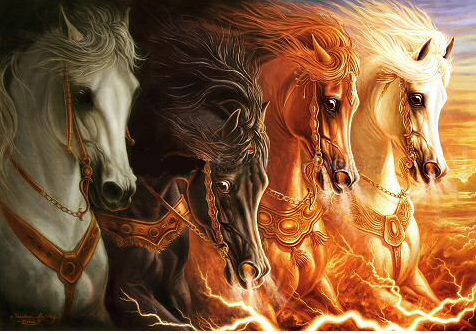
The Great White Throne Judgment

This great and important event takes place immediately after the destruction of heaven and earth. We will comment on it verse by verse from Revelation 20:11 to 20:15.

Verse 11. After John saw (in his vision) the devil being thrown into the lake of fire, he then immediately saw the vision of a great white throne and Him (God) sitting upon it. And the Scripture text here is written as if this throne with God upon it was all there was. That is, the earth and heaven had fled away, or we could say that it disappeared or gone into non-existence. It seems here as if John missed the great explosion of heaven and earth. His eyes saw the great white throne, and then he realized that heaven and earth were gone.

Verse 12. Then next John saw the dead (those who had died) standing (now alive) before the throne. And John here is careful to make clear that all the dead are here: great and small, which means the young and old; the rich and the poor; the big ones and the short ones, etc. And the books were opened; and another book was opened, which is the book of life. And the dead were judged according to what was written about them in the books—all their deeds (everything they ever did, good or bad, was recorded in these books).

Verse 13. God here seems to circle back to make certain that no dead is left out, even those who died at sea, or that were thrown into the sea; these were included in the number of dead. And all the places of death and hell turned in or released their dead ones to go and sand before the throne of God. Apparently, these dead beings are given new bodies suited for hell.

Verse 14. At first glance this verse was difficult to me. But when I looked back at 1 Corinthians 15:26 the meaning was made clear. At this point, that is, at the great white throne, death and hell will be abolished forever—cast into the lake of fire. And this is the second death. The first death was only physical death, but this second death is spiritual and eternal.

Take note also that this second death is only for unbelievers. It will have no power over believers. They will reign with Christ for a thousand years and then on into eternity (Rev. 20:6; 22:5).

Verse 15. Here it is made clear who will be judged. It is all those whose names are not written in the book of life.

The Five Judgments of God

There are five judgments that we know of. Here they are.

Judgment #1: Of the Believer and Sin

The first has to do with the believer and sin. Will he be condemned or not because of his sins? How will God judge the believer? Well, right from the start we must say that God has already made a judgment on this. He has already declared every believer innocent based on Christ’s finished work on the cross. In 1 peter 2:24 it says,

And He Himself bore our sins in His body on the cross, so that we might die to sin and live to righteousness; for by His wounds you were healed.

Then in Romans 8:1 and 2 it says,

Therefore there is now no condemnation for those who are in Christ Jesus. 2 For the law of the Spirit of life in Christ Jesus has set you free from the law of sin and of death.

Here is a third wonderful promise as to this judgment; in John 5:24 Jesus says to us,

Truly, truly, I say to you, he who hears My word, and believes Him who sent Me, has eternal life, and does not come into judgment, but has passed out of death into life.

Judgment #2: Of the Believer and his Works

This second judgment is in regard to the believer and his works. This judgment, often called the BEMA judgment, will be conducted in heaven, just after the Rapture of the church. This judgment is described in 1 Corinthians 3:11-15.

For no man can lay a foundation other than the one which is laid, which is Jesus Christ. 12 Now if any man builds on the foundation with gold, silver, precious stones, wood, hay, straw, 13 each man’s work will become evident; for the day will show it because it is to be revealed with fire, and the fire itself will test the quality of each man’s work. 14 If any man’s work which he has built on it remains, he will receive a reward. 15 If any man’s work is burned up, he will suffer loss; but he himself will be saved, yet so as through fire.

Hence, the result of this judgment is a reward or loss. All our bad works will be consumed by fire, and our good works shall remain and we will be rewarded for them.

Judgment #3: Of the Jews

This is a judgment of the Jews. While the church is being judged in heaven, the Jews will be judged on earth during the Tribulation. The basis of their judgment is their rejection of God and of their messiah. For their sin they have been scattered among the nations until the Time of the Gentiles are fulfilled—at the Rapture. At that time, they will be gathered back to the Holy Land and will suffer under the Antichrist and under God’s wrath upon the earth, which is called the “Time of Jacob’s Trouble” (Jer. 30:4-7). Many Jews will die, but a third will call upon the Lord and be saved (Ezek. 13:8-9).

Judgment #4: Of the Nations

This is the judgment of the nations, a judgment on all Gentiles who are still alive after Armageddon. This judgment is sometimes called the judgment of the sheep and goats. The sheep represent believers and the goats represent unbelievers. This judgment is well described for us in Matthew 25:31-46. Here it describes King Jesus as separating all the people as a shepherd would separate the sheep from the goats. And He will put the sheep on His right and the goats on the left. Here is the passage from verse 34:

“Then the King will say to those on His right, ‘Come, you who are blessed of My Father, inherit the kingdom prepared for you from the foundation of the world.  35 ‘For I was hungry, and you gave Me something to eat; I was thirsty, and you gave Me something to drink; I was a stranger, and you invited Me in;  36 naked, and you clothed Me; I was sick, and you visited Me; I was in prison, and you came to Me.’  37 “Then the righteous will answer Him, ‘Lord, when did we see You hungry, and feed You, or thirsty, and give You something to drink?  38 ‘And when did we see You a stranger, and invite You in, or naked, and clothe You?  39 ‘When did we see You sick, or in prison, and come to You?’  40 “The King will answer and say to them, ‘Truly I say to you, to the extent that you did it to one of these brothers of Mine, even the least of them, you did it to Me.’

41 “Then He will also say to those on His left, ‘Depart from Me, accursed ones, into the eternal fire which has been prepared for the devil and his angels; 42 for I was hungry, and you gave Me nothing to eat; I was thirsty, and you gave Me nothing to drink;  43 I was a stranger, and you did not invite Me in; naked, and you did not clothe Me; sick, and in prison, and you did not visit Me.’  44 “Then they themselves also will answer, ‘Lord, when did we see You hungry, or thirsty, or a stranger, or naked, or sick, or in prison, and did not take care of You?’  45 “Then He will answer them, ‘Truly I say to you, to the extent that you did not do it to one of the least of these, you did not do it to Me.’  46 “These will go away into eternal punishment, but the righteous into eternal life.”

Notice the basis of the judgment of these Gentile peoples. It hinges on how they will treat Christ’s brothers. Most scholars would say that these brothers refer to Jewish believers, mainly the 144,000 Jews who will be His witnesses.

As you remember, during the Tribulation no one will be able to buy or sell anything without the beast’s mark. But since believers were not to take the mark, they will have to get food and anything they needed by other means. Since the Jewish witnesses were to commit all of their time on preaching the gospel, they could not spend much time trying to provide for themselves.

Those who were believing Gentiles, they were the ones that will provide for them. Even though they will not take the mark either, they will make the time to somehow feed themselves as well as the believing Jews. And God will help them do it. He will give them the heart and the knowhow to feed themselves as well as others. Moreover, this good work will reveal that they in fact are believers—that they are His sheep.

Judgment #5: Of the Unbeliever

This fifth judgment is called the great white throne judgment. The time of this judgment is immediately after the end of the Satanic rebellion, when the devil is thrown into the lake of fire (Rev. 20:7-10), and just before the new heaven and earth comes into existence (Rev. 21:1). Hence, it will be during that time when there is nothing—when the old universe is “passed away” or “destroyed with intense heat” (2 Pt. 3:10), and when the new heaven and earth have not yet come (Rev. 21:1). There will be nothing but a “great white throne” with God sitting on it. This is the judgment of all unbelievers of all time. They will all be resurrected and will be brought here to be judged. The account of this judgment is in Revelation 20:11-15.

Then I saw a great white throne and Him who sat upon it, from whose presence earth and heaven fled away, and no place was found for them. 12 And I saw the dead, the great and the small, standing before the throne, and books were opened; and another book was opened, which is the book of life; and the dead were judged from the things which were written in the books, according to their deeds. 13 And the sea gave up the dead which were in it, and death and Hades gave up the dead which were in them; and they were judged, every one of them according to their deeds. 14 Then death and Hades were thrown into the lake of fire. This is the second death, the lake of fire. 15 And if anyone’s name was not found written in the book of life, he was thrown into the lake of fire.

The Judgment of the Nations

After the Tribulation is over, and likewise, after the fall of Babylon (Rev. 16:19; 17 & 18), and after the return of Christ (Rev. 19:11-16), and after Jesus brings all the believing Jews to safety (Rev. 12:16; Zech. 12:9; 14:3-4), and after He casts the beast and the false prophet into the lake of fire (Rev. 19:20), and after He goes out to kill all unbelievers who have gathered at Armageddon to do battle with Him (Rev. 19:21), Jesus will then gather all nations together (all gentiles that  are still alive), and will bring them to a certain place on earth, probably to a place near Jerusalem to be judged. It will be the place of His earthly reign in the Millennial kingdom (Matt. 25:31; Rev. 20:4-6).

This judgment is sometimes called the judgment of the sheep and goats. The sheep represent believers and the goats represent unbelievers. This judgment is well described for us in Matthew 25:31-46. Here it describes King Jesus as separating all the people as a shepherd would separate the sheep from the goats. And He will put the sheep on His right and the goats on the left. Here is the passage from verse 34:

“Then the King will say to those on His right, ‘Come, you who are blessed of My Father, inherit the kingdom prepared for you from the foundation of the world.  35 ‘For I was hungry, and you gave Me something to eat; I was thirsty, and you gave Me something to drink; I was a stranger, and you invited Me in;  36 naked, and you clothed Me; I was sick, and you visited Me; I was in prison, and you came to Me.’  37 “Then the righteous will answer Him, ‘Lord, when did we see You hungry, and feed You, or thirsty, and give You something to drink?  38 ‘And when did we see You a stranger, and invite You in, or naked, and clothe You?  39 ‘When did we see You sick, or in prison, and come to You?’  40 “The King will answer and say to them, ‘Truly I say to you, to the extent that you did it to one of these brothers of Mine, even the least of them, you did it to Me.’

41 “Then He will also say to those on His left, ‘Depart from Me, accursed ones, into the eternal fire which has been prepared for the devil and his angels; 42 for I was hungry, and you gave Me nothing to eat; I was thirsty, and you gave Me nothing to drink;  43 I was a stranger, and you did not invite Me in; naked, and you did not clothe Me; sick, and in prison, and you did not visit Me.’  44 “Then they themselves also will answer, ‘Lord, when did we see You hungry, or thirsty, or a stranger, or naked, or sick, or in prison, and did not take care of You?’  45 “Then He will answer them, ‘Truly I say to you, to the extent that you did not do it to one of the least of these, you did not do it to Me.’  46 “These will go away into eternal punishment, but the righteous into eternal life.”

Notice the basis of the judgment of these Gentile peoples. It hinges on how they will treat Christ’s brothers. Most scholars would say that these brothers refer to Jewish believers, mainly the 144,000 Jews who will be His witnesses.

As you remember, during the Tribulation no one will be able to buy or sell anything without the beast’s mark. But since believers were not to take the mark, they will have to get food and anything they needed by other means. Since the Jewish witnesses were to commit all of their time on preaching the gospel, they could not spend much time trying to provide for themselves.

Those who were believing Gentiles, they were the ones that will provide for them. Even though they will not take the mark either, they will make the time to somehow feed themselves as well as the believing Jews. And God will help them do it. He will give them the heart and the knowhow to feed themselves as well as others. Moreover, this good work will reveal that they in fact are believers—that they are His sheep.

Now I want to write a little more on all the judgments—so that we can put this judgment of the nations in perspective. But that will be on a coming blog.

The Harvest On The Earth

The harvest of the earth speaks of the great judgment of God upon all unbelievers, which occurs at the very end of the Tribulation. We will look at the entire passage and then break it down into three points.

Revelation 14:14-20. Then I looked, and behold, a white cloud, and sitting on the cloud was one like a son of man, having a golden crown on His head and a sharp sickle in His hand. 15 And another angel came out of the temple, crying out with a loud voice to Him who sat on the cloud, “Put in your sickle and reap, for the hour to reap has come, because the harvest of the earth is ripe.” 16 Then He who sat on the cloud swung His sickle over the earth, and the earth was reaped.

17 And another angel came out of the temple which is in heaven, and he also had a sharp sickle. 18 Then another angel, the one who has power over fire, came out from the altar; and he called with a loud voice to him who had the sharp sickle, saying, “Put in your sharp sickle and gather the clusters from the vine of the earth, because her grapes are ripe.” 19 So the angel swung his sickle to the earth and gathered the clusters from the vine of the earth, and threw them into the great wine press of the wrath of God. 20 And the wine press was trodden outside the city, and blood came out from the wine press, up to the horses’ bridles, for a distance of two hundred miles.

The Executioners

There will be two executioners: Jesus Christ and special designated angels. Jesus Christ is seen by John as “a son of man having a golden crown on His head and a sharp sickle in His hand.” This imagery, especially the golden crown on His head, shows us vividly that Christ is victorious in battle; and even before the battle is over, we know that He will conquer His enemies.

His special angels helping Him also have sharp sickles (deadly weapons), and they will be working to gather all the sinners into the great wine press of God (the wrath of God).

The Harvest Will Be Ripe

The harvest in this passage is first of grain (vs 14-16), and then of grapes (17-20). In the first group of verses I think the harvest of grain is dealing with the separation of the tares from the good grain, or the unbelievers from the believers (This is explained for us in Matthew 13:39-43). We can’t be sure exactly when or how this will occur, but I think it will occur sometime before Armageddon—which is what is described in verses 17 through 20.

So, as for this second passage, where the imagery is clearly of the harvest of grapes, the separation has already occurred, and all of the unbelieving people left (represented as grapes) are harvested (judged); they are all ripe and are cast into the great wine press.

Notice that in both cases—the harvest of grain (the separation) and the harvest of grapes—the timing is exactly right. Hence, as the writer of Ecclesiastes puts it, “There is an appointed time for everything” (Ecc. 3:1). And in this case, the time for God’s judgment on unbelievers has come. He has waited patiently for people to repent and come to Him. But there will be an appointed time when His patience runs out and His judgment begins. At that time nothing can be done to delay His time of judgment.

The Great Wine Press

The great wine press is the slaughter of all unbelievers like the pressing of grapes. The writing here portrays all those who will come to the great battle ground in Israel. As is described in the sixth bowl (Rev. 16:13-16), they (hundreds of millions) will be drawn to this place of battle: mainly in Armageddon, but I think in most of the land of Israel, by demons which will come out of the mouths of the dragon, the beast, and the false prophet; these three will demonically convince the world to come and fight. And so, they will be led by demons to this great battle. But they will come to be slaughtered by the angels of God and Christ Himself. They will be slaughtered by the sword, and their blood will be as deep as the horses’ bridles—as it flows for 200 miles from Armageddon in the North to Edom in the south.

Now these who gather, at least most of them, I think, are military men (armies). But what of the civilian unbelievers. I assume that they will be judged too—wherever they may be located. None will escape the sword of God’s wrath. All will die because of their rebellious unbelief. As the seventh bowl judgment describes, some will die by a great earthquake, and some will die by huge hail stones, and I imagine that some will die merely out of fear—the fear of His judgment. In the end there will be no unbelievers left. All will die.

Spiritual Judgment and Discrimination — Matthew 7:6

In Matthew 7:1-5, our Lord has been preaching on judgment. He tells us not to judge others; and whenever we try to correct another we must first look at and purify ourselves, then we can see clearly to help them.

In the sixth verse, most bibles put this verse in a special paragraph on its own. But D. Martyn Lloyd-Jones suggests that that is not right, that it should connect to the previous five verses, that it is the final statement on judgment. Indeed, I agree. It tells the spiritual Christian how he must judge another—with “a spirit of discrimination.” So, Jesus says in verse six…

Do not give what is holy to dogs, and do not throw your pearls before swine, lest they trample them under their feet, and turn and tear you to pieces.

What is meant here? First of all, pearls are the Christian message. And the dogs and the swine are all that is unholy and unclean, or all those who are unworthy to hear the Christian message. And we know that all of us have sinned, but in this context, Jesus was referring to those sinners who reject the gospel and the truth of God and those who hate Him and even snarl at the message of His truth.

So, Jesus is telling us that we ought not to just spread His word of truth to everyone, but only to those who are worthy of it—or who are seeking it. This may come as a surprise to some people. Some may say that since God loves all people, all should hear the gospel. But the end of verse six gives an explanation of why not. Jesus says that some who hear the gospel will “trample them [our words] under their feet, and turn and tear you to pieces.” In short, they reject the truth and even do damage to it and to you.

If you need an example of this, we can look at Jesus teaching. First, we can compare how He answered Pilate with Herod, in Luke 23:3 and 9. With Pilate, in verse three, Jesus answered him; but with Herod, in verse nine, he answered him nothing. Why? Because Jesus judged Pilate to be a genuine seeker of truth, but He knew that Herod cared nothing for the truth. He knew it by his attitude. And there are other examples. Many times Jesus would not speak to the Pharisees, or at least answer their questions. He instead would go and minister to the Gentiles and to the sinners, as also Paul did.

In all our evangelism efforts and when we seek to teach the truth to people, we should always learn who we are talking to, to see if they are worthy of hear us. Here are three sets of instructions that may be helpful to you in your speaking to others.

  • Learn to know what to give each person in each particular situation.
  • Learn to know the way to present the truth to each person. Learn to assess people.
  • Learn which aspect of truth is appropriate in each particular case.

Also, know that our presentation to unbelievers must be different than to believers. An unbeliever only needs one thing, the doctrine of justification by faith. They need only to know of their sinful life and their need of salvation. Any other bit of truth will have no meaning to them; or we should say that they will take it wrong because of their unregenerated state.

To believers, some have a need for basic truth only—the milk of the word; others should be fed more solid food—the meat of the word.

On What Basis Will We Be Judged at the Bema?

Stephen Nielsen's avatarStudying Bible Prophecy


Most Christians, it seems, have very little concern about whether they will have to give an account for their life or not. They live as if what they do now will have little effect on eternity. But the bible tells us that we will stand before Christ some day at what is called the Bema Seat, and will be judged by Him. In this post we will consider, in the following three points, on what basis we will be judged.

We will not be judged on the basis of sins.

It is true that through Adam, sin entered into the world; and because of that sin, spiritual death was passed on to all men at birth (Romans 5:12). But because of the mercy and grace of God, those who have believed in Him have received redemption through His blood, the forgiveness of our trespasses (Rom. 1:17). Thus, those who…

View original post 636 more words

The Righteous and the Wicked: Fruit Trees and Chaff – Psalm 1

I’ve been thinking lately about the first Psalm—mainly about chaff. In this Psalm the Psalmist compares the righteous man to the wicked man.

Here is what is said about the righteous man:

How blessed is the man who does not walk in the counsel of the wicked,

Nor stand in the path of sinners,

Nor sit in the seat of scoffers!

2 But his delight is in the law of the Lord,

And in His law he meditates day and night.

3 And he will be like a tree firmly planted by streams of water,

Which yields its fruit in its season,

And its leaf does not wither;

And in whatever he does, he prospers.

(Psalm 1:1-3)

Here are my observations on the righteous man:

  • He does not listen to the teaching of the wicked or even spend much time with them.
  • He meditates on the word and delights in it all the time.
  • He is like a fruit tree. He is fruitful and prosperous.
  • Like a tree, his life is stable and is firmly planted.
  • The Lord knows him and will be with him for eternity.

Here is what the Psalmist says about the wicked, unsaved man:

The wicked are not so,

But they are like chaff which the wind drives away.

5 Therefore the wicked will not stand in the judgment,

Nor sinners in the assembly of the righteous.

6 For the Lord knows the way of the righteous,

But the way of the wicked will perish.

(Psalm 1:4-6)

Here are my observations about the unrighteous man:

  • He is like chaff. He has no fruit, no stability, no real prosperity.
  • He has no hope of eternal life. In the final judgment he will be found unrighteous and will be cast into the lake of fire for eternity (Rev. 20:11-15).
A farmer tosses the wheat into the air so that the wheat chaff will be blown away.

More on the Chaff

How would you like to be compared to chaff? Well, the Psalmist compares the wicked to chaff in verse 4. Think of it. Chaff. Chaff has absolutely no value, no worth. Wheat chaff is the outer casing of the wheat kernel that has gotten old and is coming off. That outer shell is so flimsy that when you would throw the wheat into the air, the wind would blow the chaff away.

Think of that.  Think of being blown away. The non-Christian is in a state of constantly being blown away. He is blown wherever the wind happens to blow. He has no strength of will.  He lets the evil world blow him wherever the devil and the world want him to go. Just like the chaff, the unbeliever has no fruit, no value, and no real prosperity. Oh, he may have momentary desires and delights of the flesh, but nothing that will last and nothing that has any lasting (eternal) value. And he has no stability. He is not like a stable tree. He has no roots. He is just chaff that is blown from place to place with the wind—with the evil world.

The Chaff Compared to the Unformed Earth

As it happened, on the same day (yesterday) that I read Psalm 1, I also read Genesis 1. As I was thinking of the chaff, I also thought of how the earth was in the beginning.  The bible says, “And the earth was formless and void.” (I’m not sure how to interpret this. I tend to think that God first created an unformed earth—like a big lump of clay—out of nothing; then later He formed it as it is now). Anyway, I began to think of the chaff much like that formless earth.

And that got me to thinking. If God could make a beautiful, fruitful earth out of that formless mass, why couldn’t He make something out of the chaff. Well He can and He has. Every time a person is saved it is like a formless piece of chaff being miraculously created into a beautiful new creation of God—with hope and purpose. 2 Corinthians 5:17 says,

Therefore if any man is in Christ, he is a new creature; the old things passed away; behold, new things have come.