This is our twentieth study. Please click HERE for an intro to this study.
Matthew 23:29-31
29 “Woe to you, teachers of the law and Pharisees, you hypocrites! You build tombs for the prophets and decorate the graves of the righteous. 30 And you say, ‘If we had lived in the days of our forefathers, we would not have taken part with them in shedding the blood of the prophets.’ 31 So you testify against yourselves that you are the descendants of those who murdered the prophets.
Observations
By decorating the graves of the prophets, that indicates to me that they were trying to put on a show of self-righteousness, and even trying to cover up their own sins. And when they said, ‘If we had lived in the days of our forefathers, we would not have taken part with them in shedding the blood of the prophets,’ they were not being honest. John MacArthur has stated, “[This was] a ridiculous claim to self-righteousness when they were already plotting the murder of the Messiah (cf. Jn. 11:47-53).”
Application
It is better to face up to the sins of your descendance and not try to say that you would have lived better. I think we should instead be like Daniel who confessed before God the sins of his people (Dan 9:5-6)—even though he himself was innocent.
This is our nineteenth study. Please click HERE for an intro to this study.
Matthew 23:27-28
27 “Woe to you, teachers of the law and Pharisees, you hypocrites! You are like whitewashed tombs, which look beautiful on the outside but on the inside are full of dead men’s bones and everything unclean. 28 In the same way, on the outside you appear to people as righteous but on the inside you are full of hypocrisy and wickedness.
Observations
The explanation of Jesus is quite clear. The Pharisees worked to make themselves look good and righteous, but inside their heart they were spiritually dead, and therefore all their attempts to make themselves look righteous were wicked and hypocritical. They were phonies, people in masks. People who could not be trusted, unreliable.
Application
We ought always to watch out for these types of people. We should do what we can to test them. And if we are thinking about going to a church, always ask questions about the pastor and teachers. As for professors of a college, it may be harder to get around those who you think are as Pharisees, but in most cases you can do what they say, but you don’t have to do what they do.
This is our seventeenth study. Please click HERE for an intro to this study. Today we will look at how the Pharisees tithed.
Matthew 23:23-24
23 “Woe to you, teachers of the law and Pharisees, you hypocrites! You give a tenth of your spices — mint, dill and cummin. But you have neglected the more important matters of the law — justice, mercy and faithfulness. You should have practiced the latter, without neglecting the former. 24 You blind guides! You strain out a gnat but swallow a camel.
Observations
It is a little puzzling to me why the Pharisees concentrated on the little things as the spices but neglected the larger and spiritual things. But here are my ideas. Maybe they thought people would be impressed with them, that they were so diligent in giving a tenth of their spices; or maybe it was all they knew how to do; they were just doing things as they were taught. As for neglecting the larger things of justice, mercy and faith, I suggest that it was because they were unconverted and they did not understand those spiritual things (1 Cor. 2:14).
Application
We should regard first the things of the Spirit and His kingdom. First give your life totally to Him and then He will direct you in what else to do. Never do things to impress people, but only to obey God in love.
The Old Testament Tabernacle, with its various articles and the offering up of animal sacrifices, were insufficient in their attempt to commune with God and forgive sins. But these things now speak of Christ and helps us to commune with Him.
In my last post on this subject we journeyed through the tabernacle and discussed the symbolic meaning of the gate, the bronze altar, and the laver. Now, in this post, we will go in our mind into the sanctuary—the Holy Place. To the left of us we see a shining golden lampstand with seven golden lamps, burning brightly and giving light to the whole room. To the right we see a dazzling golden table with twelve small loaves of bread on top. Directly ahead of us, in front of a beautiful veil is a small smoldering golden altar—about 3 ½ feet high and 20 inches square.
This is our eleventh study. Please click HERE for an intro to this study. Today we will focus on the Biblical teaching of divorce.
Matthew 19:3-9
Some Pharisees came to him to test him. They asked, “Is it lawful for a man to divorce his wife for any and every reason?”
4 “Haven’t you read,” he replied, “that at the beginning the Creator ‘made them male and female,’ 5 and said, ‘For this reason a man will leave his father and mother and be united to his wife, and the two will become one flesh’? 6 So they are no longer two, but one. Therefore what God has joined together, let man not separate.”
7 “Why then,” they asked, “did Moses command that a man give his wife a certificate of divorce and send her away?”
8 Jesus replied, “Moses permitted you to divorce your wives because your hearts were hard. But it was not this way from the beginning. 9 I tell you that anyone who divorces his wife, except for marital unfaithfulness, and marries another woman commits adultery.”
Observations
The Pharisees asked Jesus about divorce, as always, to test Him—to see how much He knew. And they may also have been looking for more information for their own debates. The Rabbis Shammai interpreted the law as permitting a man to divorce his wife only for sexual immorality. But the Hillelites permitted divorce for any reason.
Jesus appears to side with the Shammai, but He also gave them more informaation than they asked for. He instructed them on what the original intent of marriage was—to be of one flesh. He also corrected them on what was said about a command of divorce. He said that Moses didn’t command divorce, he permitted it, and only for one reason, adultery.
Applications
I think these verses should definitely be studied by any couple who is thinking about marriage. And it is my opinion that if they can’t be serious about staying together for life, they should not be married. It is better to remain single.
This is our ninth study on this topic. Please click HERE for an intro to this study. Today we will focus on how Jesus rebuked the Pharisees for not being able in interpret the signs of the times, and how many of us can’t do it either.
Matthew 16:1-4
The Pharisees and Sadducees came to Jesus and tested him by asking him to show them a sign from heaven.
2 He replied, “When evening comes, you say, ‘It will be fair weather, for the sky is red,’ 3 and in the morning, ‘Today it will be stormy, for the sky is red and overcast.’ You know how to interpret the appearance of the sky, but you cannot interpret the signs of the times. 4 A wicked and adulterous generation looks for a miraculous sign, but none will be given it except the sign of Jonah.” Jesus then left them and went away.
Observations
The Pharisees seemed to be obsessed with miracles—that Jesus had to prove Himself by miracles. This was the second time they asked Jesus to show them a sign. The first time was in Matthew 12:38.
Jesus rebuked them for being so concerned with miracles, that they should first be able to read the signs of the times all around them. That is, to know who He was, to understand how people were rejecting Him, and how prophecy was being fulfilled right in front of their eyes.
Jesus again, as in Matthew 12, gives them the sign of Jonah, which was through Jonah a foretelling of and the miracle of His resurrection on the third day.
Applications
So many people today can’t read the signs of the times. So many have no idea what is happening or what will happen. It comes only to those who study bible prophecy. Many don’t even realize their own sin; they don’t read in the bible about sin and how sin begins and grows like a cancer (read Romans 1:24-32). Then they don’t realize how world events are falling into place, telling us that His coming is very soon. Of course, they don’t realize it because they don’t read the prophetical books in the bible. Some people don’t even bother to watch the world news on TV, or read the paper. They maybe don’t want to know what’s going on. They just want to be left along with their games and entertainment and pleasing themselves.
We should look around more and see all the transvestites and the queers, etc., and so to discern our times. We should also look at some of our politicians and see all the corruption and lying, and then to discern how things will end.
God wants us to be aware of things going on, and He wants us to know something of the future—both good and bad—which He has written out for us in His word.
This is our eighth study on this topic. Please click HERE for an intro to this study.
Matthew 15:10-20
10 Jesus called the crowd to him and said, “Listen and understand. 11 What goes into a man’s mouth does not make him ‘unclean,’ but what comes out of his mouth, that is what makes him ‘unclean.'”
12 Then the disciples came to him and asked, “Do you know that the Pharisees were offended when they heard this?”
13 He replied, “Every plant that my heavenly Father has not planted will be pulled up by the roots. 14 Leave them; they are blind guides. If a blind man leads a blind man, both will fall into a pit.”
15 Peter said, “Explain the parable to us.”
16 “Are you still so dull?” Jesus asked them. 17 “Don’t you see that whatever enters the mouth goes into the stomach and then out of the body? 18 But the things that come out of the mouth come from the heart, and these make a man ‘unclean.’ 19 For out of the heart come evil thoughts, murder, adultery, sexual immorality, theft, false testimony, slander. 20 These are what make a man ‘unclean’; but eating with unwashed hands does not make him ‘unclean.'”
Observations
In this text Jesus goes back to the Pharisees complaint that the disciples didn’t wash their hands before eating (vv. 1-2). He explains why He was unconcerned about it, or why He was more concerned about the inside of a person—the heart. He said that what comes out of a man, or what a man speaks will defile him. It is exactly what James tells us (in James 3:6), that when we speak something sinful, our sinful words will defile the entire man and will cause us to do evil things (v. 19).
Also, when the disciples came and told Jesus that the Pharisees were offended by what he was saying, His reply seemed very callous; however, Jesus knew their evil heart and was more concerned that His disciples not be influenced by them. John MacArthur said that Jesus here (in vv. 13-14) is declaring God’s wrath on the Pharisees, that God has already given them over, as in Romans 1:18-32).
Applications
We ought to be much more concerned with our moral purity than with out physical uncleanness. We also should be watchful of “blind guides,” so that we will not be led down the wrong path.
This is our seventh study on this topic. Please click HERE for an intro to this study.
Matthew 15:1-6
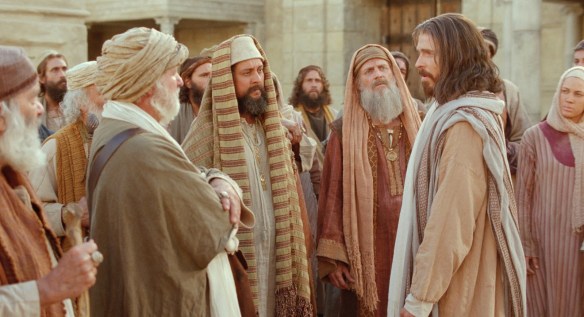
Then some Pharisees and teachers of the law came to Jesus from Jerusalem and asked, 2 “Why do your disciples break the tradition of the elders? They don’t wash their hands before they eat!”
3 Jesus replied, “And why do you break the command of God for the sake of your tradition? 4 For God said, ‘Honor your father and mother’ and ‘Anyone who curses his father or mother must be put to death.’ 5 But you say that if a man says to his father or mother, ‘Whatever help you might otherwise have received from me is a gift devoted to God,’ 6 he is not to ‘honor his father’ with it. Thus you nullify the word of God for the sake of your tradition.
Observations
The tradition of washing hands before meals is a good one, but it wasn’t commanded by God through Moses, so Jesus wasn’t that concerned about it. He was concerned more over why the Pharisees were teaching that it was okay not to honor father and mother for the sake of their tradition. The Pharisees were teaching that it was okay not to help your mother and father with a financial need, or with any other need, if you gave your time and money to God instead—because God is more important.
Applications
I see all kinds of applications here, especially if one’s parents are elderly and poor. We cannot use any excuse for not honoring parents by helping them with their needs, no matter what good thing we are doing for God. Honoring parents is always a greater priority. We should not say, I cannot help my parents with their needs because I need that money to go to Bible School. We cannot say I cannot honor my parents by supporting them because I support this missionary or this good work. Honoring one’s father and mother is the 5th commandment and a high priority—an absolute must over any other good work.
This is our fifth study on this topic. Please click HERE for an intro to this study.
Matthew 12:13-14; 22-25
13 Then he said to the man, “Stretch out your hand.” So he stretched it out and it was completely restored, just as sound as the other. 14 But the Pharisees went out and plotted how they might kill Jesus.
22 Then they brought him a demon-possessed man who was blind and mute, and Jesus healed him, so that he could both talk and see. 23 All the people were astonished and said, “Could this be the Son of David?”
24 But when the Pharisees heard this, they said, “It is only by Beelzebub, the prince of demons, that this fellow drives out demons.”
25 Jesus knew their thoughts and said to them, “Every kingdom divided against itself will be ruined, and every city or household divided against itself will not stand.
Observations
First of all, in both cases by healing the men Jesus demonstrated His deity. Then in both cases The Pharisees had a negative reaction. In the first case they plotted to kill Him, and in the second case they contributed the healing to Beelzebub (Satan).
I’m not sure what is going on with the Pharisees, but I will take a guess. In both healings they were jealous of His power and deity; they didn’t want Him to be more powerful than they were. I think they also didn’t want their own sin and corruption to be revealed. So, they did whatever they could think of to make Him look bad. Notice in verse 24 they called Him, “this fellow.”
It is also possible that they could not recognize that Jesus was a good man, because of their own depravity. Hence their sin and corruption caused their thinking to be depraved and reversed, so that they saw good as evil and evil as good (Rom. 1:28; Isa. 5:20).
Applications
I did not include what Jesus did, but that is the application. In the first case when the Pharisees plotted to kill Him, Jesus simply withdrew from them and continued healing people (v. 15). Hence, the Pharisees threats did not deter Jesus’ mission.
In the next case, when the Pharisees said that He was casting out demons by Beelzebub (Satan), Jesus took that as an opportunity to teach. Some teacher I think would be offended and walk away. But Jesus showed His compassion as a truth teacher. Here is His teaching:
Matthew 12:25-30
25 Jesus knew their thoughts and said to them, “Every kingdom divided against itself will be ruined, and every city or household divided against itself will not stand. 26 If Satan drives out Satan, he is divided against himself. How then can his kingdom stand? 27 And if I drive out demons by Beelzebub, by whom do your people drive them out? So then, they will be your judges. 28 But if I drive out demons by the Spirit of God, then the kingdom of God has come upon you.
29 “Or again, how can anyone enter a strong man’s house and carry off his possessions unless he first ties up the strong man? Then he can rob his house.
30 “He who is not with me is against me, and he who does not gather with me scatters.
When I read in the bible about how God deals with slavery and polygamy, and other sins, I have to stop and think. I sometimes wonder why He hasn’t spent more time condemning those things. It almost seems like He has just gone along with it—tolerated it. From the beginning of time it seems that slavery has occurred, and all through the Old Testament most men have had more than one wife. And divorce was also rampant. It wasn’t until Jesus came along in the New Testament that polygamy and divorce were dealt with. But even in the New Testament slavery was still an issue—still something that seemed to be excepted as normal (Eph. 6:5-9; Philemon).
Well, I don’t know what to say, except that from the beginning God gave man free will—the freedom to do as he wished. And God rarely intervened, except in the flood, and also when He directed Israel to wipe out the evil nations (by Joshua’s leadership).
But it is interesting how God has worked within the evil world system to bring testing on His people in order to discipline us. And we are commanded to live in this world without complaining so that we may appear as shinning light in the world (Phil. 2:14-15), and be a pleasure to God.
In regard to slavery, it has seemed that God hasn’t said much about it, except how masters ought to treat slaves and how slaves ought to please their masters (Eph. 6:5-9). So, even after Christ, slavery seemed to be excepted, but something that should be regulated or made acceptable —more like a boss and an employee.
But that certainly wasn’t how it has been—all the way into the 60’s in our country (USA). And it has taken a long time to change it. Even now there is still so much tension between whites and blacks. And what’s going on now with this Black Lives Matter movement is not helping. It seems to be just stirring up more bitterness.
I sometimes wonder why God didn’t put a stop to slavery from the start. Surely, He saw what would happen and the racism. But, like I said, that’s not how God chose to work. He gave us free will; and He also gave us the ability to ask for His help. We should do that. We should be constantly praying and asking Him to help us with our tendency toward racism. Instead of all the riots and the terrible BLM speeches (with awful language), made to stir people up to do horrible things, Christians should meet together to pray, and then be obedient in however He directs.





 Stephen Nielsen