Now there was a man at Caesarea named Cornelius, a centurion of what was called the Italian cohort, 2 a devout man and one who feared God with all his household, and gave many alms to the Jewish people and prayed to God continually. 3 About the ninth hour of the day he clearly saw in a vision an angel of God who had just come in and said to him, “Cornelius!” 4 And fixing his gaze on him and being much alarmed, he said, “What is it, Lord?” And he said to him, “Your prayers and alms have ascended as a memorial before God. 5 “Now dispatch some men to Joppa and send for a man named Simon, who is also called Peter; 6 he is staying with a tanner named Simon, whose house is by the sea.” 7 When the angel who was speaking to him had left, he summoned two of his servants and a devout soldier of those who were his personal attendants, 8 and after he had explained everything to them, he sent them to Joppa.
In this text we have an introduction for a very important mission, which will change the entire mode of the gospel ministry. It began with a Gentile named Cornelius. In a vision an angel instructed him to send men to Joppa to get Peter. Apparently, he will be the man who will somehow know what message the Lord will bring to him.
Now as Peter was traveling through all those regions, he came down also to the saints who lived at Lydda. 33 There he found a man named Aeneas, who had been bedridden eight years, for he was paralyzed. 34 Peter said to him, “Aeneas, Jesus Christ heals you; get up and make your bed.” Immediately he got up. 35 And all who lived at Lydda and Sharon saw him, and they turned to the Lord.
36 Now in Joppa there was a disciple named Tabitha (which translated in Greek is called Dorcas); this woman was abounding with deeds of kindness and charity which she continually did. 37 And it happened at that time that she fell sick and died; and when they had washed her body, they laid it in an upper room. 38 Since Lydda was near Joppa, the disciples, having heard that Peter was there, sent two men to him, imploring him, “Do not delay in coming to us.” 39 So Peter arose and went with them. When he arrived, they brought him into the upper room; and all the widows stood beside him, weeping and showing all the tunics and garments that Dorcas used to make while she was with them. 40 But Peter sent them all out and knelt down and prayed, and turning to the body, he said, “Tabitha, arise.” And she opened her eyes, and when she saw Peter, she sat up. 41 And he gave her his hand and raised her up; and calling the saints and widows, he presented her alive. 42 It became known all over Joppa, and many believed in the Lord. 43 And Peter stayed many days in Joppa with a tanner named Simon.
After the controversy Peter had with Simon, Luke (the author of Acts) sets forth, in Acts 8:12-40, the ministry of Philip; then in Acts 9:1-31, he also sets forth Paul’s conversion and early ministry.
In Acts 9:32, Luke returns again with Peter, this time talking about his ministry in Lydda and Joppa, about 30 miles northwest of Jerusalem. And we can’t be sure whether he was doing this ministry at the same time as the ministry of Philip and Paul (from Acts 8:12 to 9:31), or whether it came later. It seems to me that there may have been some overlapping.
Nonetheless, it seemed that Peter was traveling by himself through all the regions of Judea and Galilee and Samaria (v. 31), probably checking on all the church believers to see how they were progressing in the Lord. We don’t have an account of everything Peter did, except for these two incidents: the healing of Aeneas from Lydda and the resurrection of Tabitha at Joppa.
What Peter did with Aeneas and Tabitha reminds me of the ministry of Elijah the Prophet (1 Kings17:1 to 2 Kings 3: l1). Peter had so much spiritual power just like Elijah had and also like Jesus had. It was wonderful, and it was used by God to turn people to the Lord and to believe in Him.
Now when Simon [see verses 9-13] saw that the Spirit was bestowed through the laying on of the apostles’ hands, he offered them money, 19 saying, “Give this authority to me as well, so that everyone on whom I lay my hands may receive the Holy Spirit.” 20 But Peter said to him, “May your silver perish with you, because you thought you could obtain the gift of God with money! 21 “You have no part or portion in this matter, for your heart is not right before God. 22 “Therefore repent of this wickedness of yours, and pray the Lord that, if possible, the intention of your heart may be forgiven you. 23 “For I see that you are in the gall of bitterness and in the bondage of iniquity.”
This fellow Simon had been practicing magic (some kind of divination and of the occult), but supposedly he was saved and baptized by Philip’s preaching. And when he saw the miracles done by Philip he was amazed, and I suppose he wanted to do the same (vv. 9-13).
Well, then when Peter and John also were laying their hands on some, and by that act they were receiving the Holy Spirit (and they may have received some gift of the Holy Spirit), this Simon was again amazed and wanted to do the same. But this time he offered Peter money, thinking that he could buy this authority.
Well, Peter immediately set him straight and told him that his heart was not right—that it was wicked. Apparently, some of that wickedness from his past life was still with him; and Peter advised him to repent of it so that he would be forgiven and cleansed of it. But Simon did not feel strong enough to pray for himself, so he asked Peter to pray for him. We don’t know what happened to Simon or if he was ever a true believer.
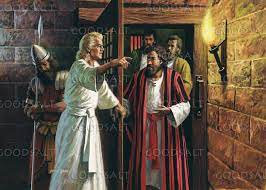
But the high priest rose up, along with all his associates (that is the sect of the Sadducees), and they were filled with jealousy. 18 They laid hands on the apostles and put them in a public jail. 19 But during the night an angel of the Lord opened the gates of the prison, and taking them out he said, 20 “Go, stand and speak to the people in the temple the whole message of this Life.” 21 Upon hearing this, they entered into the temple about daybreak and began to teach.
Now when the high priest and his associates came, they called the Council together, even all the Senate of the sons of Israel, and sent orders to the prison house for them to be brought. 22 But the officers who came did not find them in the prison; and they returned and reported back, 23 saying, “We found the prison house locked quite securely and the guards standing at the doors; but when we had opened up, we found no one inside.” 24 Now when the captain of the temple guard and the chief priests heard these words, they were greatly perplexed about them as to what would come of this. 25 But someone came and reported to them, “The men whom you put in prison are standing in the temple and teaching the people!” 26 Then the captain went along with the officers and proceeded to bring them back without violence (for they were afraid of the people, that they might be stoned).
27 When they had brought them, they stood them before the Council. The high priest questioned them, 28 saying, “We gave you strict orders not to continue teaching in this name, and yet, you have filled Jerusalem with your teaching and intend to bring this man’s blood upon us.” 29 But Peter and the apostles answered, “We must obey God rather than men. 30 “The God of our fathers raised up Jesus, whom you had put to death by hanging Him on a cross. 31 “He is the one whom God exalted to His right hand as a Prince and a Savior, to grant repentance to Israel, and forgiveness of sins. 32 “And we are witnesses of these things; and so is the Holy Spirit, whom God has given to those who obey Him.”
Well, here we go again. The Apostles were just being obedient to God: preaching, and healing the sick, and casting out demons; and the high priest and his associates couldn’t stand it and were jealous of their power. So, they threw them in jail.
But during the night an angel set them free and told them to get busy preaching in the temple. The next day when the Jewish leaders found out what happened, they came and questioned them and asked them why they were continuing to preach about Jesus and to bring His blood down upon them.
Well, Peter saw his opportunity to preach to them saying, “We must obey God rather than men.” And they also preached the gospel to them and blamed them for His death. Oh, they were furious and intended to kill them. But a wise man named Gamaliel talked them out of it (verses 33-39).
So they flogged them, ordered them not to speak of Jesus any more, and let them go (v. 40). But, as you may guess, they kept on preaching in the temple and from house to house. And it seemed that they were even more energized to do it.
At the hands of the apostles many signs and wonders were taking place among the people; and they were all with one accord in Solomon’s portico. 13 But none of the rest dared to associate with them; however, the people held them in high esteem. 14 And all the more believers in the Lord, multitudes of men and women, were constantly added to their number, 15 to such an extent that they even carried the sick out into the streets and laid them on cots and pallets, so that when Peter came by at least his shadow might fall on any one of them. 16 Also the people from the cities in the vicinity of Jerusalem were coming together, bringing people who were sick or afflicted with unclean spirits, and they were all being healed.
After the death of Anania and Sapphira, great fear came over the church (v. 11). Then also, because of the great miraculous power of healings and casting out demons by the Apostles—especially by Peter—the people dared not associate with them.
This power was given to all that believed after the Holy Spirit came at Pentecost. I would say that it was given to some more than others, according to their faith. It seemed to be especially given to Peter (v. 15). He, and I suppose some of the other Apostles, had the same healing power that Jesus had; for “they were all being healed” (Mk. 16:17-18; Lu. 24:49).
But a man named Ananias, with his wife Sapphira, sold a piece of property, 2 and kept back some of the price for himself, with his wife’s full knowledge, and bringing a portion of it, he laid it at the apostles’ feet. 3 But Peter said, “Ananias, why has Satan filled your heart to lie to the Holy Spirit and to keep back some of the price of the land? 4 “While it remained unsold, did it not remain your own? And after it was sold, was it not under your control? Why is it that you have conceived this deed in your heart? You have not lied to men but to God.” 5 And as he heard these words, Ananias fell down and breathed his last; and great fear came over all who heard of it. 6 The young men got up and covered him up, and after carrying him out, they buried him.
7 Now there elapsed an interval of about three hours, and his wife came in, not knowing what had happened. 8 And Peter responded to her, “Tell me whether you sold the land for such and such a price?” And she said, “Yes, that was the price.” 9 Then Peter said to her, “Why is it that you have agreed together to put the Spirit of the Lord to the test? Behold, the feet of those who have buried your husband are at the door, and they will carry you out as well.” 10 And immediately she fell at his feet and breathed her last, and the young men came in and found her dead, and they carried her out and buried her beside her husband. 11 And great fear came over the whole church, and over all who heard of these things.
As you may read from the text, a man named Ananias and his wife Sapphira sold a piece of their property; and they kept a portion of the price for themselves; and they gave the rest to the church (the Lord). Their sin was that they were declaring to the church that they gave all the money from the land to the church. Hence they were lying to the church—and the Lord. Yes, their sin was really to God; anytime we sin against anyone, we are sinning against God. And in a broader sense, their sin was of spiritual hypocrisy. They were faking their Christianity. They wanted so badly to be popular in the church so they lied about the full price of the land.
As for how Peter knew of their lie, there is no doubt that the Holy Spirit revealed it to him. And he did not hesitate to deal with it harshly and immediately. For just as Achon was caught in a lie and he and his entire family were stoned to death for it (Josh. 7:16-26), Peter knew that this sin of Ananias and Sapphira was of equal disgrace to God; particularly since the New Testament church was just starting, and it had to be built on a strong and holy foundation of truth—without hypocrisy.
Now as they observed the confidence of Peter and John and understood that they were uneducated and untrained men, they were amazed, and began to recognize them as having been with Jesus…
19 But Peter and John answered and said to them, “Whether it is right in the sight of God to give heed to you rather than to God, you be the judge; 20 for we cannot stop speaking about what we have seen and heard.”
This text, as you can see, comes directly after Peter’s reply to the Jewish leaders (verses 8-12). Their amazement was not so much that they were involved in a miraculous healing, but rather that they, being uneducated, could speak so well; and they recognized that they spoke with the same authority as Jesus; and thus, they perceived that it was because they spent so much time with Him. To this we also must be amazed and recognize that our best knowledge and learning will come by being around godly people—in addition to reading and memorizing Scripture.
In verses 14 through 18, we have what we may call a conundrum among the leaders. They didn’t know what to do with the evidence of the healing and all of what Peter and John said. But it was certain that they could not allow what had happened to continue.
Why? I suppose because they feared what would happen to their own ruling power. And certainly, Satan was controlling them. But Peter and John knew what to do. They knew that God was a greater authority. They must obey God rather than men; they must continue to speak all the words of God and to obey Him.
On the next day, their rulers and elders and scribes were gathered together in Jerusalem; 6 and Annas the high priest was there, and Caiaphas and John and Alexander, and all who were of high-priestly descent. 7 When they had placed them in the center, they began to inquire, “By what power, or in what name, have you done this?” 8 Then Peter, filled with the Holy Spirit, said to them, “Rulers and elders of the people, 9 if we are on trial today for a benefit done to a sick man, as to how this man has been made well, 10 let it be known to all of you and to all the people of Israel, that by the name of Jesus Christ the Nazarene, whom you crucified, whom God raised from the dead — by this name this man stands here before you in good health. 11 “He is the STONE WHICH WAS REJECTED by you, THE BUILDERS, but WHICH BECAME THE CHIEF CORNER stone. 12 “And there is salvation in no one else; for there is no other name under heaven that has been given among men by which we must be saved.”
Immediately after Peter (with John) gave his message to the people (Acts 3:11-26), priests, the captain of the temple guard, and the Sadducees came and put Peter and John in jail for preaching about Jesus (mainly for proclaiming His resurrection; for the Sadducees did not believe in the resurrection).
On the next day (v. 5), they questioned Peter and John as to what gave them the authority to speak about Jesus the way they did. Well, I imagine that Peter immediately recognized his open door to preach to them. And Peter was indeed filled with the Spirit and held nothing back, He proclaimed Jesus as the healer of the sick man and as the chief cornerstone which they rejected. Then, to put a cap on it, Peter told them that they could be saved by no other name except by Jesus Christ. Peter certainly was filled with the Holy Spirit—which became evident by his great boldness.
While he was clinging to Peter and John, all the people ran together to them at the so-called portico of Solomon, full of amazement. 12 But when Peter saw this, he replied to the people, “Men of Israel, why are you amazed at this, or why do you gaze at us, as if by our own power or piety we had made him walk? 13 “The God of Abraham, Isaac and Jacob, the God of our fathers, has glorified His servant Jesus, the one whom you delivered and disowned in the presence of Pilate, when he had decided to release Him. 14 “But you disowned the Holy and Righteous One and asked for a murderer to be granted to you, 15 but put to death the Prince of life, the one whom God raised from the dead, a fact to which we are witnesses. 16 “And on the basis of faith in His name, it is the name of Jesus which has strengthened this man whom you see and know; and the faith which comes through Him has given him this perfect health in the presence of you all.
17 “And now, brethren, I know that you acted in ignorance, just as your rulers did also. 18 “But the things which God announced beforehand by the mouth of all the prophets, that His Christ would suffer, He has thus fulfilled. 19 “Therefore repent and return, so that your sins may be wiped away, in order that times of refreshing may come from the presence of the Lord; 20 and that He may send Jesus, the Christ appointed for you, 21 whom heaven must receive until the period of restoration of all things about which God spoke by the mouth of His holy prophets from ancient time. 22 “Moses said, ‘THE LORD GOD WILL RAISE UP FOR YOU A PROPHET LIKE ME FROM YOUR BRETHREN; TO HIM YOU SHALL GIVE HEED to everything He says to you. 23 ‘And it will be that every soul that does not heed that prophet shall be utterly destroyed from among the people.’ 24 “And likewise, all the prophets who have spoken, from Samuel and his successors onward, also announced these days. 25 “It is you who are the sons of the prophets and of the covenant which God made with your fathers, saying to Abraham, ‘AND IN YOUR SEED ALL THE FAMILIES OF THE EARTH SHALL BE BLESSED.’ 26 “For you first, God raised up His Servant and sent Him to bless you by turning every one of you from your wicked ways.”
When the people saw how the man was healed and were amazed, Peter quickly shut it down, taking no credit for the healing; but he gave all the credit to Jesus—having faith in Him.
Then, starting in verse 17, Peter began a gospel presentation, declaring how Christ suffered as prophesied and how they must repent and return to God, that their sins would be forgiven. This is usually where we end our gospel presentation. But Peter when on in verses 19 through 21, to speak of the Millennial Kingdom, which Jesus will bring about; it will be times of refreshing and of the restoration of all things. Peter also spoke of Moses and Samuel and his successors that have announced the coming of Christ and the blessings He would bring.
So, we see that Peter is getting a great start in his ministry. He certainly is turning out to be a man of great faith, and a great preacher and teacher. And many are following him as they followed Jesus.
Now Peter and John were going up to the temple at the ninth hour, the hour of prayer. 2 And a man who had been lame from his mother’s womb was being carried along, whom they used to set down every day at the gate of the temple which is called Beautiful, in order to beg alms of those who were entering the temple. 3 When he saw Peter and John about to go into the temple, he began asking to receive alms. 4 But Peter, along with John, fixed his gaze on him and said, “Look at us!” 5 And he began to give them his attention, expecting to receive something from them. 6 But Peter said, “I do not possess silver and gold, but what I do have I give to you: In the name of Jesus Christ the Nazarene — walk!” 7 And seizing him by the right hand, he raised him up; and immediately his feet and his ankles were strengthened. 8 With a leap he stood upright and began to walk; and he entered the temple with them, walking and leaping and praising God. 9 And all the people saw him walking and praising God; 10 and they were taking note of him as being the one who used to sit at the Beautiful Gate of the temple to beg alms, and they were filled with wonder and amazement at what had happened to him.
Everything in this text is pretty straight forward. But I have to say with great amazement that Peter (with John) acted just like Jesus would have done. And his healing ability was very Christlike—nothing lacking.








 Stephen Nielsen