Peter Followed Jesus at a Distance

Matthew 26:57-58 (also Mk. 14:50-55; Lu. 22:54-56; Jn. 18:12-17)

Those who had seized Jesus led Him away to Caiaphas, the high priest, where the scribes and the elders were gathered together. 58 But Peter was following Him at a distance as far as the courtyard of the high priest, and entered in, and sat down with the officers to see the outcome.

Of the four gospels Luke was somewhat the same as Matthew, but Mark’s and John’s gospel had more to add. Mark included a young man (probably himself) who was taken captive but managed to escape naked when he pulled free of his loose clothing. John’s gospel includes another disciple (also, probably John himself) who was following Jesus with Peter, who helped Peter to enter with him into the courtyard of the high priest.

For some reason Peter was unable to enter the courtyard and stood at the doorway before John helped him come in; for John knew the high priest and he also had some influence with the doorkeeper. Hence I take it that John was more friendly with people, and Peter was not. But we don’t really know why the doorkeeper would not let him in.

Why Tyler Robinson Decided to Kill Charlie Kirk

We have heard over and over again that the shooting was because of “political differences.” But I would rather say that it was due to hatred against God and His truth. And I think that it was mainly from a strong bitterness that was built up against what Charlie Kirk was saying against Robinson’s moral beliefs and against his romantic relationship with his roommate who was transgender (who was transitioning from being a man to a woman).

I have a feeling that that relationship, and what Kirk said about it, took him to a very dark place by which he felt compelled to act against Kirk. I can imagine that Robinson was hurt deeply by what Kirk said, and possibly was moved with revenge and rage by demons.

We know from the bible that immorality, especially homosexuality and other perversions, will produce in the heart wickedness (Gen. 6:5), degrading passions and a depraved mind (Rom. 1:25-29). In the end, these who do these things are filled with all kinds of unrighteousness, including “murder” (Rom. 1:29).

Peter uses the Sword

John 18:10-11 (also Matthew 26:47-54; Mk. 14:47-49; Lu. 22:50-51)

Simon Peter then, having a sword, drew it and struck the high priest’s slave, and cut off his right ear; and the slave’s name was Malchus. 11 So Jesus said to Peter, “Put the sword into the sheath; the cup which the Father has given Me, shall I not drink it?”

Only John’s gospel is clear about who cut off the ear of the slave Malchus. It was Peter. The other gospels just said that he was one of those who was with Jesus. Matthew’s gospel also was more descriptive than the others about why they were not to use the sword.

As for Peter, he proved here that he was one to act without thinking. What was he intending to do? fight the entire Roman army? If he did, Jesus had a response for him; that He had at His disposal more than twelve legions of angels—if it was God’s will to fight them. But Jesus knew that what was happening was according to God’s will. And so, He had no will to fight. He was even compassionate toward His enemies; and He reached out and touched the one who was injured by the sword so that he was healed (Lu. 22:51).

Jesus Prayed while the Disciples Slept

Matthew 26:36-41

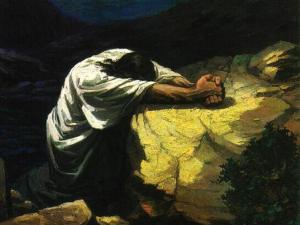
Then Jesus came with them to a place called Gethsemane, and said to His disciples, “Sit here while I go over there and pray.”  37 And He took with Him Peter and the two sons of Zebedee, and began to be grieved and distressed. 38 Then He said to them, “My soul is deeply grieved, to the point of death; remain here and keep watch with Me.”

39 And He went a little beyond them, and fell on His face and prayed, saying, “My Father, if it is possible, let this cup pass from Me; yet not as I will, but as You will.”  40 And He came to the disciples and found them sleeping, and said to Peter, “So, you men could not keep watch with Me for one hour?  41 “Keep watching and praying that you may not enter into temptation; the spirit is willing, but the flesh is weak.”

Jesus and His disciples came to the garden of Gethsemane. And when they arrived Jesus felt the need to pray; so He took with Him Peter, James and John and went a little further to pray, leaving the others. Then He felt an even deeper need to pray and went on by Himself. Hence, as it seems, there were three groups: the main group of disciples (minus the three), a little further there was Peter James and John, then further, only Jesus. All three groups were to be praying.

Notice that Jesus trusted Peter (and also James and John) to pray more than the others. But they turned out not to be trustworthy. They fell asleep. Notice also that in Mark’s gospel Jesus called Peter Simon. This I think was an indication that Jesus was frustrated with him—that he was not living up to his chosen name (Peter, the rock). But regardless of Jesus’ displeasure in His disciples, He continued to encourage them to keep watching and praying.

The gospel of Luke only recorded how an angel appeared to Him to strengthened Him. It may occur to you (as it does to me) what He needed strength for, and how could an angel help Him. Well, I don’t think angels have any difficulty with temptation; I think they are always strong and incapable of sin. They may not even understand it. Their mission is to help and encourage people with whatever they can do according to the will of God. I think what they did for Jesus was just to encourage Him to keep praying. And He did pray very fervently and was sweating drops of blood.

Jesus Told Peter that he Would Deny Him

Matthew 26:31-35 (also Mk. 14:27-31; Lu. 22:31-34; Jn. 13:21-24, 36-38)

Then Jesus said to them, “You will all fall away because of Me this night, for it is written, ‘I WILL STRIKE DOWN THE SHEPHERD, AND THE SHEEP OF THE FLOCK SHALL BE SCATTERED.’  32 “But after I have been raised, I will go ahead of you to Galilee.”  33 But Peter said to Him, “Even though all may fall away because of You, I will never fall away.” 34 Jesus said to him, “Truly I say to you that this very night, before a rooster crows, you will deny Me three times.”  35 Peter said to Him, “Even if I have to die with You, I will not deny You.” All the disciples said the same thing too.

After they partook of the Passover meal, and after Jesus led the ceremony regarding the elements (the bread as His body and the wine as His blood), while they were still at the table, He began revealing to the disciples that they would all fall away from Him. And He backed up His prediction from the Scriptures (in Zechariah 13:7).

It is amazing that Peter and all the others did not believe what Jesus said—even though he quoted from the prophet Zechariah. Apparently, they did not regard the Scriptures as the absolute, true word of God. And it appears that Peter was the most defiant about not denying Him. for he said that even if all the rest of His disciples fall away, he would never fall away. Hence he must have thought of himself as being the strongest in resisting this evil.

But Jesus quickly set Peter straight, telling him that he would definitely deny Him three times that very night. And did Peter change his position? No. He still remained certain in his supposed loyalty. It was amazing how all the disciples’ determination would not be strong enough.

The gospel of Luke (Lu. 22:31-34) has a little different account; bringing Satan into the matter. Jesus said to Peter (note: using the name Simon instead of Peter):

“Simon, Simon, behold, Satan has demanded permission to sift you like wheat;  32 but I have prayed for you, that your faith may not fail; and you, when once you have turned again, strengthen your brothers.”  33 But he said to Him, “Lord, with You I am ready to go both to prison and to death!” 34 And He said, “I say to you, Peter, the rooster will not crow today until you have denied three times that you know Me.”

Notice here that Jesus did not pray that Peter would resist falling away (for it was already prophesied); rather that when he does stumble that his faith would not fail (that is, not fail completely). And he prays also that when he repents and turns back, he would strengthen his brothers. Hence Jesus sees that Peter will be the leader that he was meant to be.

John’s gospel is also different than the others. In John 13:36, when Peter said to Jesus, “Lord, where are You going?” this is no doubt in response to what He said earlier (in verse 33), “Where I am going, you cannot come.” He was maybe referring to His death, but more likely to His ascension after His death and resurrection.

So here, Peter wanted to go with Him and die with Him if it came to that. But when Jesus said (in verse 36) “Where I go, you cannot follow me now, but you will follow Me later,” I think that Jesus was saying that they would eventually die for Him and then also be resurrected and go to heaven—just as He would.

Then, of course, when Peter insisted on his loyalty, Jesus had to give him the bad news: that he would deny Him three times. These words are found in all four gospels; and unfortunately, is what Peter has been most known for.

Peter Gets His Feet Washed

John 13:5-11

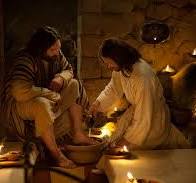
Then He poured water into the basin, and began to wash the disciples’ feet and to wipe them with the towel with which He was girded. 6 So He came to Simon Peter. He said to Him, “Lord, do You wash my feet?” 7 Jesus answered and said to him, “What I do you do not realize now, but you will understand hereafter.”  8 Peter said to Him, “Never shall You wash my feet!” Jesus answered him, “If I do not wash you, you have no part with Me.”  9 Simon Peter said to Him, “Lord, then wash not only my feet, but also my hands and my head.” 10 Jesus said to him, “He who has bathed needs only to wash his feet, but is completely clean; and you are clean, but not all of you.”  11 For He knew the one who was betraying Him; for this reason He said, “Not all of you are clean.”

That evening, when the Passover was ready, and when they all were seated, Jesus suddenly got up, wrapped a towel around His waist, poured water into a basin and began to wash His disciples’ feet.

Peter (and I think all of the disciples) was embarrassed and shocked that Jesus would stoop so low as to wash their feet. But Jesus had a different purpose in mind than mere physical washing. He was by this act cleansing them spiritually. When Jesus said to Peter “What I do you do not realize now, but you will understand hereafter” and also when He said, “If I do not wash you, you have no part with Me,” these words were to indicate to them a spiritual cleansing, so that they would be acceptable to God. I’m sure they did not fully realize His actions, but later they would.

Peter here, after Jesus said to him, “If I do not wash you, you have no part with Me,” was eager to have Jesus wash him—all of him; for he very much wanted to have fellowship with Jesus and come into His kingdom.

But Jesus not only was demonstrating a spiritual cleansing, but also a lesson in humble service; for in verses 14 and 15 He said that He as their Lord and Teacher was giving them an example to follow (read 1 Pt. 5:3).

Peter Questions Jesus about the End of the Age

Mark 13:3-5 (also Matt. 24:3; Lu. 21:7)

As He was sitting on the Mount of Olives opposite the temple, Peter and James and John and Andrew were questioning Him privately, 4 “Tell us, when will these things be, and what will be the sign when all these things are going to be fulfilled?”

From Jesus triumphal entry and His cursing of the fig tree, He continued His teaching ministry during His last days in Jerusalem. Here is a list of some of the topics on which Jesus taught.

  • His authority—as it was questioned by the Jewish elders
  • Three parables
  • About paying taxes to Caesar
  • No marriage in heaven
  • The greatest commandment
  • Seven woes on the Pharisees
  • The widow’s offering
  • Signs of the end times

This last point is where we are now. Jesus was near the temple sitting on the Mount of Olives. Some of His disciples were admiring the temple’s beautiful stones; and then Jesus began to tell them that soon it all would be torn down.

Then Peter (and also James and John and Andrew) were asking Him when these things would happen and what would be the sign of the end of the age. I think Jesus was ready and eager to reveal these things to them; for He spent all of Matthew 24 and 25 (and all of Mark 13, and Luke 21:5-38) speaking in great detail about these things. We have no record during His teaching of any questions or comments from Peter or any of the disciples on this subject of future things. Hence, I imagine that they were intently listening to every word.

Peter’s Lesson of Faith

Mark 11:20-23 (also Matt. 21:18-22)

As they were passing by in the morning, they saw the fig tree withered from the roots up.  21 Being reminded, Peter said to Him, “Rabbi, look, the fig tree which You cursed has withered.” 22 And Jesus answered saying to them, “Have faith in God.  23 “Truly I say to you, whoever says to this mountain, ‘Be taken up and cast into the sea,’ and does not doubt in his heart, but believes that what he says is going to happen, it will be granted him.

Just after Jesus’ triumphal entry into Jerusalem (Mk. 11:9-11), He went to Bethany to retire (since it was late in the day). Then early in the morning of the next day on their way back to Jerusalem, Jesus was hungry and saw a fig tree. But He discovered that it had no figs on it, only leaves. So, He cursed the tree so that it would die. Well, it wasn’t until the next morning that it was discovered by Peter that the entire tree had withered and died.

(In Matthew’s gospel it suggests that it happened all at once, even the withering of the tree. But I think the text in Mark is more accurate, or clearer as to what happened. The cursing of the tree and its death happened immediately when Jesus cursed it, but I think it wasn’t noticed until the next morning by Peter).

Peter was the one that noticed the withering of the tree and knew that it was caused by Jesus curse on it. Jesus then took the opportunity to give Peter a lesson of faith. Hence, Jesus was keenly aware that Peter needed this faith lesson, and Peter was eager to receive it—just as he did when he tried to walk on water (and he did for a while).

Jesus Tells Peter that He would Reign with Him

Matthew 19:27-28 (also in Mk. 10:28-31; Lu. 18:28-30)

Then Peter said to Him, “Behold, we have left everything and followed You; what then will there be for us?” 28 And Jesus said to them, “Truly I say to you, that you who have followed Me, in the regeneration when the Son of Man will sit on His glorious throne, you also shall sit upon twelve thrones, judging the twelve tribes of Israel.

Before this text there seemed to be a long stretch of time when Peter kept silent; at least nothing was recorded. However, Jesus ministry was constant (and I’m sure Peter and the others were taking everything in and being awed by what Jesus was doing). They traveled from village to village, and Jesus was teaching and healing many.

While on His way to Jerusalem for the last time, He encountered a rich young ruler who asked Him what he must do to inherit eternal life (Luke 19:16-26). When Jesus told him that he must keep the commandments, the man said that he had already kept them. But when Jesus said that he must also sell his possessions and give the money to the poor and follow Him, the ruler went away with a sad face because he knew he could not do that.

Then Jesus turned to His disciples and told them how hard it was for the rich to enter into heaven. He said that it is easier for a camel to go through the eye of a needle. The disciples were astonished and wondered who then could ever be saved. But Jesus came to their rescue and said, “All things are possible with God.”

At this point a light flashed in Peter’s head because he realized that he and his comrades, unlike the rich man, had left everything to follow Him.

Well, Jesus was more than willing to tell them what was to come for them. They would reign with Him on His throne (a reference to the earthly kingdom; but then later in heaven we all will reign forever with Him, Rev. 22:5).