Peter and John Brought Healing to a Man

Acts 3:1-10

Now Peter and John were going up to the temple at the ninth hour, the hour of prayer. 2 And a man who had been lame from his mother’s womb was being carried along, whom they used to set down every day at the gate of the temple which is called Beautiful, in order to beg alms of those who were entering the temple. 3 When he saw Peter and John about to go into the temple, he began asking to receive alms. 4 But Peter, along with John, fixed his gaze on him and said, “Look at us!” 5 And he began to give them his attention, expecting to receive something from them. 6 But Peter said, “I do not possess silver and gold, but what I do have I give to you: In the name of Jesus Christ the Nazarene — walk!” 7 And seizing him by the right hand, he raised him up; and immediately his feet and his ankles were strengthened. 8 With a leap he stood upright and began to walk; and he entered the temple with them, walking and leaping and praising God. 9 And all the people saw him walking and praising God; 10 and they were taking note of him as being the one who used to sit at the Beautiful Gate of the temple to beg alms, and they were filled with wonder and amazement at what had happened to him.

Everything in this text is pretty straight forward. But I have to say with great amazement that Peter (with John) acted just like Jesus would have done. And his healing ability was very Christlike—nothing lacking.

Peter the Great Evangelist

Acts 2:37-42

Now when they heard this, they were pierced to the heart, and said to Peter and the rest of the apostles, “Brethren, what shall we do?” 38 Peter said to them, “Repent, and each of you be baptized in the name of Jesus Christ for the forgiveness of your sins; and you will receive the gift of the Holy Spirit. 39 “For the promise is for you and your children and for all who are far off, as many as the Lord our God will call to Himself.” 40 And with many other words he solemnly testified and kept on exhorting them, saying, “Be saved from this perverse generation!” 41 So then, those who had received his word were baptized; and that day there were added about three thousand souls. 42 They were continually devoting themselves to the apostles’ teaching and to fellowship, to the breaking of bread and to prayer.

Here we have an immediate response by the people to Peter’s previous sermon—particularly when he said that they nailed Christ to the cross. They no doubt were convicted by the Holy Spirit who just came down to them.

When they asked Peter what to do, he said that they should repent and be baptized. And I take it that Peter did not separate repentance from baptism. He was not telling them to just be dunked under the water as an act of obedience; but to act out the meaning of baptism—that they would be buried and resurrected with Christ; hence, that they would be forgiven of their sins and receive the gift of the Holy Spirit. It may be that Peter explained to them more thoroughly what baptism means.

“The promise” (in verse 39) I think is both the receiving of the Holy Spirit and their salvation; for they could not be saved apart from the Holy Spirit.

The three thousand souls that were saved and added to the church is something hard to fathom. Where did they come from? Those in the upper room (120 persons) must have immediately gone out to evangelize others and then brought them together. How did it all happen so quickly? No doubt it was a revival that was spread quickly by the Holy Spirit as well as by all those who witnessed the Holy Spirit’s coming and Peter’s message.

Peter’s Upper Room Sermon

 Acts 2:14-36

But Peter, taking his stand with the eleven, raised his voice and declared to them: “Men of Judea and all you who live in Jerusalem, let this be known to you and give heed to my words. 15 “For these men are not drunk, as you suppose, for it is only the third hour of the day; 16 but this is what was spoken of through the prophet Joel:

17 ‘AND IT SHALL BE IN THE LAST DAYS,’ God says, ‘THAT I WILL POUR FORTH OF MY SPIRIT ON ALL MANKIND; AND YOUR SONS AND YOUR DAUGHTERS SHALL PROPHESY, AND YOUR YOUNG MEN SHALL SEE VISIONS, AND YOUR OLD MEN SHALL DREAM DREAMS; 18 EVEN ON MY BONDSLAVES, BOTH MEN AND WOMEN, I WILL IN THOSE DAYS POUR FORTH OF MY SPIRIT. And they shall prophesy. 19 ‘AND I WILL GRANT WONDERS IN THE SKY ABOVEAND SIGNS ON THE EARTH BELOW, BLOOD, AND FIRE, AND VAPOR OF SMOKE. 20 ‘THE SUN WILL BE TURNED INTO DARKNESSAND THE MOON INTO BLOOD, BEFORE THE GREAT AND GLORIOUS DAY OF THE LORD SHALL COME. 21 ‘AND IT SHALL BE THAT EVERYONE WHO CALLS ON THE NAME OF THE LORD WILL BE SAVED.’

22 “Men of Israel, listen to these words: Jesus the Nazarene, a man attested to you by God with miracles and wonders and signs which God performed through Him in your midst, just as you yourselves know —  23 this Man, delivered over by the predetermined plan and foreknowledge of God, you nailed to a cross by the hands of godless men and put Him to death. 24 “But God raised Him up again, putting an end to the agony of death, since it was impossible for Him to be held in its power. 25 “For David says of Him,

‘I SAW THE LORD ALWAYS IN MY PRESENCE; FOR HE IS AT MY RIGHT HAND, SO THAT I WILL NOT BE SHAKEN. 26 ‘THEREFORE MY HEART WAS GLAD AND MY TONGUE EXULTED; MOREOVER MY FLESH ALSO WILL LIVE IN HOPE; 27 BECAUSE YOU WILL NOT ABANDON MY SOUL TO HADES, NOR ALLOW YOUR HOLY ONE TO UNDERGO DECAY. 28 ‘YOU HAVE MADE KNOWN TO ME THE WAYS OF LIFE; YOU WILL MAKE ME FULL OF GLADNESS WITH YOUR PRESENCE.’

29 “Brethren, I may confidently say to you regarding the patriarch David that he both died and was buried, and his tomb is with us to this day. 30 “And so, because he was a prophet and knew that GOD HAD SWORN TO HIM WITH AN OATH TO SEAT one OF HIS DESCENDANTS ON HIS THRONE, 31 he looked ahead and spoke of the resurrection of the Christ, that HE WAS NEITHER ABANDONED TO HADES, NOR DID His flesh SUFFER DECAY. 32 “This Jesus God raised up again, to which we are all witnesses. 33 “Therefore having been exalted to the right hand of God, and having received from the Father the promise of the Holy Spirit, He has poured forth this which you both see and hear. 34 “For it was not David who ascended into heaven, but he himself says:

‘THE LORD SAID TO MY LORD,”SIT AT MY RIGHT HAND, 35 UNTIL I MAKE YOUR ENEMIES A FOOTSTOOL FOR YOUR FEET.”‘

36 “Therefore let all the house of Israel know for certain that God has made Him both Lord and Christ — this Jesus whom you crucified.”

This is the second time that Peter stood up to preach to the people in the upper room. This time his sermon was much longer. First, as an introduction, Peter told the crowd that the people who spoke in other languages (v. 4) were not drunk as they thought. He explained that what was spoken (in other languages) was from the prophet Joel (in Joel 2:28-32).

These words (from verses 17 to 21) are prophetic (from Joel) for their present time, and also for the future: for the seven years of God’s judgment (the Tribulation), and then for the millennial kingdom.

Then in verse 22, Peter began preaching about Jesus; that He was crucified, but then raised up. Peter gave them a familiar quote from David (Ps. 16:10), and then went on to explain that it was not he (David) that was being spoken of, but his descendant Christ. He, not David, is now in heaven at God’s right hand.

Peter Directs the Disciples to Elect A Replacement for Judas

Acts 1:12-16

Then they returned to Jerusalem from the mount called Olivet, which is near Jerusalem, a Sabbath day’s journey away. 13 When they had entered the city, they went up to the upper room where they were staying; that is, Peter and John and James and Andrew, Philip and Thomas, Bartholomew and Matthew, James the son of Alphaeus, and Simon the Zealot, and Judas the son of James. 14 These all with one mind were continually devoting themselves to prayer, along with the women, and Mary the mother of Jesus, and with His brothers.

15 At this time Peter stood up in the midst of the brethren (a gathering of about one hundred and twenty persons was there together), and said, 16 “Brethren, the Scripture had to be fulfilled, which the Holy Spirit foretold by the mouth of David concerning Judas, who became a guide to those who arrested Jesus.

Sometime after Jesus performed the miracle of fish on the Sea of Galilee in front of the seven disciples, and after Jesus encouraged Peter to continue to follow Him in discipleship (Jn.  21:1-23), He gathered all eleven of His disciples together on the Mount of Olives where He spoke His last words to them and then ascended to heaven (Acts 1:4-9).

The disciples then, according to Jesus command, immediately went to Jerusalem (a Sabbath day’s journey) to the upper room, where they were staying. We don’t know what kind of arrangements they had made with the owner; whether they purchased the room, or were renting it, or he was just letting them stay there. But we know that they ate the last supper there; and it was also where Jesus appeared to them after His resurrection. Now they would stay there as a place of safety, and to wait and pray until the day of Pentecost (vv. 4-5).

It appears from the text that the upper room was rather large; for one hundred and twenty people were gathered there, waiting for the coming Holy Spirit.

As for Peter, he had apparently felt the strong call of God to lead this group of disciples. And here it seems that he was led by God to give his first sermon, mainly having to do with electing another man to replace Judas. And as it happened by lot, Matthias was the one who was divinely chosen (verse 26).

Peter Looks Ahead to His Death

John 21:18-22

“Truly, truly, I say to you, when you were younger, you used to gird yourself and walk wherever you wished; but when you grow old, you will stretch out your hands and someone else will gird you, and bring you where you do not wish to go.”  19 Now this He said, signifying by what kind of death he would glorify God. And when He had spoken this, He said to him, “Follow Me!”

20 Peter, turning around, saw the disciple whom Jesus loved following them; the one who also had leaned back on His bosom at the supper and said, “Lord, who is the one who betrays You?” 21 So Peter seeing him said to Jesus, “Lord, and what about this man?” 22 Jesus said to him, “If I want him to remain until I come, what is that to you? You follow Me!” 

This is the last mention of Peter from the gospels. Jesus was telling him that he would die a martyr’s death, but not until he was old. Peter being a young man would have plenty of time to serve God.

You remember that Peter declared to Jesus that he was ready to die for Him. Well, Jesus was telling him now that he would later in life get that opportunity.

Then an unlikely thing happened. Peter pointed to John that was nearby, and said, what about him? Will he also die for You? Peter, even at the last encounter with Jesus, was showing his immaturity. I think he was just a little jealous of John—of his close relationship with Jesus (and it seemed that the disciples were constantly debating who was the greatest). But Jesus quickly shut it down. He wanted Peter to focus on his own ministry, and what he himself would do for Him. He should have no business knowing what kind of ministry John would have and whether he would die for Him of not.

Jesus Questioned Peter’s Love for Him

John 21:15-17

So when they had finished breakfast, Jesus said to Simon Peter, “Simon, son of John, do you love Me more than these?” He said to Him, “Yes, Lord; You know that I love You.” He said to him, “Tend My lambs.”  16 He said to him again a second time, “Simon, son of John, do you love Me?” He said to Him, “Yes, Lord; You know that I love You.” He said to him, “Shepherd My sheep.”  17 He said to him the third time, “Simon, son of John, do you love Me?” Peter was grieved because He said to him the third time, “Do you love Me?” And he said to Him, “Lord, You know all things; You know that I love You.” Jesus said to him, “Tend My sheep.

After the glorious time the disciples had with Jesus, eating breakfast and sharing their love for each other, Jesus began to direct His words toward Peter; and I suppose, the other disciples, knowing that Jesus wanted to talk to Peter alone, busied themselves with the large catch of fish.

Jesus was immediately very direct. He said to Peter, “Simon, son of John, do you love Me more than these?” I’m not sure that Jesus ever addressed Peter that way. It was not a casual address. I’m sure Peter knew that Jesus had something important to say to him. And indeed, He did. He questioned his love for Him. By saying to Peter, do you love me more than these, he was questioning whether Peter loved Him more than fish—or more than the business of fishing. Had Peter forgotten Jesus’ call to Him to be fishers of men? Jesus wanted to remind him—strongly remind him—of what his real calling was. It was to tend His lambs and to shepherd His sheep.

Well Peter was grieved because Jesus had seemed to doubt Peter’s love for Him. But Jesus did not relent. He was persistent at His attempt to enlist Peter’s ongoing discipleship.

Peter and Jesus had Fish Together

John 21:1-11

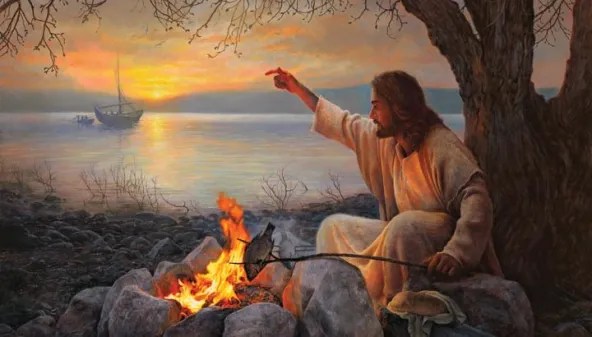
 After these things Jesus manifested Himself again to the disciples at the Sea of Tiberias, and He manifested Himself in this way. 2 Simon Peter, and Thomas called Didymus, and Nathanael of Cana in Galilee, and the sons of Zebedee, and two others of His disciples were together. 3 Simon Peter said to them, “I am going fishing.” They said to him, “We will also come with you.” They went out and got into the boat; and that night they caught nothing.

4 But when the day was now breaking, Jesus stood on the beach; yet the disciples did not know that it was Jesus. 5 So Jesus said to them, “Children, you do not have any fish, do you?” They answered Him, “No.” 6 And He said to them, “Cast the net on the right-hand side of the boat and you will find a catch.” So they cast, and then they were not able to haul it in because of the great number of fish. 7 Therefore that disciple whom Jesus loved said to Peter, “It is the Lord.” So when Simon Peter heard that it was the Lord, he put his outer garment on (for he was stripped for work), and threw himself into the sea. 8 But the other disciples came in the little boat, for they were not far from the land, but about one hundred yards away, dragging the net full of fish.

9 So when they got out on the land, they saw a charcoal fire already laid and fish placed on it, and bread. 10 Jesus said to them, “Bring some of the fish which you have now caught.”  11 Simon Peter went up and drew the net to land, full of large fish, a hundred and fifty-three; and although there were so many, the net was not torn.

Here in this story is one of the last earthly appearances of Jesus. And it is much like an earlier story (in Luke 5:1-11). In that story, about three years earlier, Jesus told Peter to go out into the deep water and let down his net for a catch. And Peter said, “Master, we worked hard all night and caught nothing, but I will do as You say…” And, as you remember, they caught so many fish that their nets began to break. And you remember also that Peter was amazed and also humiliated at his sinfulness (unbelief), so much so that he didn’t feel worthy to be in the presence of Jesus.

In this story, three years later, the situation is almost exactly the same, except that the nets did not break. And when John said to Peter, “It is the Lord,” he had the exact opposite reaction. Instead of feeling ashamed of his sinful unbelief and wanting to go away from Jesus, he quickly made himself more presentable (he put on an outer garment), jumped out of the boat, and ran through the water to meet Jesus. What was the difference? The difference, no doubt, was whatever he gained from his meeting with Jesus after His resurrection (Lu. 24:34). It was a sanctification, a renewal of spiritual strength and new life.

Jesus Appeared to Peter

John 20:1-10 (also Mk. 16:5-8; Lu. 24:1-12)

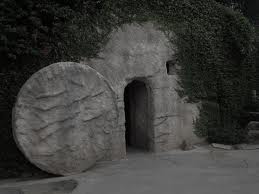
Now on the first day of the week Mary Magdalene came early to the tomb, while it was still dark, and saw the stone already taken away from the tomb. 2 So she ran and came to Simon Peter and to the other disciple whom Jesus loved, and said to them, “They have taken away the Lord out of the tomb, and we do not know where they have laid Him.” 3 So Peter and the other disciple went forth, and they were going to the tomb. 4 The two were running together; and the other disciple ran ahead faster than Peter and came to the tomb first; 5 and stooping and looking in, he saw the linen wrappings lying there; but he did not go in. 6 And so Simon Peter also came, following him, and entered the tomb; and he saw the linen wrappings lying there,  7 and the face-cloth which had been on His head, not lying with the linen wrappings, but rolled up in a place by itself. 8 So the other disciple who had first come to the tomb then also entered, and he saw and believed. 9 For as yet they did not understand the Scripture, that He must rise again from the dead. 10 So the disciples went away again to their own homes.

I think this passage in John contributes the most to our study of Peter, but Mark and Luke will help to fill in the gaps. As we can see in John’s gospel, only Mary Magdelene is mentioned; and she may have been the leading character, but there were actually three women that went to the tomb (Mk. 16:1): Mary Magdalene, Mary the mother of James, and Salome. And when these three arrived they found the stone of the tomb rolled away. Then, when they entered the tomb, they found it empty, and two angels said to them, “Why do you seek the living One among the dead? 6 “He is not here, but He has risen. Remember how He spoke to you while He was still in Galilee, 7 saying that the Son of Man must be delivered into the hands of sinful men, and be crucified, and the third day rise again” (Lu. 24:5-7).

And Mark’s gospel also tells us that one of the angel’s said to them, “But go, tell His disciples and Peter, ‘He is going ahead of you to Galilee; there you will see Him, just as He told you’” (Mk. 16:7).

So, the three women ran to tell the disciples what had happened; and apparently, Mary Magdalene outran the other women and told Peter (and also John) what the angels had said.

Well, as you can read in the John text, Peter and John ran to the tomb and discovered that it was empty just as Mary had told them. So, it appears that besides the three women, Peter was the next (and then John) to see that Jesus was resurrected. I have a feeling that God wanted Peter to be the first disciple to discover His resurrection; and according to Luke 24:34, though we don’t have any direct account of it, it seems that he was also the first disciple that Jesus appeared to. First, He appeared to Mary Magdalene (Jn. 20:14-18); next, he appeared to the other two women (Matt. 28:9-10); third, according to the Scripture record, He appeared to the two men on the road to Emmaus (Lu. 24:13-33); then, these two Emmaus disciples met with the eleven disciples at Jerusalem, and they all happily declared the news of Jesus resurrection and that he appeared to Simon (Lu. 24:34).

And though we don’t know exactly when Jesus and Peter met together, I’m sure it was a happy reunion, as Peter had much to confess, and when Jesus, I’m sure, assured Peter of His love and forgiveness toward him.

Peter Denied Jesus Three Times

Matthew 26:69-75 (also Mk. 14:66-72; Lu. 22:55-62; Jn. 18:25-27)

Now Peter was sitting outside in the courtyard, and a servant-girl came to him and said, “You too were with Jesus the Galilean.” 70 But he denied it before them all, saying, “I do not know what you are talking about.” 71 When he had gone out to the gateway, another servant-girl saw him and said to those who were there, “This man was with Jesus of Nazareth.” 72 And again he denied it with an oath, “I do not know the man.” 73 A little later the bystanders came up and said to Peter, “Surely you too are one of them; for even the way you talk gives you away.” 74 Then he began to curse and swear, “I do not know the man!” And immediately a rooster crowed. 75 And Peter remembered the word which Jesus had said, “Before a rooster crows, you will deny Me three times.” And he went out and wept bitterly.

In this account of Peter’s three denials, it appears that all four gospels generally agree to the details. Peter (and possibly John) was standing (and also sitting) in the courtyard with slaves and officers, warming themselves around a charcoal fire, waiting for what was to be done with Jesus as the high priest was questioning Him (Jn. 18:19-24).

Then suddenly as they were sitting around the fire, a servant-girl, followed by another servant-girl, came and accused Peter of being one of Jesus’ followers. And Peter denied it each time. Then about an hour later a bystander accused him and he again denied it. And it seemed that with each accusation Peter’s denial became stronger, And on the third denial, by the bystander, Peter even began to curse and swear—trying to make his denial more believable.

Then, without warning, after Peter’s third denial a rooster crowed, and Peter remembered what Jesus said, “Before a rooster crows, you will deny Me three times.” Also, as Peter was remembering what Jesus said, he turned and saw Jesus looking straight at him. At that point Peter began to weep, and he ran out of the courtyard still weeping bitterly.

We hear nothing more about Peter or any of the disciples until after Jesus was resurrected. But I think that at the point of Peter’s weeping, this was the point of his repentance. And from that day to His resurrection, I think it may be assumed that they all were repentant of their betrayal of Jesus, were morning His death, and were very confused.

Peter Followed Jesus at a Distance

Matthew 26:57-58 (also Mk. 14:50-55; Lu. 22:54-56; Jn. 18:12-17)

Those who had seized Jesus led Him away to Caiaphas, the high priest, where the scribes and the elders were gathered together. 58 But Peter was following Him at a distance as far as the courtyard of the high priest, and entered in, and sat down with the officers to see the outcome.

Of the four gospels Luke was somewhat the same as Matthew, but Mark’s and John’s gospel had more to add. Mark included a young man (probably himself) who was taken captive but managed to escape naked when he pulled free of his loose clothing. John’s gospel includes another disciple (also, probably John himself) who was following Jesus with Peter, who helped Peter to enter with him into the courtyard of the high priest.

For some reason Peter was unable to enter the courtyard and stood at the doorway before John helped him come in; for John knew the high priest and he also had some influence with the doorkeeper. Hence I take it that John was more friendly with people, and Peter was not. But we don’t really know why the doorkeeper would not let him in.