In this article we are interested in the marriage between Christ (the Lamb) and the church, which takes place in heaven after the bema seat. And since this marriage is patterned after a typical ancient Jewish wedding, we will present it as such. First we will show all the events of a typical Jewish wedding; then we will describe those same events in theological terms showing our marriage with Christ the Lamb.
The marriage of a typical Jewish wedding.It all begins by an arrangement of a betrothal period and payment of the wedding by the father of the groom. When these arrangements are made and the price is paid, the marriage covenant is established and is binding.
After the marriage covenant is made the groom returns to the father’s house. During this time of separation, the groom is busy preparing a place for his betrothed, and she is also preparing herself for him.
After a period of time known only by the groom and his father, the groom comes unexpectantly to get his bride. But he will warn her with a shout, something like, “Behold the bridegroom comes!”
Within four days of the wedding, the bride and sometimes the groom will undergo a ritual bath called the mikuah—which is for both outer and inner cleansing.
Each Jewish wedding ceremony has been different, but the most basic practice has been the exchange of rings symbolizing purity and honesty in the relationship.
After the wedding ceremony the happy couple retires to the bridal chamber to consummate the wedding. Shortly after there will be a big celebration of the couple’s first union.
The last event is the marriage feast, which usually lasts for an entire week.
Our marriage with Christ the Lamb.Just as with a Jewish betrothal period, our marriage with Christ begins with His Father loving us and paying the price of His own Son’s death. If we chose to believe in Him we enter into an eternal marriage covenant with Him.
After Christ died on the cross for our sins, He left this earth and is now preparing a place for us in heaven (Jn. 14:23). And we, His betrothed should be preparing ourselves for Him.
Just as the groom comes unexpectantly to get the bride in the Jewish wedding, Jesus will come from heaven to get us and bring us to His Father’s house in heaven. He will resurrect the dead believers first, and then rapture the living ones (Jn. 14:2-3; 1 Thess. 4:17).
The next event after we arrive in heaven is the cleansing. In the Jewish wedding the cleansing was by a ritual bath, but in our marriage to Christ it will be a cleansing by fire—the bema judgment, where all our hidden motives will be revealed (1 Cor. 4:4-5).
Both the wedding ceremony and the consummation of the marriage will be very private and sacred. Since our bodies will be transformed, our relationship and communion with Him will be very different—very good but very different.
The marriage feast in a Jewish wedding was for one week. But our marriage with Christ will last for one-thousand years, all during the millennial kingdom—after which the new bride (the church) and groom (Jesus) will enjoy each other in heavenly bliss forever.
The bema judgment, or as it is sometimes called, the judgment seat of Christ will probably occur just after the Rapture and our transformation. And I am guessing that it will be one of those timeless events. That is, things that happen in a few days or even a few years in our time will take only a second in God’s time. Really, since Christ will be the only judge, and since He will have to judge every Christian for all of their works, in our time this could take over a thousand years. But since God is God and He will not be restricted by time, it will take only a second—or less.
Now this bema judgment (bema, indicating an elevated judgment platform) will happen somewhere in heaven—we don’t know where. And the subjects of the judgment are the church—those who will be raptured. All others who are not of the church will, I suppose, be judged at another time and place. And, as I said, Christ is our judge.
As for the basis of this judgment; it will not be according to our sins, for they have already been paid for on the cross, and His blood has already cleansed us of all sins (1 Jn. 1:7). Praise God for that! But we will be judged according to our deeds, whether they are good or bad. Our bad deeds will have no value for His kingdom, so we will get no reward for those. But our good deeds, whatever value they have for His kingdom, we will be rewarded on that basis (read 1Cor. 3:10-15).
Now, as for what reward we will get, that is hard to say. God has not revealed that specifically. Certainly, He will judge us according to our motives and our attitude toward Him and toward others. And we know that He is a perfect judge and He knows our heart. There has been much said in Scripture about crowns that we will get as rewards. There has also been things said about rewards of land, rulership, and of responsibilities. But I think the best reward we will want to receive is to hear Jesus say to us, “Well done My good and faithful servant.” Also, in the end of things, whatever glory we receive from Him, we will so much desire to reflect that glory back to Him—that all things will be to the praise of His glory (Eph. 1:12).
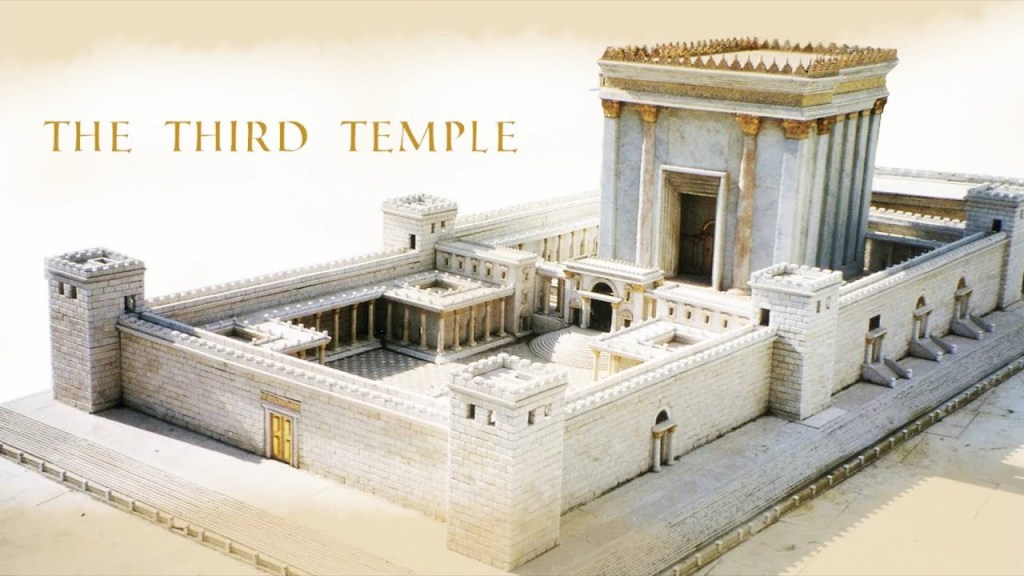
My last blog, if you have been following along, was about the war of Gog and Magog. And I am suggesting here that after that war Israel will be starting to make plans to build the third temple—with the Antichrist wanting to take a leadership roll in it. But none of us really know for sure all the details of what will happen or the order of the events. But anyway, here is my post…
As the people of Israel (after the Ezekiel war) are busy burying the dead bodies and are in the process of burning the weapons, they will have a chance to think about what comes next. Of course, we know now how we think about the Antichrist—he is evil! But the Jews and the world at that time don’t know him. They think he is wonderful and a man of peace. Since he and the EU were not involved in the war, and were in fact against it, they probably will see him as a peacemaker and a good man. They will also see him as a religious person—maybe even a Christian—since he will be taking steps to be unified with the new global religion. More importantly, he will at this time be cultivating a friendship with Israel, and very soon will announce his seven-year peace plan and the building of the third temple—and I’m sure the rumors are spreading.
As for the temple, what do you think Israel and the world are thinking about it? Are they in favor of it?
Let’s take the Jews first. There is quite a mixed bag of Jewish beliefs. Mainstream Orthodox Jews, which is by far the largest group, want the temple, but they believe it can only be built by the coming Messiah. Another group called Ultra-orthodox Judaism, a much smaller group, believe they already have a command of God (Ex. 25:8) to build the temple. And there are already several organizations that are in the process of carrying out this order. Then there are a few more liberal denominations that see no need for the temple—and especially for animal sacrifices.
True Christians, of course, see no need for a temple, since every Christian believes that he is a temple and God dwells in him (1 Cor. 3;16). Even so, we see the building of a temple as prophetical; and so, it is a sign that His coming is near.
The Antichrist may not know all of what his future is, but I’m sure Satan will fill him in as to what his role is; and so, he will have somewhat of a plan to sign a peace agreement and also to take charge of building the temple for the Jews. He may even know what he will do half-way through the seven-year peace plan.
There is so much more we could say about the progress made for the building of the temple and about all the obstacles they are encountering; but we will put that off for another time.
However, I’m thinking that if mainstream Orthodox Judaism comes to believe that this great man of peace is their Messiah, everything may very quickly fall into place.





 Stephen Nielsen