7 so that the proof of your faith, being more precious than gold which is perishable, even though tested by fire, may be found to result in praise and glory and honor at the revelation of Jesus Christ;
Their trials will be used to test their faith to see if it is genuine; and if it is, it is something that will bring them much praise and glory and honor when He rewards them (1 Thess 4:13-18; 1 Cor. 3:13-14).
6 In this you greatly rejoice, even though now for a little while, if necessary, you have been distressed by various trials,
Peter tells them that they should be glad in their sure salvation and in the protection God will give them, even in the trials they are having to endure. But they are to know that the trials will only last for a little while (Some of these trials were from their persecution that came during the reign of Nero, who blamed the burning of Rome on Christians.).
5 who are protected by the power of God through faith for a salvation ready to be revealed in the last time.
Not only is our inheritance protected and preserved eternally; we are protected by the power of God until we are glorified and arrive in heaven. We may die before our glorification (a temporary setback), but when He comes we will be resurrected and glorified (1Cor. 15:52; 1 Thess. 4:15-17).
4 to obtain an inheritance which is imperishable and undefiled and will not fade away, reserved in heaven for you,
In our living hope we have confidence in God that we will receive a great inheritance in heaven, which is imperishable (will not decay; it will last forever) and undefiled (will not be corrupted by evil) and will not fade away (like flowers that wither).
This inheritance is everything that belongs to our new life of glory—all the things that make us like Christ. We have some of those things now, like all the fruits of the Spirit. In heaven those things will be much more pronounced and free of corruption. We will also have a body that is perfect and will not age. And we will have great companionship with God and Christ and all the saints. And our rewards, of course, will be delightful.
3 Blessed be the God and Father of our Lord Jesus Christ, who according to His great mercy has caused us to be born again to a living hope through the resurrection of Jesus Christ from the dead,
Here Peter exhorts believers to bless, or to praise (NIV version) God for His great mercy, a mercy that has reached down in love and forgiveness, to give us new birth (to be a new creature in Christ, 2 Cor. 5:17). In this new birth we have a “living hope.’ This is a hope in what we will receive in our glorification at the Rapture—when we see Him in His glory (1 Jn. 3:2). This living hope is “through” the resurrection of Jesus Christ from the dead; that is, His resurrection gives us hope in our resurrection; hence, it makes our faith valid (1 Cor.15:17). Likewise, because He is resurrected to life, we also will live in a resurrected body (Jn. 11:25, 26).
2 according to the foreknowledge of God the Father, by the sanctifying work of the Spirit, to obey Jesus Christ and be sprinkled with His blood: May grace and peace be yours in the fullest measure.
Here in verse two, Peter introduces these alien recipients as people who have been chosen according to the foreknowledge of God the Father. This means that God predetermined their salvation; and He did it by the sanctifying work of His Spirit, by which He made them holy (justified and righteous by His blood). But in addition to their justification, they were chosen to daily obey Jesus Christ by faith (Rom. 1:5), and also, to obtain a daily cleaning from sin, which Peter calls here to be “sprinkled with His blood.” This daily cleansing may be accomplished by a regular confession of sins, with the promise of His forgiveness and cleansing (1 Jn. 1:9), and by our understanding, in our faith, that the Lord automatically and continually forgives and cleanses His own (1 Jn. 1:7).
And so, according to what God has declare to us, we may have, and are welcome to have, a full measure of God’s grace and peace.
To those who reside as aliens, scattered throughout Pontus, Galatia, Cappadocia, Asia, and Bithynia, who are chosen…
In this first verse of 1 Peter, we see that Peter was definitely one of Jesus’ apostles. In fact, he was the first to be chosen, along with his brother Andrew. When Jesus first saw them they were fishing in the Sea of Galilee, and He said to them, “Follow Me, and I will make you fishers of men” (Matt. 4:18-20).
Peter refers to the recipients of this letter as “aliens.” That word is used because they are true believers who by their conversion to Christ have their citizenship not of this earth but in heaven (Phil. 3:20).Peter later on (in 2:11) also calls them “aliens and strangers,” an even stronger term, depicting their excellent behavior among Gentiles (but strange to them, 2:12).
The ones he is sending this letter to are “chosen” believers who are scattered throughout Pontus, Galatia, Cappadocia, Asia, and Bithynia—which are areas you can easily find on any bible map, generally located between the Black Sea and the Mediterranean Sea.
But on the contrary, seeing that I had been entrusted with the gospel to the uncircumcised, just as Peter had been to the circumcised 8 (for He who effectually worked for Peter in his apostleship to the circumcised effectually worked for me also to the Gentiles), 9 and recognizing the grace that had been given to me, James and Cephas and John, who were reputed to be pillars, gave to me and Barnabas the right hand of fellowship, so that we might go to the Gentiles and they to the circumcised. 10 They only asked us to remember the poor — the very thing I also was eager to do.
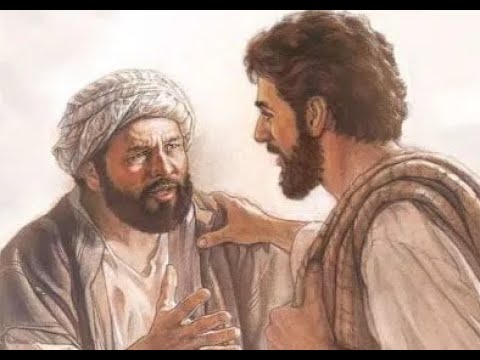
11 But when Cephas came to Antioch, I opposed him to his face, because he stood condemned. 12 For prior to the coming of certain men from James, he used to eat with the Gentiles; but when they came, he began to withdraw and hold himself aloof, fearing the party of the circumcision. 13 The rest of the Jews joined him in hypocrisy, with the result that even Barnabas was carried away by their hypocrisy. 14 But when I saw that they were not straightforward about the truth of the gospel, I said to Cephas in the presence of all, “If you, being a Jew, live like the Gentiles and not like the Jews, how is it that you compel the Gentiles to live like Jews?
Here we will look at one last passage in Galatians having to do with Peter. I will make two comments. Even though Peter was used by God to begin a revival of the Gentiles, he was mainly a minister to the Jews (the circumcised), and Paul to the Gentiles.
Secondly, Paul thought that he needed to write about what happened with Peter at Antioch. Yes, Paul would not let Peter off the hook. He was guilty of fearing the more uppity-up Jews, choosing to eat only with them in order to make a favorable impression on them. In so doing he was guilty of hypocrisy. He was also sinning against all those he was wrongly influencing—other Jews (even Barnabus), and also believing Gentiles. But his sin was mainly toward God.
I would say that Peter, by Paul’s confrontation of him, had probably changed his hypocritical behavior. We all get caught up in this kind of fear and hypocrisy, and we need to check ourselves. We ought always to treat everyone the same, with love, regardless of what others may think. Jesus is our best example.
Some men came down from Judea and began teaching the brethren, “Unless you are circumcised according to the custom of Moses, you cannot be saved.” 2 And when Paul and Barnabas had great dissension and debate with them, the brethren determined that Paul and Barnabas and some others of them should go up to Jerusalem to the apostles and elders concerning this issue. 3 Therefore, being sent on their way by the church, they were passing through both Phoenicia and Samaria, describing in detail the conversion of the Gentiles, and were bringing great joy to all the brethren. 4 When they arrived at Jerusalem, they were received by the church and the apostles and the elders, and they reported all that God had done with them. 5 But some of the sect of the Pharisees who had believed stood up, saying, “It is necessary to circumcise them and to direct them to observe the Law of Moses.”
6 The apostles and the elders came together to look into this matter. 7 After there had been much debate, Peter stood up and said to them, “Brethren, you know that in the early days God made a choice among you, that by my mouth [10:1-48] the Gentiles would hear the word of the gospel and believe. 8 “And God, who knows the heart, testified to them giving them the Holy Spirit, just as He also did to us; 9 and He made no distinction between us and them, cleansing their hearts by faith. 10 “Now therefore why do you put God to the test by placing upon the neck of the disciples a yoke which neither our fathers nor we have been able to bear? 11 “But we believe that we are saved through the grace of the Lord Jesus, in the same way as they also are.”
12 All the people kept silent, and they were listening to Barnabas and Paul as they were relating what signs and wonders God had done through them among the Gentiles.
We have seen in Acts 10:1 to 11:18 how Peter was used by God to begin a revival of the Gentiles. Then in Acts 13 and 14, Paul and Barnabus were sent out by the church (and the Holy Spirit) on a missionary journey; and they discovered that both Jews and Gentiles were believing in Jesus.
But here (in chapter 15) God allowed Satan to put Him to the test, as some of the Pharisees were saying that unless the Gentiles were circumcised they could not be saved. Hence, the apostles and elders were somewhat concerned about this matter—enough to debate over it.
However, both Peter and Paul closed the debate. Peter made his case that the Gentiles were saved based on what he had witnessed in Acts 10:1 through 11:18. Likewise, Paul and Barnabus also had great stories to tell of how God did great signs and wonders among the Gentiles in all the cities that they went to on their missionary journey.
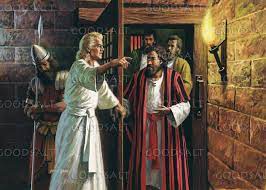
Now about that time Herod the king laid hands on some who belonged to the church in order to mistreat them. 2 And he had James the brother of John put to death with a sword. 3 When he saw that it pleased the Jews, he proceeded to arrest Peter also. Now it was during the days of Unleavened Bread. 4 When he had seized him, he put him in prison, delivering him to four squads of soldiers to guard him, intending after the Passover to bring him out before the people. 5 So Peter was kept in the prison, but prayer for him was being made fervently by the church to God.
6 On the very night when Herod was about to bring him forward, Peter was sleeping between two soldiers, bound with two chains, and guards in front of the door were watching over the prison. 7 And behold, an angel of the Lord suddenly appeared and a light shone in the cell; and he struck Peter’s side and woke him up, saying, “Get up quickly.” And his chains fell off his hands. 8 And the angel said to him, “Gird yourself and put on your sandals.” And he did so. And he said to him, “Wrap your cloak around you and follow me.” 9 And he went out and continued to follow, and he did not know that what was being done by the angel was real, but thought he was seeing a vision. 10 When they had passed the first and second guard, they came to the iron gate that leads into the city, which opened for them by itself; and they went out and went along one street, and immediately the angel departed from him. 11 When Peter came to himself, he said, “Now I know for sure that the Lord has sent forth His angel and rescued me from the hand of Herod and from all that the Jewish people were expecting.” 12 And when he realized this, he went to the house of Mary, the mother of John who was also called Mark, where many were gathered together and were praying. 13 When he knocked at the door of the gate, a servant-girl named Rhoda came to answer. 14 When she recognized Peter’s voice, because of her joy she did not open the gate, but ran in and announced that Peter was standing in front of the gate. 15 They said to her, “You are out of your mind!” But she kept insisting that it was so. They kept saying, “It is his angel.” 16 But Peter continued knocking; and when they had opened the door, they saw him and were amazed. 17 But motioning to them with his hand to be silent, he described to them how the Lord had led him out of the prison.
Here is the dramatic story of how Peter was released from prison by an angel of the Lord. I will make only two comments. God knew how useful Peter was to Him so He could not allow him to be imprisoned for long. Secondly, I think Peter’s release had much to do with those who were praying for him (v. 12). God heard their prayers.







 Stephen Nielsen