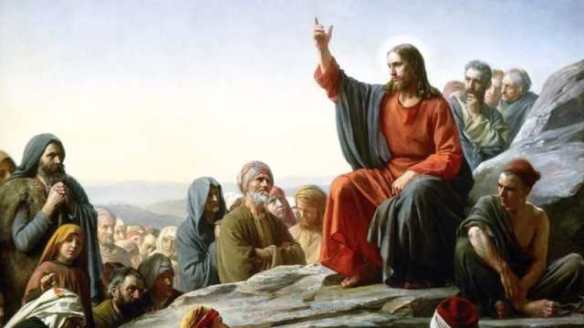
Spiritual Judgment and Discrimination — Matthew 7:6

In Matthew 7:1-5, our Lord has been preaching on judgment. He tells us not to judge others; and whenever we try to correct another we must first look at and purify ourselves, then we can see clearly to help them.

In the sixth verse, most bibles put this verse in a special paragraph on its own. But D. Martyn Lloyd-Jones suggests that that is not right, that it should connect to the previous five verses, that it is the final statement on judgment. Indeed, I agree. It tells the spiritual Christian how he must judge another—with “a spirit of discrimination.” So, Jesus says in verse six…

Do not give what is holy to dogs, and do not throw your pearls before swine, lest they trample them under their feet, and turn and tear you to pieces.

What is meant here? First of all, pearls are the Christian message. And the dogs and the swine are all that is unholy and unclean, or all those who are unworthy to hear the Christian message. And we know that all of us have sinned, but in this context, Jesus was referring to those sinners who reject the gospel and the truth of God and those who hate Him and even snarl at the message of His truth.

So, Jesus is telling us that we ought not to just spread His word of truth to everyone, but only to those who are worthy of it—or who are seeking it. This may come as a surprise to some people. Some may say that since God loves all people, all should hear the gospel. But the end of verse six gives an explanation of why not. Jesus says that some who hear the gospel will “trample them [our words] under their feet, and turn and tear you to pieces.” In short, they reject the truth and even do damage to it and to you.

If you need an example of this, we can look at Jesus teaching. First, we can compare how He answered Pilate with Herod, in Luke 23:3 and 9. With Pilate, in verse three, Jesus answered him; but with Herod, in verse nine, he answered him nothing. Why? Because Jesus judged Pilate to be a genuine seeker of truth, but He knew that Herod cared nothing for the truth. He knew it by his attitude. And there are other examples. Many times Jesus would not speak to the Pharisees, or at least answer their questions. He instead would go and minister to the Gentiles and to the sinners, as also Paul did.

In all our evangelism efforts and when we seek to teach the truth to people, we should always learn who we are talking to, to see if they are worthy of hear us. Here are three sets of instructions that may be helpful to you in your speaking to others.

  • Learn to know what to give each person in each particular situation.
  • Learn to know the way to present the truth to each person. Learn to assess people.
  • Learn which aspect of truth is appropriate in each particular case.

Also, know that our presentation to unbelievers must be different than to believers. An unbeliever only needs one thing, the doctrine of justification by faith. They need only to know of their sinful life and their need of salvation. Any other bit of truth will have no meaning to them; or we should say that they will take it wrong because of their unregenerated state.

To believers, some have a need for basic truth only—the milk of the word; others should be fed more solid food—the meat of the word.

True or False Judgment – Matthew 7:1-5

In this seventh chapter of Matthew, in His Sermon on the Mount, Jesus talks about judging others—or criticizing and condemning others.

Matthew 7:1-5

“Do not judge lest you be judged. 2 “For in the way you judge, you will be judged; and by your standard of measure, it will be measured to you. 3 “And why do you look at the speck that is in your brother’s eye, but do not notice the log that is in your own eye? 4 “Or how can you say to your brother, ‘Let me take the speck out of your eye,’ and behold, the log is in your own eye? 5 “You hypocrite, first take the log out of your own eye, and then you will see clearly to take the speck out of your brother’s eye.

Just previously (in chapter 6) Jesus spoke on worry. Now He turns to judging others. This is an interesting transition—from worry to judging others. But I think this is what we tend to do in our sins. At first, we think inwardly at all we have to do and worry about it; then we will turn our sins and frustrations outward toward others. Thus, when we get tired of looking inwardly at ourselves, we try to console ourselves and make ourselves look and feel better by condemning others. How sad.

But Jesus sets us straight as to what is going on. First of all, He tells us that whenever we point the finger at others, the same judgment will be pointed back at us—by others, and also, more importantly, by God.

His judgment will come to Christians in three ways:

1. There will be a final and eternal judgment to determine if you are really a true believer or not. If your name is found in the book of life then you are saved from eternal hell; if not, then you are not really a Christian at all and you will be cast into the lake of fire (Rev. 20:11-15).

2. There is a judgment for disobedience and sin. Scripture tells us that some are judged with sickness and even death; and in some cases, God will deliver them to Satan to let him carry out His will (1 Cor. 5:5).

3. When He comes to take believers to heaven there will be a judgment of rewards, where our works will be manifest (1 Cor. 3). And this judgment is so important because it will affect us for eternity.

So, we should be careful about judging others, because God will certainly judge us. And that judgment will be just. And interestingly, it will be measured to us by the same standard we use on others (v. 2).

Romans 2:1 says, “In whatever you judge another you condemn yourselves; for you who judge practice the same things.” Isn’t that interesting. Paul is saying that whatever we are guilty of, we tend to condemn others of.

James 3:1 says, “My brethren, let not many of you become teachers, knowing that we shall receive a stricter judgment. Here, similarly, God judges us with the same judgment we set for others.

Looking at verses 3 and 4 of Matthew 7, we see that we, in many cases, should not be judging others at all because we are incapable of doing it. We can’t do it because we are not right in ourselves. If we were really concerned about righteousness in others, we would deal with that same sin in ourselves.

What Is True Judgment?

Yes, there is a true or correct judgment. What does it look like?

1. In true judgment there is no prejudice or personal element. It is an objective judgment based on principles of truth, not on personalities.

2. In true or correct judgment the one who judges will first judge himself. A great singer or actor is always more critical of himself than others. A good judge sets the correct standard for others. In fact, one who is good at his game, say a Mikael Jordan, does not need to say anything to others. His good game will say more than any words will ever say. But if he does give his team mates any words of correction, believe me, they will listen!

3. True judgment cares about the righteousness of God, in others and in the one judging. The true judge has already dealt with sin in himself and sees clearly to help another.

“Judge Not” – from Matthew 7:1

When our Lord says, “judge not,” in Matthew 7:1, He is using the term only in its negative sense—as the Pharisees judged. Certainly, we are to have discerning judgment, as to who is a false prophet and who is a true one, and to judge doctrine. And the state has judges and magistrates that are appointed by God to judge. And the church also is to judge its people in certain matters of discipline.

The kind of judgement our Lord is speaking of when He says “judge not” is a condemning judgement—a judgment we see in the Pharisees. This negative, condemning judgment can be seen in six ways.

  1. It has an evil spirit attached to it. I would say that, for this reason, it is of the devil and it works to destroy us.
  2. It condemns and despises others for no good reason. We have seen this toward the Samaritans, and also toward the Jews. Certainly, we see it toward Jesus and toward Christians. Recently we see it from some toward Donald Trump; and we also see it toward entire races of people—toward blacks and toward whites.
  3. It has a spirit of self-righteousness and supremacy. This spirit of judgment is based on the lie that one person or persons is better or more righteous than another. It is what condemned an entire race of people (the Jews) to extermination.
  4. It hopes for the worst in others. Hence, we see its evil, diabolical nature; a nature that is the opposite of love.
  5. It focuses on personalities instead of principles. In correct judgment we always judge according to biblical principles, but in wrong judgment it is always according to something we just don’t like about a person—according to our personal preferences.
  6. It is expressing an opinion about someone without gathering knowledge of all the facts. It is a snap judgment. It is a first impression that is often wrong.

Source: Studies in the Sermon on the Mount, by D. Martyn Lloyd-Jones

Worry: Its Causes and Cure

The verse we will consider today is Matthew 6:34.

Therefore do not worry about tomorrow, for tomorrow will worry about its own things. Sufficient for the day is its own trouble.

This verse is a concluding verse on the subject of worry, which Jesus has been preaching on from the preceding 14 verses (vv. 19-33); hence, He uses the word “therefore” to begin the verse. The verse also extends the teaching. D. Martyn Lloyd-Jones, whom I have been following, says this: “[Jesus adds] an extension of His teaching…In adding this [verse] He carried the teaching [about worry] one step further.”

Here we see that Jesus personalizes worry. In effect, worry seems to have its own power. I would say that worry teams up with the demonic; the demons mean to use worry to overpower us and defeat us. Almost all of us are familiar with what worry does to us. It argues with us and tries to convince us to overthink things, to over-plan for tomorrow. And it has a very active imagination, and it will come up with all kinds of possibilities—things that could happen, troubles! I am a house painter. And when I have a job coming up that I think will be difficult, I tend to want to sit and plan it all out. Some of that wise—I’m not against planning—but when it keeps me up half the night, its not good. I really don’t need that much thought on all the potential problems.

Jesus here tells us that worrying about the future is futile and achieves nothing. It is pointless because we can’t do anything about it until we get there. We are to live one day at a time, dealing only with the worries of the day—the present. But when we stack onto our present worries tomorrows worries, we are overburdening ourselves for that day; we are lessening our efficiency for that day.

We could look at it this way. God has given us twelve hours in each day. In order to be efficient in doing the tasks for that day, we must learn to concentrate most on that one day, blocking out the past and also the possible future. Oh, I know that it is wise to do some planning and reflecting. But when we have finished doing that—and it shouldn’t take that much time—we must move on and concentrate on the now. And one reason why we should do that is because thoughts on the past and the future are not always reliable. I think it is better to take things (problems) to God in prayer as they arise. It is better to live adventurously, and in faith and obedience.

We should say to ourselves, “Here is a day which is going to bring me a few problems; I will need God’s grace and help along the way.” And we could claim certain promises, like 1 Corinthians10:13:

No temptation has overtaken you but such as is common to man; and God is faithful, who will not allow you to be tempted beyond what you are able, but with the temptation will provide the way of escape also, that you may be able to endure it.

In conclusion, here are one or two thoughts:

Know that worry is always a failure to grasp and apply our faith. We apply it by learning to talk to ourselves and to convince ourselves to live by faith. We could say to ourselves with the Psalmist, “Why are thou cast down, O my soul? Hope in God…” (Ps. 43:5).

Then refuse any anxious thoughts. Faith in God is refusing to think about worrisome things and to set our mind toward God and trust in Him for today.

Living Like a Christian In a Non-Christian World

I have been writing on the subject of worry. We are still on that subject, from Matthew 6; this time our emphasis is on not living like a Gentile (a non-Christian), but rather like a Christian. In Matthew 6:31 through 33 Jesus said,

“Do not be anxious then, saying, ‘What shall we eat?’ or ‘What shall we drink?’ or ‘With what shall we clothe ourselves?’ 32 “For all these things the Gentiles eagerly seek; for your heavenly Father knows that you need all these things. 33 “But seek first His kingdom and His righteousness; and all these things shall be added to you.

We Are Not to Live Like the Non-Christian

In verse 32 Jesus mentions that the Gentiles (non-Christians) are always seeking food, drink, and clothing, and yet they always seem to be worried over it. It is because they have a wrong view of life, a view that leaves open the door to worry. Here are two life views of the non-Christian.

1. The theory of contingency. This view holds that everything in life is accidental, that things happen without rhyme or reason and we never know what will happen next.

2. The theory of fatalism. This is the idea that whatever happens we can’t do anything about it. It is the belief that there are unknow powers, good and bad, controlling things, but we can’t do anything about it—whatever happens, happens; whatever will be will be. Doris Day use to sing that song, remember?

When I was just a little girl
I asked my mother, what will I be
Will I be pretty
Will I be rich
Here’s what she said to me

Que sera, sera
Whatever will be, will be
The future’s not ours to see
Que sera, sera
What will be, will be

The non-Christian still has these views about life, and so you can see why they worry. And many will try to overcome worry by one of two way.

1. Party it up. They say, we don’t know what’s going to happen, so we might as well live it up now, for tomorrow we may die.

2. Suicide. There are all kinds of suicide. There is drug overuse, or immorality, both are used to blot out a depressed life. And some go crazy and just flip out, killing others and themselves.

Living by Faith

The Christian view of life is quite different than the non-Christian view. We could call it…

The doctrine of certainty. In this view things are certain because we are in the hands of the living God.

Romans 8:28 says, “And we know that l all things work together for good to those who love God, to those who are called according to His purpose.”  Therefore, we believe that God has a perfect plan for our lives, and much of that plan we see from day to day as we read His word and walk in His Spirit.

But why do so many Christians still worry (like me)? The answer is easy. Though they are believers and have the Holy Spirit, they unknowingly live not by the Christian view of life, but by the non-Christian view. And sometimes what they may say in ordinary conversation betrays them. They may say something like, “Well, we never know what the future holds.”

The answer to a worried life, of course, is to build up our faith; to constantly remind ourselves that we are a child of God and that we were meant to live by faith. Here are four things you can do to build up your faith in God.

1. Put every crisis in the context of your faith.

2. When faced with a crisis ask yourself, will my conduct show me and others that I am a Christian and that I belong to a higher realm.

3. Know that you will never be in any situation that is outside of God’s love and care.

4. When faced with any situation in life, know that you should seek first His kingdom and righteousness, and then believe that all other things will be taken care of by God (read Matthew 6:33).

Moving on from Little Faith to Great Faith

In Matthew 6:25-34, Jesus talks about how we ought not to worry or be anxious in life; and He talks about how we should look at the birds and the flowers to see how God our Father takes care of them and how He will even more take care of us. Then in Matthew 6:30 Jesus points out to us what the ultimate problem is that is causing us to worry. We have a lack of faith. He said, “O ye of little faith.”

What does He mean by little faith? He does not say “no faith,” but little faith, or not enough faith. And Jesus is not speaking to unbelievers, but to believers—those who began a life of faith in Him.

But we must proceed on from the faith we began with—from the faith that saved us. Let us desire a larger, deeper faith. Or let me say this: if we don’t move on to a larger faith, we may always have trouble with worries and doubts—and along the way, some may even doubt their salvation!

What is a larger faith? It is a faith that believes on God for more than salvation; for our entire life—for every little thing; for food and drink and clothing, and also that He will care for you in everything you do.

To be of little faith means that we are mastered by our circumstances. This should not happen to a Christian! We as Christians should be above our circumstances. We can even rejoice in tribulation.

Another way of looking at it is that we as Christians who are of great faith learn to be thinkers not just responders. Hence, the trouble with the one of little faith is that he does not think; he does not think of the truth and the promises of God. He is just blown around by the wind of circumstances.

We must spend more time studying the bible and thinking of on the lessons that the Lord gives us, and on His promises, and to believe them. This is the essence of faith. And conversely, little faith is not to open the bible but rather to cling to a vague memory of our salvation.

I am not saying that our salvation is not important. But we must go on and build on that salvation. A larger faith realizes the full implication of our salvation. It sees who we are as Christians; that we are children of our heavenly Father and that we have a great inheritance in Christ. All the promises of God are meant for us. Paul wrote, “He that spared not His own Son, but delivered Him up for us all, how shall He not with Him also freely give us all things (Ro. 8:32).

Here are some things to think about which He has given us:

  • He has put our names in His book (Rev. 20:12). He has many things in store for us for all eternity.
  • Think of His great love for us (John 3:16).
  • He is concerned for us. He cares for us (1 Pt. 5:7).
  • He is so strong for us. His great power is working for us (Eph. 3:16-20).

Don’t Be Anxious

This is a subject that I know I need. It seems that the older I get the more I worry about things. I think it is because I feel weaker and more vulnerable. So, I look forward to what I will learn here. Our text is Matthew 6:25-34.

Matthew 6:25-34

“For this reason I say to you, do not be anxious for your life, as to what you shall eat, or what you shall drink; nor for your body, as to what you shall put on. Is not life more than food, and the body than clothing? 26 “Look at the birds of the air, that they do not sow, neither do they reap, nor gather into barns, and yet your heavenly Father feeds them. Are you not worth much more than they? 27 “And which of you by being anxious can add a single cubit to his life’s span? 28 “And why are you anxious about clothing? Observe how the lilies of the field grow; they do not toil nor do they spin, 29 yet I say to you that even Solomon in all his glory did not clothe himself like one of these. 30 “But if God so arrays the grass of the field, which is alive today and tomorrow is thrown into the furnace, will He not much more do so for you, O men of little faith? 31 “Do not be anxious then, saying, ‘What shall we eat?’ or ‘What shall we drink?’ or ‘With what shall we clothe ourselves?’ 32 “For all these things the Gentiles eagerly seek; for your heavenly Father knows that you need all these things. 33 “But seek first His kingdom and His righteousness; and all these things shall be added to you. 34 “Therefore do not be anxious for tomorrow; for tomorrow will care for itself. Each day has enough trouble of its own.

This text follows immediately after Matthew 6: 19-24, having to do with not laying up treasures on earth, but in heaven; and having a single (or a pure) eye, and therefore having only one master, God. The text for this post having to do with not being anxious is a little different, but it has a connection to the previous text in the following ways:

  • The Matthew 6:19-24 passage is about laying up treasures; and the Matthew 6:25-34 text is about worrying over treasures.
  • Those who can’t afford treasures will worry about not having them.
  • Those who have treasures will still worry; they will worry about losing them, or getting more treasures, or over what to do with the treasures they have.

Satan doesn’t care if you have conquered having treasures, because he will get you to think and worry about them. His goal is to get your mind off of God and he will do it one way or another, either to be laying up treasures on earth or to be thinking about them—worrying about them.

Now the theme remains for us to have a single (or pure) eye, and to seek first His kingdom. To do that we are to trust Him and to “take no thought for our life.” This is the King James translation, in the time of Shakespeare, about 1600s; and in that day the meaning of “taking thought” was meant in the sense of being anxious or to worry. We may also understand the term as having a divided mind, or having a doubtful mind or double vision.

If you are using the KJV and the term “take no thought” you must understand that it does not mean that we are not to think about things or not to do anything about our problems except to trust God—to just sit and trust Him. No. We should be busy to provide for ourselves and work out our problems just like the birds do. They are always busy searching for their food. And in their search God rewards them and cares for them. So, the man also must work—or he will not eat. And if you begin to worry you should pray and God will give you peace (Phil. 4:6-7).

Here is one idea that may help you. If God has given you your life as a gift to you, and He has, then He will certainly make sure that your life is sustained for as long as He wills. God has a good plan for every life that He has created.

God or Mammon

The following text is part of Jesus’ Sermon on the Mount, which is on the subject of wealth and worldly-mindedness; and it is meant mainly for Christians, but also for non-Christians. 

Matthew 6:19-24

“Do not lay up for yourselves treasures upon earth, where moth and rust destroy, and where thieves break in and steal. 20 “But lay up for yourselves treasures in heaven, where neither moth nor rust destroys, and where thieves do not break in or steal; 21 for where your treasure is, there will your heart be also. 22 “The lamp of the body is the eye; if therefore your eye is clear, your whole body will be full of light. 23 “But if your eye is bad, your whole body will be full of darkness. If therefore the light that is in you is darkness, how great is the darkness! 24 “No one can serve two masters; for either he will hate the one and love the other, or he will hold to one and despise the other. You cannot serve God and mammon.

We will look at this teaching in three parts: 1) general observations, negative and positive, from verses 19 and 20; 2) spiritual dangers, from verses 21-23; and 3) On God and mammon, from verse 24.

General Observations (vv. 19 and 20)

Do not lay up for yourselves treasures upon earth, where moth and rust destroy, and where thieves break in and steal (v. 19).

Here are three general or common-sense observations of this verse:

  • Worldly treasures do not last. They are impure and corruptible like moth and rust. They are like beautiful flowers that will soon wilt and die.
  • Earthly treasures never fully satisfy. They always lack something and we are soon tired of them.
  • Earthly treasures are never safe from robbers.  

But lay up for yourselves treasures in heaven, where neither moth nor rust destroys, and where thieves do not break in or steal (v. 20).

Here are four general or common-sense observations of this verse:

  • Treasures in heaven will not be corrupted. They are incorruptible or imperishable.
  • Treasures in heaven cannot be stolen. They are in a place that is impregnable and will be kept for us for eternity.
  • The love of God is our greatest treasure and nothing can separate us from that (Rom. 8:38-39).
  • Heaven is the realm of life and light and purity, and nothing tainted or polluted can enter there.

Spiritual Dangers (vv. 21-23)

21 for where your treasure is, there will your heart be also. 22 “The lamp of the body is the eye; if therefore your eye is clear, your whole body will be full of light. 23 “But if your eye is bad, your whole body will be full of darkness. If therefore the light that is in you is darkness, how great is the darkness!

     Let’s look at verse 21 first: “Where your treasure is, there your heart will be also.” This tells us that our treasures tend to put a power-grip on our heart—and the heart involves the mind; so, we will also have a power-grip on our mind. This power-grip is very subtle, and to those who are not truly spiritual (who have not given themselves fully to Christ), a subtle change will happen to them (to their mind and heart). They will soon become influenced by a worldly-minded outlook on life, which will eventually master them and make them slaves to the world.

In verses 22 and 23 Jesus begins talking about the eye. He says,

“The lamp of the body is the eye; if therefore your eye is clear, your whole body will be full of light. 23 “But if your eye is bad, your whole body will be full of darkness. If therefore the light that is in you is darkness, how great is the darkness!

Normally or naturally the eye is clear (or single). This describes the spiritual vision of a spiritual person. But, in keeping with the context, if a person allows himself to be worldly-minded and in love with his treasures, he will develop an evil eye, or one who has double vision or blurred vision, vision colored by prejudices, or lusts, etc.; hence our earthly treasures affect us morally.

The last part of verse 23 is interesting. I think it means that a man who is so attached to his earthly treasures may actually not see anything wrong in it; so that the light that he thinks he sees in himself (and in his treasures) is actually darkness—a darkness that comes out of his hypocrisy and delusion. This is a person who has lost his mind and no longer knows right from wrong, good from evil.

God and Mammon

In verse 24 Jesus comes to the climax of the matter.

24 “No one can serve two masters; for either he will hate the one and love the other, or he will hold to one and despise the other. You cannot serve God and mammon.

So it all comes down to this: which do we love, God or mammon (our wealth)? God wants all our love; He wants our total attention. But so does the world; and the world comes after our attention through all the things of the would—earthly treasures. And we have to choose between the two. Jesus said no man can have two masters.

Now it seems to me that we can evaluate where we are by our attitude toward our things. If we are holding on to our things tightly so that we can’t imagine parting with them we have a problem. Since if we love our things, that means that we hate God (that is what verse 24 says). So, if you want to maintain a relationship with God and love Him, you must let go of your things. You must trust God to give you all you need, and all the things you have, recognize that they come from Him. Make God your only master. Love Him alone.

Jesus and the Pharisees : Study #1

To begin our study, I think we should say a little bit about who the Pharisees are. An article I found by Jack Zavada, I think is good. I will give you just the first part of it.

Who Were the Pharisees in the Bible?

The Pharisees in the Bible were members of a religious group or party that frequently clashed with Jesus Christ over his interpretation of the Law.

The Pharisees formed the largest and most influential religious-political party in New Testament times. They are consistently depicted in the Gospels as antagonists or opponents of Jesus Christ and the early Christians.

The name “Pharisee” means “separated one.” The Pharisees separated themselves from society to study and teach the law, but they also separated themselves from the common people because they considered them religiously unclean.

Besides this article—and there is a lot more to it if you care to click the title and read it—I’m sure we will gain a good bit of info on the Pharisees just by this progressive study.

What I want to do in this study is to just observe what the Pharisees do and say toward Jesus and about Jesus; we want to see their attitude toward Jesus. We also want to see Jesus’ attitude and sayings about the Pharisees. In the end, we want to make some applications for ourselves and maybe also about other people. We want to look and see how some people are like the Pharisees and how others are more like Jesus. Generally, we can say that Jesus is the good guy who does everything right (because He is God); and the Pharisees are the bad guys who do most things wrong—though in their eyes, they are always right—righteous.

Okay, here is what we will do. I have already found all the passages in the gospels where there is a conversation or debate between Jesus and a pharisee, or a group of Pharisees. I found 41 such passages, eliminating all the repeat passages (mainly between Matthew and Mark, in which case I used Matthew). We will take this study a little at a time until we are finished. We will start this first blog with Matthew 5:17-20.

Matthew 5:17-20

“Do not think that I have come to abolish the Law or the Prophets; I have not come to abolish them but to fulfill them. 18 I tell you the truth, until heaven and earth disappear, not the smallest letter, not the least stroke of a pen, will by any means disappear from the Law until everything is accomplished. 19 Anyone who breaks one of the least of these commandments and teaches others to do the same will be called least in the kingdom of heaven, but whoever practices and teaches these commands will be called great in the kingdom of heaven.

20 For I tell you that unless your righteousness surpasses that of the Pharisees and the teachers of the law, you will certainly not enter the kingdom of heaven. (Bold text for emphasis)

Observations

In this passage Jesus is preaching in His famous Sermon on the Mount. He is saying here that He has come to fulfill the law, not to abolish it—as the Pharisees may have been saying about Him. In this public sermon He does not tip toe around the Pharisees. He comes right at them, telling His disciples and all who are listening that their kind of righteousness is not good enough to enter heaven. He said that “unless your righteousness surpasses that of the Pharisees…you will certainly not enter the kingdom of heaven.”

John MacArthur in his bible notes writes that the Pharisees “had a tendency to soften the law’s demands by focusing only on external obedience.” But Jesus here was preaching a more “radical holiness” that demanded on “internal conformity to the spirit of the law.”

Applications

If we are to follow Jesus’ example, we ought to boldly warn against false teachers. And if we know who they are we ought not to be afraid to point them out.

How to Live the Christian Life in This World – From Matthew 6:19-20

We have been studying Jesus’ Sermon on the Mount, and following D. Martyn Lloyd-Jones teaching from his Studies in the Sermon on the Mount. We have now come to the section following the Disciples Prayer outline, verses 19 -20, where Jesus tells us,

“Do not lay up for yourselves treasures upon earth, where moth and rust destroy, and where thieves break in and steal. 20 “But lay up for yourselves treasures in heaven, where neither moth nor rust destroys, and where thieves do not break in or steal.

So here, we come to the problem of living the Christian life in the world and therefore how to overcome to world while living in it. Jesus gives us two points to follow: 1) we are not to store up for ourselves treasures upon earth, but 2) we are to store up treasures in heaven.

We Are Not to Store Up for Ourselves Treasures Upon Earth

Here are a few notes from my reading:

Jesus wants us to be concerned not so much with having wealth and possessions, but with our attitude toward them.

We are to be concerned with our whole attitude toward life in this world. That is, we ought not to get our total satisfaction in life from things in this world.

A person’s treasures are the things that mean everything to him—what he is living for.

Here are some things in this world that can become our treasures: love of money, of honor, of position, of status. We are not to be so concerned with these things that they take up our entire life. These things will all pass away in the end.

We Are to Store Up Treasures in Heaven

Use your riches to prophet you for the next life.

Do not labor for what will perish but for what will endure to everlasting life.

Have a right view of life. In this world we are pilgrims.  We walk under the eye of God, toward our everlasting hope.

Our attitude must be that I am not the possessor of my things. They really do not belong to me. I am but a custodian of them.

 I should always be using my things for the glory of God.

I am a child of God placed here for His purpose.

I must hold my things loosely; I am to be in a state of blessed detachment from them; and I should always be considering how I can use the things that God has entrusted to me for His kingdom.