This is a CH46 Marine helicopter, used to transport Marines and cargo.
After my combat training in San Diego and my week off at home, my first stop on the way to Vietnam was Okinawa to be processed. During my week stay there I stored my extra military uniforms (that I wouldn’t be needing in Vietnam), and I was issued new combat clothes, boots, rifle, poncho and liner, and backpack—everything I needed for Vietnam. That didn’t take more than 20 minutes or so. So why were we there for a whole week? Good question. Nobody questions things like that. We were just glad to get a few more days off. Okinawa was beautiful compared to where we were headed. And the food was good too.
When we left Okinawa I kind of expected to go right to my new unit, but we had one more stop to make—Da Nang, one of Vietnam’s major cities. We stopped there for I think it was two days. I wasn’t sure what was happening there, but I suppose we were waiting to be assigned to our new unit and to complete any final paperwork. When it was finally time to go, we all got separated into different groups, according to what our particular duty classification was, and where we were needed. My duty classification was listed as 0311, rifleman (better known as “grunt”); and my new address was: Co K, 3rd Bn, 5th Marines, 1st Marine Division. So, those of my group, just a few of us, were directed to get onto a large green helicopter. I remember looking out the helicopter window as we flew over the trees and rice patties. It didn’t take long at all before we arrived at our destination—hill 52. Vietnam is a small country and my unit was only about 15 miles southwest of Da Nang.
The first thing I remember upon landing, was all the dust that the helicopter was creating, and a few dirty-faced Marines that were there to greet us. Though it was late February, in Vietnam it was warm. Questions raced through my head. What had I gotten myself into? Where was I? Where was the enemy? We all needed some direction.
I hope to conclude this boot camp segment with this blog. Then I will begin writing about my tour in Vietnam.
About halfway through boot camp they (my drill instructors, I think) decided that I wasn’t motivated, so I was transferred to what was called “motivation platoon.” I don’t know why they decided that; maybe it was because I didn’t seem fearful enough of them. Like I said previously, I prayed a lot, especially while I stood at attention; and I was always committing everything to God. Maybe they sensed that I was too calm about everything. Anyway, motivation platoon only lasted about a week. We did things like, set up tents, and camped out, and watched movies about how great the Marine Corps was. Then they transferred me to another boot camp platoon—which seemed easier; and the drill instructors seemed nicer and didn’t swear as much. I remember that the top drill instructor said to me that he couldn’t figure out why I was transferred, because I was doing so well. He especially likes my high marks in the physical exercise tests, like pullups and pushups, etc. And so, anyway, I was feeling good about the whole thing. No doubt God had something to do with it.
After boot camp everybody got sent home for a week. I don’t know why, but I can’t remember any details about that week. It was a time to relax and get ready for more training (at ITR) and Vietnam.
ITR (Infantry Training Regiment) was located also at Camp Pendleton, but was separate from the boot camp area. It was a place with lots of hills and trees and underground bunkers, a perfect area to train for war. The instructors there were kinder, I mean they didn’t harass you as much. We were respected more—as marines. But the training was more intense. Oh, I remember trudging up and down those hills with back packs and rifles. In fact, everywhere we went we carried our rifles. And they would sternly let us know if we didn’t always have our rifles with us. That was part of the training: to know that we had to be always combat ready.
I really don’t remember anything in particular about ITR, except that it was very intense. I think I had my mind more on what was to come—Vietnam. And they would constantly talk about it, to prepare us for it. ITR wasn’t nearly as long-lasting as boot camp, though it seemed long. I think it lasted about six weeks, enough time to get us all geared up for our year long tour. But before Vietnam, they gave us another week off to say goodbye to friends and family.
If it wasn’t for the pictures I took, I wouldn’t remember this week. I guess it went by fast, and I probably had my mind on what was to come. I know that I saw my girl friend Joy a lot; and though I really felt that I loved her, it was a strained and awkward relationship, mainly because I knew she wasn’t a Christian. But I was going off to Vietnam, and somehow, I knew that that would provide me with a way of escape. That is, to get away from temptation.
I also slightly remember that during that week my mom, as well as my grandparents (on my mom’s side) were quite upset and fearful for me going to Vietnam. In fact, my grandpa had taken some legal steps to get me a humanitarian discharge. The whole thing was strange to me, because I really didn’t want it. It was all his idea, and maybe my mom’s too, and they pursued it kind of behind my back. As I remember it, there never was a time that I didn’t want to go to Vietnam. I never was a person that would fight against going to war. I always figured that if your country called you to go, you should go; that it was part of God’s will. And, this may seem strange, but I really kind of wanted to go. There was something in me that was excited about it. I wanted to fight for my country, and I was ready.
There were some things in boot camp that weren’t on a daily basis. Here are eight of those events.
1. The three-mile run. This was a regular exercise, but not daily; more like every other day. And we usually ran in full gear: boots and backpack. I didn’t mind this event or any of the other more physical events. I was in pretty good shape.
2. The twenty-mile run and walk. We only did this a couple of times during boot camp, and it was also in full gear. I think this exercise was planned especially for those who would be going to Vietnam (most of us). What a workout!
3. The rifle-range. I think I remember going to the rifle-range about once a week. It was basically an event to learn how to hold your rifle steady while shooting, and in different positions. We would shoot standing up, in the prone position, and sitting. We also did some shooting with the 45-caliber pistol. One thing I couldn’t understand is why we trained with an M14 rifle in boot camp and then were issued an M16 in Vietnam? It made no sense to me. And even though the M16 was lighter, I wish I had an M14 in Vietnam. I would have felt safer with it, because I think it was more accurate.
4. Weapons training. In addition to shooting the M14 and the 45, we would also learn how to throw grenades. That was scary to me, just knowing that you only had a few seconds to throw it after pulling the pin before it would explode. We were also introduced to a few other weapons like the M60 machine gun, the M72 LAW, a very nifty lightweight anti-tank weapon, and the M79 grenade launcher, which was my primary weapon in Vietnam. We all had our turns to shoot these weapons—kind of fun. We also watched demonstrations of other larger, more powerful weapons like tanks, cannons, mortars (an artillery weapon), and we even watched the fully- armed, black-hawk helicopter destroy things. A great show!
5. Self-defense and bayonet training. As for the self-defense training, I already knew quite a bit from high school wrestling. But the bayonet training we got I think was helpful—that is, it would have been if I had an opportunity to use it. Most of the close hand to hand combat was done earlier and during the Tet Offensive (from 1965-68). I didn’t get to Nam until 1970.
6. Guard duty. Guard duty in boot camp was on a rotating basis during the night, about a two-hour shift. I never liked it. I did the same thing in Vietnam every night. I didn’t like it there either.
7. Surprise cleaning duties. Every once in a while, our drill instructor would announce to the platoon that we had a project to do. I remember once when we washed a rather large concrete floor. We did it all by hand scrub brushes and white towels. I remember the instructor saying that it had to be clean enough to eat off of. And it was.
8. Punishments. We were harassed and yelled at constantly; that was part of the training. But punishments were different and less often. One time the entire platoon was punished, but I can’t remember what for. Anyway, we spent hours doing calisthenics in deep sand. Most of the time the punishment was on just one Marine. It was usually quite brutal and for the least offences. But then we were Marines and were expected to perform out duties well, and without complaining.
When you left boot camp you had to be in tip top shape.
After boot camp processing, and all the preliminary instructions of the first day were completed, we finally settled into somewhat of a daily routine—except for events that we did less frequently, which I will cover in the next blog post. Here are six things that I remember doing on a daily basis for my three month long stay at boot camp.
Our regular morning routine. The first thing we did after getting up was to do our business, shower, and shave. Then we got dressed, made our bed (tight), and lined up outside for roll call and inspection. If we shaved properly (closely, without misses or blood), and if our boots were shined and clothes were fairly well pressed and clean, the drill instructor would usually pass us by, which was usually the case for me. But if any of those things were missed, he would let you know—very rudely. And also, it seemed to be always the case that the drill instructor would pick on someone just because he didn’t like the way they looked—or really, for any reason. Like for instance, if someone seemed to stand out because they were short or tall or a bit overweight, they had a good chance of being harassed, repeatedly.
Close order drill. This is probably the most impressive event that we did; and it was kind of fun. I’m sure most people have seen a marching band drill at the half-time of a football game. But when you see Marines in their dress blues and rifle, it is especially impressive. Most of the time we would drill without a rifle, in our regular uniform. At first, for me, it was hard keeping in step. But after a while, no problem. I especially liked hearing the drill instructor’s cadence call. Each instructor had his own unique style and sound.
Some might question the value of drilling because we didn’t ever do it on the battle field. Yet, when I think about it, I think it has more of a motivational value and something Marines (and all branches of service) do just to build in themselves the pride of being a Marine.
Calisthenics.I think each boot camp unit was I bit different, but generally we did the regular exercises beginning with stretches and jumping jacks, then pushups, setups, pullups, burpees, and some sprints. Toward the end of boot camp, we would be tested to see how many of each exercise we could do. I was always at the top, probably because of the sports I did in high school—wrestling and track.
Classes. There were alwaysone or two classes each day pertaining to a variety of subjects the Marines wanted you to learn. The ones I remember were on general hygiene, Marine Corps history, cleaning and handling of weapon, and map reading. They were usually at least an hour long. I didn’t mind having the time to sit and relax, but I didn’t care much for the learning part of it. It was too much like school. I don’t remember getting tested on any of the classes. I think that is something they should have done, to force us to listen and learn.
Free time. They called it free time, but it really wasn’t your own time. It was a period of time, about an hour or so, to do things like polish your boots and belt buckle, write a letter, clean your pistol and rifle, study class notes, and get mail at mail call. I would usually get a letter every day from mom or a girlfriend. But most of my mail was from a young girl (about 14 years old) that I didn’t know. She got my name and address from Stars and Stripes, a military newspaper. It was a great ministry for her, and I really appreciated it and always looked forward to her cheerful letters and homemade cookies! Now that I think about it, I’m not sure when she started writing me. It was either in boot camp or maybe in my tour of Vietnam; and we continued to write each other all during my time in service.
To be honest, I didn’t like writing that much. But I figured that since I enjoyed getting mail, I had to keep writing people to get them to write me. I also considered that I should probably not talk too negatively or about myself or my situation too much, and to talk more about them—so that they would feel more compelled to like me and write back. I was desperate to get mail, to hear from a friendly person, so I did what I thought would work. I kept this writing practice up all through my service time.
Mess hall. We always had three meals a day and the food was good. Unfortunately, though you could get as much as you wanted, you didn’t have much time to eat it. Sometimes, I remember that after standing and waiting for a long time at attention to get fed, when we finally got our food on our metal tray and sat down to eat, the drill instructor would yell out something like, “Alright you pigs, you’ve had enough, get out, get out,” And we had to just leave our tray full of food and run out of the mess hall into formation. Why did he do that? I would like to tell you that it was for a good reason, but I really didn’t know why. It is my guess that he just wanted us not to get too comfortable. Boot camp was a place to train us, not to make us feel good or satisfied.
I had been thinking for a while about joining the Marines. Then one day I suddenly made the decision. My mom was the first one to get the news. “Mom,” I said, “I’m gonna enlist in the Marines.” I guess she knew I was serious, because I don’t remember that she was too opposed to it or tried to talk me out of it. I quickly got out the phone book to find where to go, and on that very day I talked mom into driving me down to the Marine Corps enlistment building, downtown Minneapolis, to get signed up. I was very excited.
I don’t remember exactly, but I don’t think it took very long. It’s my guess that they were eager to sign guys up during that time of war (1969), and the requirements were quite low. If you could walk and breath, you were in. Seriously, there were only two things I remember about the recruitment: the short physical exam, including shots, and all the paperwork.
The next day—or maybe it was a couple of days—I was off to boot camp at Camp Pendleton, in San Diego, California. I don’t remember the airplane ride or the bus ride to the base, but I do remember being instructed, loudly and rudely, to go and stand on the “yellow footprint.” So, all of us recruits very willingly fell in line. From that time on we did just what we were told. It was dark, maybe about midnight, and we stood there at attention on those yellow footprints. I dared not move, or even look around. I just waited for what I would be instructed to do next. Some guys, by the look on their faces, seemed afraid and almost shocked. As I remember, I don’t think I had that same emotion, but I was tense—and also very prayerful. I remember praying over and over again Romans 8:28, “And we know that all things work together for good to them that love God, to them who are called according to His purpose.” I was trusting God that what I was going through, and whatever I was going to go through, would all work out for God’s good purpose. That was my firm belief. I had no worries about it.
Well, finally, after what seemed to be at least a couple hours of standing at attention on those footprints, we began to be processed. That is, we were marched over to a place where we were measured and given all the clothes and supplies we needed for boot camp. I didn’t mind the process, but I didn’t understand why many of the workers were so rude to us, calling us “maggots” and worse. It all seemed so unnecessary.
I don’t remember exactly all that went on that night, besides getting our gear, but I’m sure I was ready to retire. Eventually we did get put to bed. We were led into what was called Quonset huts and were given brief instructions that we were not to talk after lights went out. Suddenly, after only about ten minutes to undress, someone shouted, “lights out!” The lights went out, and it was quiet. No one dared to say a word.
Only about two hours later our drill instructor stormed in, turned on the lights, and started banging on the inside of an empty garbage can and yelling, “Get up you maggots! Get up!” We were told, in so many crude words, that we had only so many minutes to do our business, shower and shave, and get outside in formation for roll call.
That morning, while it was still dark, we were introduced to the first full day of boot camp. I’m not sure what all happened on that first day, but I imagine we were given more instructions; and haircuts were definitely in order. We had to look like Marines, so I think that happened first. It only took a few seconds to shave our heads with those big clippers. It was brutal! Then, I suppose, we were instructed on how to make our beds—with tight hospital corners, and also how to fold our clothes and pack our foot lockers. Those were the basics. Other instructions were given to us along the way. Soon we would be settled into a daily routine.
One thing that was sadly lacking in my life was someone to come along side me and counsel me in the area of sexual temptation and dating and marriage. I think young people really need that guidance, especially in those high school years, when their bodies and thoughts are swiftly moving in that area. All through high school I wasn’t at all seriously thinking of marriage or even dating. In fact, I purposely set my mind toward God and bringing people to Christ any way possible, especially through Hi-C club, the Christian group I was involved in.
Then again, when my guard was down, which was too often, I couldn’t keep my eyes and my mind off of girls. And I didn’t exactly know how to handle it. I didn’t feel ready or bold enough to ask girls on dates, but still I had eyes and an imagination. Sometimes, at a weak moment, I longed to see as much as I could. I remember going to the beach just to see as much skin as I could. And I was a Christian! What was I doing? Well, in those days, much of the time I was just very rebellious.
And then along came Joy. A girl named Joy. The first time I remember seeing her was while I was in band practice playing my trombone. She would be looking at me through the glass classroom door and smiling and waving at me. And it was a little embarrassing, because I really didn’t know her, and some of the kids noticed that she was trying to get my attention.
I really wasn’t attracted to her and she wasn’t that attractive. But she seemed to really like me. So, I invited her to our Hi-C group. I figured that as long as I had her attention, maybe I could get her saved. She started to come to our group, but I kind of knew that she was just interested in me.
One evening after group I walked her home; and when we got to her house, she really laid one on me—she kissed me. My first reaction was repulsion; her breath stunk of stale tobacco. But then, without warning, the feeling hit me. I felt something deep down in my soul. Instantly, I was in seventh heaven, and I wanted more. We kissed again, and I felt even better. But when I went in for a third time, she said she had to go. That was okay; I knew I would be back and I was still flying high. I ran all the way home. I was in love. For the first time in my life I was really in love.
I can’t remember exactly what I did next. All I remember is that I wanted more kisses from her. So, I tried to see her more. Even though I was always busy after school with sports and Hi-C clubs, I always had her in the back of my mind—especially her kisses. I longed for her, but it seemed that things were reversed. I was wanting her more than she was wanting me. I was going full steam ahead and she was putting on the breaks. I remember sitting in her house one time. Her mom was home, busy with house work, and me and Joy were sitting—in separate places. I was sitting on her couch watching TV—I think. And she was sitting in another chair reading a book. She was like my sister, always reading. I would be just sitting and she would be sitting and reading. All I could think of was when I was going to get another kiss. I have no idea what she was thinking. It was a strange relationship.
One day she opened up to me about her life. It wasn’t good. She had been—and maybe still was—on drugs; and she also had sexual relationships. I started to think that maybe pursuing her wasn’t the best idea. Yet I wasn’t ready to give up on her. I felt that I really loved her, and so, I doubled down on praying for her. Sometimes I prayed for a long time with tears, begging God to save her. I remember those prayer times. In fact, even now, fifty years later, every time I think of her, I pray for her salvation. Yet I have no idea where she is or if she is even alive.
Toward the end of my senior year, I got the itch to work. It didn’t take me long to find my first job at Minneapolis Floral, just a couple blocks from the school. It was a fairly easy job. I mainly just swept the floors, especially around the people who were trimming and arranging flowers to be sent out to weddings and funeral and such. I think I had that job for only a couple of months.
The next job I had was in a foundry, which was located in the warehouse district of Minneapolis. It was a lot harder, but it paid more. I think I made $2.50 an hour. I stood all day long in front of a grinding wheel, grinding and smoothing off little medal parts. What those parts were used for I had no idea and I didn’t care. Oh, my back and shoulders would just ache after a few hours of work. But it was work. Soon I got use to it. I think I only had the job for about a month. They were sorry to see me go, but I had to leave to serve my country.
A few months before I went to work, it must have been just at the end of my senior year, I remember walking down the sidewalk with a friend of mine, a wrestling buddy, on my way home from school one day. We were talking about what we were going to do next. He suggested going into the service, maybe the Marines. That was the first time I had thought about the service, but that thought kind of intrigued me. I wasn’t thinking at all about war; I was thinking more about really getting into shape and “becoming all I could be.” Something like that. Well it didn’t take me long to decides on the Marines.
Looking back on it, I think it was how God provided a way for me to escape from the temptations I had for Joy, and what would have been a very wrong path.
When the bus could’t go any further, this is how we got to our destination at Arrowhead Springs I am in the upper right corner.
Hi-C actually started in Junior High, as I have already written about. But it continued into high school. I am so thankful to God for this group, because it kept me excited about my Christian life. And one of the verses that I remember using during that time was John 10:10, “The thief cometh not, but for to steal, and to kill, and to destroy: I am come that they might have life, and have it more abundantly.” Yes, I think Hi-C for a me was all about living the abundant life in the midst of so much pain and turmoil at home, and also in the classroom—I just wasn’t a very good student.
I think God was using Hi-C, along with sports, to get me through life at that time; otherwise I think I would have been very depressed. The first thing I remember about the club was our trip to Arrowhead Springs, Colorado (pictured). I don’t remember a lot, just that it was a great motivator and I felt so much joy being around other believers. It was like experiencing a small bit of heaven.
Similarly, I remember our city-wide rallies. Hi-C wasn’t just in my high school. It was in several high schools in Minneapolis. Jerry Kaufman was a God-send for the rallies—a great motivator. Anyway, we would have city-wide rallies about once a month, and Jerry Kaufman, with his accordion, would lead them. It was mainly a time of singing Christian songs; and we also usually had a special speaker that would give a gospel presentation. Oh, we also had plenty of time to play games and be rowdy. And now that I think of it, there were also city-wide hay rides and other events.
This is Gary.
I think I actually made more friends from other schools, through the city-wide events, then from my school at West High. And I went to great lengths to keep those relationships going. I remember having to ride the bus for very long distances, using two or three transfers to get to places. And it was worth it. I often visited my friend Gary Westlund. He became sort of a mentor to me. I remember when we would team up and go witnessing at Lake Calhoun beach. It was always me and Gary.
The Hi-C Club at West was a much smaller group. I was elected President, and we also had two secretaries and a treasurer—so I guess we were fairly organized. Anyway, we had weekly meetings where we would usually invite a speaker. I remember that one of our regular speakers was Mr. Baxter, who was a teacher and a coach at West. Everyone liked him.
Our intention in the group was not just to have fun. We set out to invite as many as we could from school to group meeting so that they would eventually find Christ. I’m not sure how many that was, but there were a few. I sometimes wonder where they all are right now. I know that many have been greatly influenced by Hi-C just as I have been. I don’t have many pictures, but I do have several writings in my year books that have mentioned Hi-C, and they usually signed off with “In Christ,” or even “Love in Christ.” Those were the days. I pray that they are still going on for the Lord as I am.
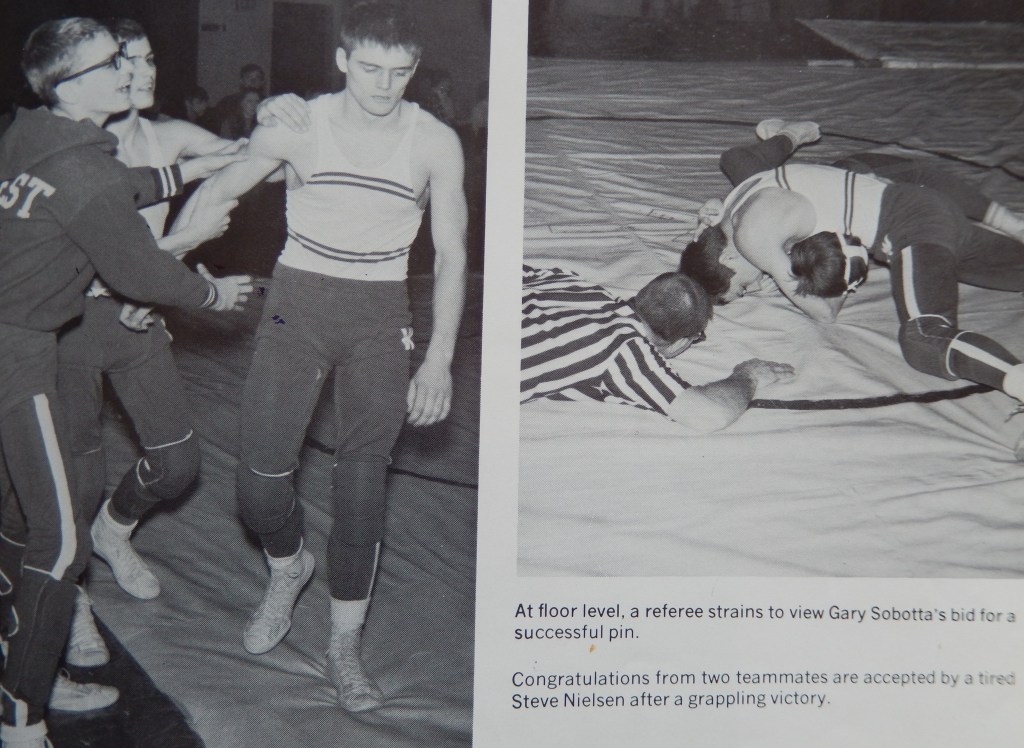
This was taken from my year book. That’s me on the left being congratulated after a grappling victory.
I have far more memories of sports than any of my classes, or anything else in school. I excelled probably the most in wrestling, but I also went out for track, cross country, and football.
I’ll start with wrestling. I already had a taste for wrestling since I wrestled with my brother Mark very early in life; and I also wrestled some in seventh grade, but I didn’t do too well so I think I was eager to improve. In my sophomore year at West, right away I was pretty good—better than any other sophomore in my weight class. But I was not better than anyone on the varsity squad, so all year I was stuck on the B-squad. I ended up winning all my B-squad matches either by a wide margin or by a pin. It felt good.
In the next couple of years, I also was pretty good, but I did lose a few matches. And in my senior year at finals I didn’t go far at all. Those guys seemed to be so much stronger than any of the guys I wrestled in our conference. Here I thought I was so good, but all along I was deceived. I wished then, after my humiliating loss, that I had better competition and better training. But I couldn’t do anything about it; the season was over.
Aside from the memories I have of wins and losses at the meets, there were also many other things I remember about my time in wrestling at West. Wrestling practice took up a lot of time, three hours every day after school. Too long! It was brutal. Everyone always lost about 5 pounds of sweat in just one practice—and then gained it all back for the next day. I always wore two or three layers of sweat clothes and sometimes a plastic suit just to lose more weight. Some guys hated practice, others seemed to excel in it and even smiled while they worked out—like out team captain Halonen. He was good. A great wrestler. And he really took us to the limit in practice; I mean to the point where we thought we were gonna die. We did our regular calisthenics; we ran around the school hallways; and then we wrestled each other. We also had a slower time when the coach would talk to us and show us wrestling moves and techniques. That was our learning time and also the time when we could sort of rest and catch our breath.
But I the most beneficial and lasting thing about wrestling was the friendships I made, and also the whole concept of the benefit of work and practice—that the more you really work at something, the more you will achieve the goal you set for yourself. I think that had a lot to do with our coach, coach Skavnak. He knew that in order to win we had to really work at it and to build our strength and endurance in practice. I learned that lesson well in wrestling.
I also went out for track. And I think it was coach Skavnak that encouraged me, because he was also one of the track coaches. The thing I liked best about track was the whole environment. I just loved watching all the different events going on at the same time: the high jump, the long jump, the pole vault, the discuss and the shotput throw; and then all the running events: the 100 yard dash, the 220, the 440, the 880, and the mile run, and the low hurdles and the high hurdles. It was all so grand. And I wanted to do everything! As much as I could.
But I remember clearly when coach Skavnak took me aside and said to me that I should concentrate on just one or a couple events and be good at those. He said that I was like the guy who was a jack of all trades but a master of none. So, I got his point. The coach wanted me to run the 880 (yards, or one-half mile) and also to try the discus throw. Well, I had some trouble with my shoulder, so I knew I wouldn’t be good at the discus—and I wasn’t. But I think I did fairly well at the 880, though it was hard. I mean it was grueling, but I was up for the task. Wrestling practice I think had built into me a strong work ethic and so I was prepared to put the work into it.
Looking back at it, I think I did have a good work ethic and good practices. But I’m not sure I had the best body type for being a runner. It takes both. If you look at the best runners, they all have the same body types. They are all strong but also slender. A guy who has a wrestler’s body (more like mine), wouldn’t be that good as a runner.
But I tried my best and I think I did pretty good. At the meets I always placed near the top. As I remember, most of the time I took second place. It was so frustrating not to be able to win the race. But like I said, I just didn’t have the body type. That’s my excuse anyway.
I also went out for cross country and football. I really liked football and was looking forward to it, but because of all the contact and shoulder injuries (bursitis and pinched nerves) I was forced to quit early. That was disappointing.
Cross country also went bad. I just wasn’t built for those very long runs. I could run around Lake of the Isles, which was about 2 ½ miles, but they wanted you to run twice that far. That wasn’t for me. I just didn’t have the body for it. Some guys have no trouble at all running long distances. God has given them that gift.
This is West High school. I took this picture from my year book.
West High school was torn down not long after I graduated, in 1969, to make room for condominiums. I always thought that it was a great looking school and I was sad to hear that it was demolished. I couldn’t understand why. It seemed to be just as sturdy as any of the other schools in the city that were of the same age, many that are still standing to this day.
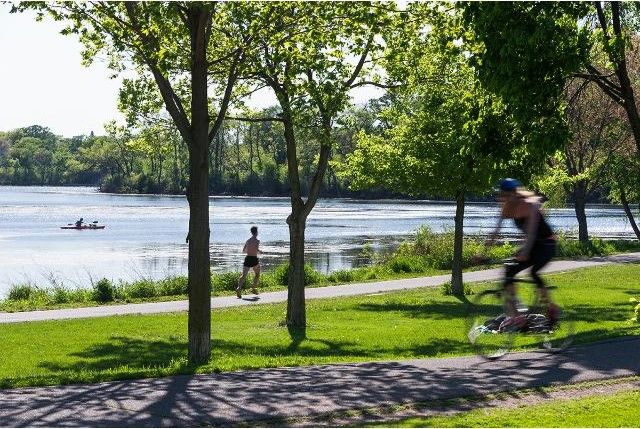
This is Lake of the Isles, a great place to walk or run.
West had a great location. Hennepin Avenue, the standard bus route, that I took to school, goes right by the front of the school. Right across Hennepin Avenue, from the school, was the famous Thirty-One Flavors ice cream parlor. Then, if you were to walk only two blocks from the back of the school, you would run into Lake of the Isles, where you can always see people walking and running around it on the lake’s winding paved path. I often would come there to run. It’s about a 2 ½ mile jog all the way around, and its great scenery made it a great place to get a workout.
I loved the inside of the school; it was so majestic looking. The grey marble floors and the wide marble stairway made you proud to attend. The only negative memory I have of the school was trying to remember where all my classes were. And sometimes, because the school was to big, I had to run between classes to make it on time. I still have bad dreams of that—and also of not remembering where my locker was or remembering the combination.
As far my classes and the teachers, I’m sad to say that I don’t have too much of a memory of any of it. The classes that I liked best were art class and woodworking class, I suppose because you didn’t have to read anything. It was mainly just working with your hands. I think that I have always been naturally skilled in those areas. I do have some memory of other classes and the teachers, not so much because of their teaching, but for other reasons. I remember my history teacher because of the way he scribbled wildly on the black board; he was so funny. I also remember the time when he stopped and gave me a ride to school. I think I had missed the bus. Anyway, be stopped and gave me a lift. His driving was as wild as his teaching. I will never forget it.
I remember my English teacher only because she looked attractive to me. I think I tried really hard in her class, but because my reading comprehension was terrible, I did very poorly. I don’t think I ever got above a D grade.
I remember my math and biology classes because the teachers were both football coaches. Coaches were much more memorable to me, maybe because they seemed to talk straight at you, and they seemed to care more.
I remember band the most. I played the trombone, and for part of the time I was the only trombone in the band. My fond memories of band practice I’m sure was just because I loved music and love making music. Sometimes it was hard playing all the notes as written, but when it finally came together, it was so rewarding and made me feel good. And when any of the music pieces had a special trombone part, I knew it was my time to shine—and sometimes I tended to ham it up a bit!
Well, that’s all for this part. Next time I will write about my favorite thing—sports.
This is the house I lived in during my high school years. This picture was taken in 2018, 50 years after I lived there, but it looks exactly the same.
During my high school years, we lived in a two-story house in south Minneapolis. Both of my parents were working. My dad was working as a door to door salesman in Fuller Brush and also in Watkins products, and my mom worked as a secretary. I don’t think either of them made too much money, but it was enough to get by. In those days it seemed like we all had our own lives; we looked out just for ourselves—all seven of us: two parents and five of us kids. It was a big family but none of us really saw each other much. Like I said, my parents worked a lot. And me, during the school months I was always involved in sports, and in the summer time you could usually find me at the beach on Lake Calhoun.
My older sister, Diane, like me, had her own life. I really couldn’t tell you what she was involved in, except that she was kind of a book worm. Mark, just a year younger than me, seemed to get in trouble a lot. Instead of being involved with sports, he would hang out with friends, that, well, I really don’t know what they did; it seemed that they would just walk around and act cool, and smoke. Mom was always worried about him.
I had another brother and sister, Jimmy and Donna, that came along later. When I was 17 and busy with high school, they were about 6 and 7. I really didn’t get to know them much at all. They were around, but I was so busy with my life that I didn’t hardly notice them. After high school I enlisted in the Marines, went off to Vietnam, and then stayed in North Carolina with the Navigators for the next four years. When I came back home, both Jim and Donna were almost like strangers.
I don’t know why, but I rally didn’t think about any of my siblings much, and I can’t remember that as a family we did anything together. When we lived on the farm (3 and 4 years earlier) it was a little different. I mean, we didn’t do any fun things together, but at least we worked together—in the fields and doing the chores.
I did see my mom the most. I saw her every morning when she got me up for my paper route and for school. I also saw her in the evening when she would be busy working around the house. I guess I did see my siblings from time to time, but, like ai said, we all had our own lives, and sadly, we didn’t much care what the other was doing. I guess mom cared most about the family and everyone came to her with their problems. Dad, on the other hand, seemed to be quite self-absorbed and was angry most of the time—so it was best to stay away from him. I think he was happiest when he was at work with his clients.
Well, that was my life at home. It was mainly just a place to eat and sleep. It was just a place to recharge my batteries for the main part of my life, which was school, sports, and being with my friends. I wish it could have been different, but it wasn’t. I wish home could have been more of a fun and friendly place, but it wasn’t. It was just a place to eat and sleep and to try to stay out of trouble—and away from my angry dad. I like being around mom, but it seemed like much of the time she was sad and crying—over a bad marriage. But I knew she loved and cared about me. And that was good. Fast forward to four years ago (2016), just before she died; she kept saying to me over and over again, “I love you so much Stephen. I’ve always loved you so much.”
Next blog post: I will talk about my high school, some of my classes, and my involvement in the band.




 Stephen Nielsen