Jesus and the Pharisees: No servant can serve two masters (Luke 16:13-15)

This is our thirtieth study. Please click HERE for an introduction to this study.

Luke 16:13-15

13 “No servant can serve two masters. Either he will hate the one and love the other, or he will be devoted to the one and despise the other. You cannot serve both God and Money.”

14 The Pharisees, who loved money, heard all this and were sneering at Jesus. 15 He said to them, “You are the ones who justify yourselves in the eyes of men, but God knows your hearts. What is highly valued among men is detestable in God’s sight.

Observations

When Jesus set forth the principle, you cannot serve God and money, the Pharisees sneered at Jesus, because they believed that their own riches justified themselves before God. And this, their self-righteousness, was their downfall.

Application

The love of money is idolatry. Money is useful only if it is used to benefit His kingdom—otherwise it will be our downfall. Therefore, let us stay away from any thought of getting rich for our own good. Let us despise that idea.

The Rise of the Antichrist

Even before the Rapture of the church—which will come before his ultimate rise to power—the Antichrist will be a man fully engaged in the military. We see this about him in Daniel 11:37-38; it says that “he will honor a god of fortresses.” In fact, it also says that “he will honor him [his military god] with gold, silver, costly stones and treasures”—which means that he will spare no expense in financing his military might.

We also know that he will at some point rise to power in the government; and ultimately it will be the government of the E. U.  I say that because of what it says in Daniel 9:26. In that verse, “the prince who is to come” is referring to the Antichrist; and “the people of the prince” are the Romans, the ones who destroyed the city and the sanctuary—which already happened in A.D. 70. Therefore, this passage is prophesying that the Roman people (which is part of the E.U.) will have a prince, and this prince will be the Antichrist.

We don’t know for sure when it will all come about, but we know that there will be ten kings with ten kingdoms that will be set up in the E. U. It is my guess that he will be totally engaged in that work, so much so that he will have no time for a normal life; for as Daniel 11:37 says, “And he will show no regard for the gods of his fathers or for the desire of women, nor will he show regard for any other god; for he will magnify himself above them all.”

He probably won’t be fully convinced in himself that he is God (2 Thess. 2:4) until Satan possesses him at the midpoint of the Tribulation. However, I imagine that he will be demonized before that time, to the point that he will have no time for anyone else except himself; and he will more and more believe that he alone will fix the problems of the world.

In addition to government and military business, he will make it his business to aid and encourage those religious leaders who will be setting up a new global religion. For I think he will see how all the world is being influenced by the new religion and he will see that he must jump on that bandwagon to be effective himself.

In fact, Scripture (Rev. 17:2-3) seems to indicate that he and all the world leaders will be influenced and taken in with her false teaching, to the point that she (the harlot, which is the name given to the false religion) will control him. But soon, when he is given full power by Satan, he will destroy her.

Shortly after the rapture of the church, and after the Ezekiel war (Ezek. 38-39), he will find his opportunity to focus on world peace.

Jesus and the Pharisees: from Luke 15:1-7

This is our twenty-ninth study. Please click HERE for an introduction to this study.

Luke 15:1-7

Now the tax collectors and “sinners” were all gathering around to hear him. 2 But the Pharisees and the teachers of the law muttered, “This man welcomes sinners and eats with them.”

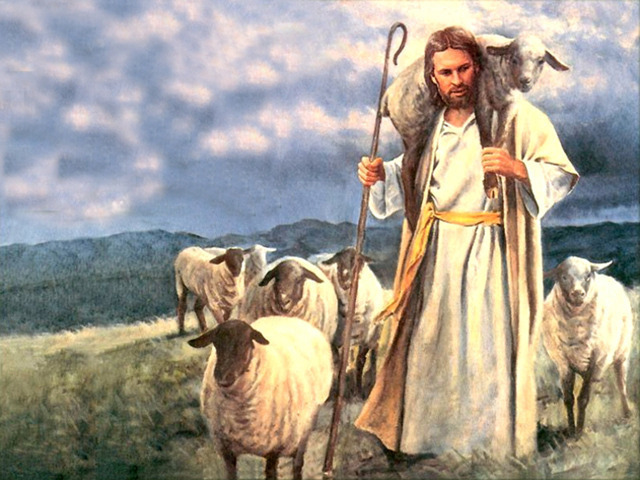
3 Then Jesus told them this parable: 4 “Suppose one of you has a hundred sheep and loses one of them. Does he not leave the ninety-nine in the open country and go after the lost sheep until he finds it? 5 And when he finds it, he joyfully puts it on his shoulders 6 and goes home. Then he calls his friends and neighbors together and says, ‘Rejoice with me; I have found my lost sheep.’ 7 I tell you that in the same way there will be more rejoicing in heaven over one sinner who repents than over ninety-nine righteous persons who do not need to repent.

Observations

In this parable the Pharisees though that the sinner had to seek God and His forgiveness—to earn the right to be in His presence. But God turns it all around. He is the one who reaches out to the sinner, to befriend the sinner in order to save him. God loves every one of his created ones, even those who are not yet found (saved).

Application

We all have a lot of work to do to bring the lost back into the fold. We must do whatever it takes to bring them to salvation. We must be a friend to them.

Earnest Prayer: a study of the greek word agonizomai

Stephen Nielsen's avatarPrayer A to Z

Agonizomai.  This word means to struggle, to wrestle with, to contend or compete with an adversary.  In Colossians 1:28-29 we see that Paul labored and struggled (agonizomai) with all the energy of God, which was working (energeo) in him, to admonish and teach everyone with all wisdom, with the goal to present everyone perfect in Christ.  So here, whereas some people struggle just with their own personal problems, Paul struggled and worked (with the power of God behind him) in behalf of others. 

And we can believe that, as he struggled to admonish and teach, the real struggle was with the devil (Eph. 6:10-13), and his weapon against him was prayer.  For this reason, we can say that earnestness in prayer is working and struggling in prayer (by the mighty power of God) against the forces of evil.  And we do it with the goal…

View original post 100 more words

The Ezekiel Invasion

There are many scholars who believe that the Ezekiel invasion (Ezek. 38-39) happens during the Tribulation. But other scholars take the view that it will happen either before the Rapture or between the Rapture and the Tribulation. I believe, with Ron Rhrodes and Thomas Ice, that it will probably occur just after the Rapture and will set the stage for the signing of the peace covenant with Israel and the Tribulation.

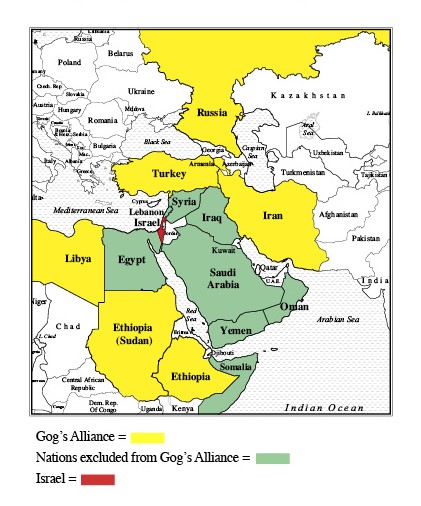
As it is given to us by the prophecy of Ezekiel, God calls out Gog, who is probably a demonic inspired Russian leader; and He summons him, with all the nations under him, to invade the small country of Israel. The countries that come under his command are these:

  • Russia (called in Ezekiel Rosh)
  • Turkey (called Meshech and Tubal and Gomer and Beth-togarmah)
  • Iran (called Persia)
  • Sudan (Ethiopia)

And there will also be “many people with you” (I think this terminology suggests that non-military people will come with all the troops to join in the battle).

Scripture says that God will call them into battle at a time when Israel will be living securely ((Ezek. 38:8, 11-12, 14)—which is now. And these nations will cover the land of Israel “like a cloud” (v. 16). This suggests that they will completely cover the land; in fact, verse 15 says, many people, a great assembly and a mighty army will come. They will probably have tanks and trucks, and helicopters and planes, and some may even be on horseback. There will be millions of them that will come to do battle.

Hence, it appears that God will draw them in, in order to bring His four-fold judgement on them at this chosen time and place (Ezek. 38:19-22).

A great earthquake. Though this quake will be great, Scripture indicates that it will be local to the land of Israel. All living creatures and all men (in that region) will shake at His presence; and the mountains and every wall will be thrown down.

Infighting. Verse twenty-one tells us that God will “call for a sword against him [Gog]…Every man’s sword will be against his brother.” Hence, it appears that God will so confuse them that all communication will breakdown and no one will know who the enemy is. This strange phenomenon, as you may know, happened a few times before in Jewish history, where each time it was the Lord’s doing (Judg. 7:22; 1 Sam. 14:20; and 2 Chron. 20:23).

Disease. Because of all the dead bodies, and because of so many birds and animals feasting on them, this will cause on outbreak of disease.

Heavy rain, hail, fire and brimstone. This final judgment will be most devastating. The skies will pour down heavy rain and hail so hard that it will kill. And the sky will also rain down fire and burning sulfur; this may be from volcanic eruptions caused by the great earthquake.

As I mentioned above, it is likely that the invasion, along with God’s judgment on the invading nations, will occur just after the Rapture of the church. And for the following reasons, that will set that stage for the signing of the peace covenant with Israel and the beginning of the Tribulation.

1. Since almost all Muslims will be wiped out by God’s judgment, this will open the door to a more peaceful, or at least compliant, interaction with them. Since their power and influence will be limited, it will be likely that Israel will dominate the holy sites and will have no trouble building their third temple on the temple mount.

2. Since the soon-to-be-Antichrist will probably reside somewhere in the E. U. and will be one of those who will question the invasion (read Ezek. 38:13), this will put him in a good position, after the failed invasion. In fact, he may claim that he had something to do with it.

3. This Antichrist, who by this time will be a great leader, will take advantage of the situation and will make great friends with Israel; and he will make to them great promises of peace—all fake promises.

Jesus and the Pharisees: from Luke 14:1-6

This is our twenty-eighth study. Please click HERE for an introduction to this study.

Luke 14:1-6

One Sabbath, when Jesus went to eat in the house of a prominent Pharisee, he was being carefully watched. 2 There in front of him was a man suffering from dropsy. 3 Jesus asked the Pharisees and experts in the law, “Is it lawful to heal on the Sabbath or not?”  4 But they remained silent. So taking hold of the man, he healed him and sent him away.

5 Then he asked them, “If one of you has a son or an ox that falls into a well on the Sabbath day, will you not immediately pull him out?”  6 And they had nothing to say.

Observations

The Pharisees were much too rigid and legalistic in their Sabbath laws. Jesus wanted them to know that the Sabbath was made to help people not to restrict them. So He gave them an example of what to do if something came up: if an ox or a son falls in a well on the Sabbath.

Application

In our dealings with people, take time to explain why things are so; don’t just say that the bible says so.

Earnest Prayer: a study of the Greek word energeo

Stephen Nielsen's avatarPrayer A to Z

Energeo.  We said earlier that earnestness, by the word ektenos, conveyed the idea of not relaxing in effort.  Well, energeo carries on that idea but goes further.  Energeo brings the idea of work being efficient, effective and productive.  In prayer our earnestness is effective for only one reason—because God is helping us.  He is the one who puts earnestness in us, and helps our prayers to be productive.  He works His power in us so that whatever effort we make in prayer, that work becomes effective—so that it will bring answers to our prayers.  But more than that, when He works in us by His mighty power—as He is putting His own earnestness into our prayers—He will bring things into our life that far exceed what we ever thought of asking for (Eph. 3:20).

Elijah was a great example of one who prayed with true earnestness—earnestness that was effective. …

View original post 147 more words

Jesus and the Pharisees: from Luke 13:31-33

This is our twenty-seventh study. Please click HERE for an intro to this study.

Luke 13:31-33

31 At that time some Pharisees came to Jesus and said to him, “Leave this place and go somewhere else. Herod wants to kill you.”

32 He replied, “Go tell that fox, ‘I will drive out demons and heal people today and tomorrow, and on the third day I will reach my goal.’ 33 In any case, I must keep going today and tomorrow and the next day — for surely no prophet can die outside Jerusalem!

Observations

The Pharisees were not being kind to Jesus by warning Him of Herod. As John MacArthur noted in his bible notes, “They hoped the threat of violence from Herod would either silence Him or drive him back to Judea.” Jesus’ comment of “that fox,” was a bold statement of fact and indicated that Herod was crafty. The Pharisees were probably astonished at His boldness. As for Jesus, He was not at all intimidated by Herod or slowed down in His mission.

Application

We ought to be steadfast in our  ministry like Jesus, willing to continue regardless of the threats of the world.

Earnest Prayer: A study of the Greek word eklenesteron

Stephen Nielsen's avatarPrayer A to Z


This is my second installment of four on this study of earnest prayer—which are excerpts from my book Principles of Prayer. 

Eklenesteron.  This word has basically the same meaning as ektenos, except with this word the intensity of earnestness is greater.  The word appears in the New Testament only in Luke 22:44, where it describes the way Jesus prayed just before His trial and crucifixion:  “And being in agony, He prayed more earnestly.  Then His sweat became like great drops of blood falling down to the ground.” 

Here it seems that the reason why He prayed so earnestly was because He was so grieved and distressed over the thought of His crucifixion—where he would suffer and pay a horrible penalty for the sin of the whole world.  But take note that His prayers were not weak as to feel sorry for Himself.  No, His prayers were strong.  As…

View original post 411 more words

Jesus and the Pharisees: from Luke 11:53-12:3

This is our twenty-sixth study. Please click HERE for an intro to this study.

Luke 11:53-12:3

53 When Jesus left there, the Pharisees and the teachers of the law began to oppose him fiercely and to besiege him with questions, 54 waiting to catch him in something he might say.

12 Meanwhile, when a crowd of many thousands had gathered, so that they were trampling on one another, Jesus began to speak first to his disciples, saying: “Be on your guard against the yeast of the Pharisees, which is hypocrisy. 2 There is nothing concealed that will not be disclosed, or hidden that will not be made known. 3 What you have said in the dark will be heard in the daylight, and what you have whispered in the ear in the inner rooms will be proclaimed from the roofs.

Observations

In verse 53 and 54, the reason why the Pharisees were so angry at Jesus is because of Jesus’ earlier rebuke of them—His “woes” on them. And so, they were plotting against Him to catch Him off guard. But Jesus, being always on guard, was more concerned with His disciples that they be on their guard against the hypocrisy of the Pharisees. He knew that they were always hiding something, they were always not being truthful. And so, He told them that in the judgment everything will come out, all that is hidden will be made known.

Application

We are always to be on our guard against unbelievers like the Pharisees. People like them are always hiding something; they are always whispering something. They are not to be trusted. But in the end, everyone will find out the truth. No one will get away with anything.