Doctrines of Demons, from C. S. Lewis’ The Screwtape Letters – Part 3
The following points are from notes I took while reading C. S. Lewis’ book, The Screwtape Letters. The book is a compilation of thirty-one letters from a demon named Screwtape to his nephew Wormwood. In it Screwtape gives instructions to his nephew on how to seduce and take down certain humans, mostly new Christians. I think it is an excellent manual on the doctrine of demons (but of course, it is according to one human’s perspective, C. S. Lewis; hence, we can’t be sure it is perfectly accurate). The following points are ways the demons will draw a person over to the evil path.
They (the demons) make it their business to get us away from the eternal present and into the past or the future; both of which will cause us anxiety.
(p. 72) They say that if a human can’t be cured of church going, send him to other churches more lacking in faith and that are more party churches. The more lukewarm he is the better.
On gluttony. They desire that the belly dominate the whole life of the human.
In gluttony, they say that excess of food is less powerful than wanting (lusting after) certain tastes of food. They say that this is a good preparation for attacks on chastity.
They feed us the lie that “being in love” is the only ground for marriage and if lost the marriage will no longer be binding.
They will try to persuade a Christian to marry someone who will be difficult.
They may try to persuade a single human that chastity is unhealthy; and they will try to use unchastity to land a desirable marriage.
(p. 93) They will try to direct men to more desirable (sexual) woman.
They will prepare the human for sexual temptation by darkening his intellect (fill it with deceptions).
They will fill the human with ideas that “my time is my own.” And when anyone invades his time he is angered.
They fill men’s beliefs with false ideas that they “own” their bodies.
(p. 101) They are revulsed at the pleasures that God gives His own, especially young couples in love.
(p. 107) They want believers to treat Jesus only as a great man, but not someone who is divine. This will destroy their devotional life.
(p. 110) They will continue to haunt a good person until they find a chink in their armor—to create in them pride or bitterness or lust.
(p. 115) They want a Christian to be of a mind of “Christian and.” That is, to add something to their faith, like psychology, or faith healing, or vegetarianism, etc.
Instead of asking the question: “Is it righteous, or is it prudent?” they would rather we ask, “Is it in accordance with the general movement of our time?” As a result, they have a better chance to bend our thoughts to what they want for us.
Doctrines of Demons, from C. S. Lewis’ The Screwtape Letters
The following points are from notes I took while reading C. S. Lewis’ book, The Screwtape Letters. The book is a compilation of thirty-one letters from a demon named Screwtape to his nephew Wormwood. In it Screwtape gives instructions to his nephew on how to seduce and take down certain humans, mostly new Christians. I think it is an excellent manual on the doctrine of demons (but of course, it is according to one human’s perspective, C. S. Lewis; hence, we can’t be sure it is perfectly accurate). The following points, in three parts, are ways the demons will draw a person over to the evil path.
They (the demons) want us to stay clear of arguments (or debates) because they will awaken reason; they prefer jargon.
They prefer we read about and speak of experiences over teaching—that is, the demons will try to draw a person into stories rather than sound teaching in order to convince a person to go the wrong way.
They prefer casual talking over science.
(p 11) They want to keep our mind hazy, not to have a clear mind, esp. for the new converts.
They want to keep us disappointed in ourselves.
They want us to depend on our emotions, so we will be easier to tempt.
They want us to be wondering what other people in our church are like, and what they do secretly.
They want us to think of ourselves as very religious and humble, better than most.
They will try to produce in people mutual annoyances.
(p 16) They want us to pray not about bodily pain but over sins—so to remind us of our sins.
They work on things that irritate—tone of voice, twitches, things that the other dislikes.
(p 20) They want to keep us from serious prayer.
They would rather we pray our childhood, parrot-like prayers.
They would rather we not pray directly to God but to our soul to have a “spirit of love.”
Instead of true prayer, they would rather we try to produce in ourselves certain desired feelings—that we try to feel forgiven.
Instead of praying to God in heaven, they would rather we pray to a picture of Christ or to a cross.
(p 24) The goal for them is to secure the soul of humans to the devil.
Their business is to undermine faith and to prevent the formation of virtues.
Their refreshment is to produce any fear and suffering, but in the end it must also bring their soul to the devil.
They may reason that it is better (for the dark side) for humans to die in costly nursing homes that to die in wars.
(p 28) They want us to be filled with uncertainty and contradictory pictures of the future.
They want our prayers to be drawn away from the Father and unto ourselves.
They want our mind to go toward itself and to insults, or to a woman’s body (to lust).
(p 32) Their policy for now is to conceal themselves.
They say that they are helped when they are perceived as comic figures.
They want religious meetings, pamphlets, movements, causes, to matter more for us than our prayers.
In Revelation 7 (from the sixth seal judgment) John, in his vision, saw a great multitude of people praising God.
Revelation 7:9-12
After these things I looked, and behold, a great multitude which no one could count, from every nation and all tribes and peoples and tongues, standing before the throne and before the Lamb, clothed in white robes, and palm branches were in their hands; 10 and they cry out with a loud voice, saying,
“Salvation to our God who sits on the throne, and to the Lamb.” 11 And all the angels were standing around the throne and around the elders and the four living creatures; and they fell on their faces before the throne and worshiped God, 12 saying,
“Amen, blessing and glory and wisdom and thanksgiving and honor and power and might, be to our God forever and ever. Amen.”
This great multitude we know are the resurrected martyrs of the fifth seal (v. 14); and they are worshipping God around His throne with the angels, and also with the elders—who are actually the resurrected church (that will be us!). What a glorious group!
John tells us that this great multitude had washed their robes and made them white in the blood of the Lamb (v. 14); for this reason, they are before the throne of God (v. 15). Hence, they worship Him because they are so grateful to God and the Lamb for their salvation which He purchased for them with His own blood.
And in their worship, they serve Him day and night in His temple; and He spreads His tabernacle over them—which means that He covers them with His presence. And they will no longer hunger or thirst or suffer from the heat of the sun; for He, their Shepherd will guide them to the springs of the water of life; and God will wipe every tear from their eyes (vv. 15-17).
This particular scene is during the Tribulation period in heaven. Of course, after the Tribulation and during the Millennial Kingdom and for all eternity we will still be worshipping Him, and for the same reasons—because He has saved us and is with us, and because He loves us and cares for us.
We will never stop serving Him or worshipping Him. In fact, our service (which includes our reigning) and our worship in some respects are the same. Our service is how we worship Him. And all that we will do in heaven forever will be for the glory of God and to bring Him worship. And that will also bring us pleasure.
None of our earthly pleasures can compare with the delight we will get in serving and worshipping Him. The Psalmist wrote, “Whom have I in heaven but You? And besides You, I desire nothing on earth” (Ps. 73:25).
Our reigning with God and with the Lord Jesus will be in heaven during the Tribulation, then during the Millennial Kingdom, and then on and on for eternity. There are four Scriptures that we will highlight.
From our first passage in Matthew 19:27-28, it happened that Jesus was traveling with His disciples to Jerusalem. And after Jesus had confronted a young man, telling him that he must sell his possessions and give that money to the poor in order to obtain eternal life, he went away grieving; for he was a rich man. Peter then came to Jesus and said to Him,
“Behold, we have left everything and followed You; what then will there be for us?” 28 And Jesus said to them, “Truly I say to you, that you who have followed Me, in the regeneration when the Son of Man will sit on His glorious throne, you also shall sit upon twelve thrones, judging the twelve tribes of Israel.
Here in verse 28, the words “in the regeneration” refer to the regeneration of the earth in the Millennial Kingdom. Clearly, he was saying to Peter and all the disciples that they would sit next to Jesus, each on his own throne, reigning with Him. And their reigning seems to be specifically toward governing the twelve tribes of Israel. Hence, we have to conclude by this that the Jews will be the primary group of people during the Millennial Kingdom.
Luke 22:29-30
And just as My Father has granted Me a kingdom, I grant you 30 that you may eat and drink at My table in My kingdom, and you will sit on thrones judging the twelve tribes of Israel.
In this setting, the disciples were partaking of the Lord’s Supper (the last one); and they began arguing among themselves as to which one of them would be the greatest in the coming kingdom. And it was during this clash that Jesus granted them to eat with Him in His kingdom, and also to rule with Him. How gracious Jesus was to forgive them of their selfishness and to speak to them of how they would reign with Him. Jesus must have thought it was pretty important to tell them what they would do. I think He was excited about it, and He wanted them to be excited and ready for it—instead of arguing among themselves.
Revelation 3:21
He who overcomes, I will grant to him to sit down with Me on My throne, as I also overcame and sat down with My Father on His throne.
This is the third time Jesus brought up the subject of reigning. But here it is not just His twelve disciple who will reign. It is he who overcomes,” which refers to all true believers. And it seems clear that at any time we are in heaven we will sit down with Him on His throne to reign. What a privilege that will be.
In the first two passages Jesus was addressing only His disciples which would rules over the twelve tribes of Israel during the Millennial Kingdom. But in this passage (Rev. 3:21) Jesus is addressing all resurrected believers—you and me. Hence, the disciples will have a special mission to rule over all Israel. But all others (who are resurrected believers) will have other duties. We don’t know what they will be; whatever Jesus assigns to us to do we will gladly do it. In general terms (as Revelation 3:21 indicates), we will reign from His throne—with Him. But more specifically, I think we will probably be assigned some region to rule over, or to do something else.
Revelation 22:5
And there will no longer be any night; and they will not have need of the light of a lamp nor the light of the sun, because the Lord God will illumine them; and they will reign forever and ever.
This passage (vv. 1-5) is clearly describing the eternal state of every believer. We are His bond-servants (v 4); there will no longer be any night, because the Lord God will illumine us; and we will reign forever and ever [with Christ]. So, we are more than servants, we are rulers over the earth and the universe. We are heirs of God and fellow heirs with Christ.
Now before we leave this topic, I want to include a few other verses. This subject is too important to leave anything out.
Genesis 1:26-28
Then God said, “Let Us make man in Our image, according to Our likeness; and let them rule over the fish of the sea and over the birds of the sky and over the cattle and over all the earth, and over every creeping thing that creeps on the earth.” 27 God created man in His own image, in the image of God He created him; male and female He created them. 28 God blessed them; and God said to them, “Be fruitful and multiply, and fill the earth, and subdue it; and rule over the fish of the sea and over the birds of the sky and over every living thing that moves on the earth.”
Just before God created man, He commissioned him to rule over all the earth.” At this point man’s rule did not include other people, but in the end—in heaven—it would, as we will see. But clearly, from the beginning, God made us with the capacity, and a purpose to rule.
Matthew 5:5
“Blessed are the gentle, for they shall inherit the earth.
The gentle can also be translated as humble or meek. They are true believers, followers of God. And I would say that the closer a person is to God, the more he will inherit from God.
Matthew 25:22-23
“Also the one who had received the two talents came up and said, ‘Master, you entrusted two talents to me. See, I have gained two more talents.’ 23 “His master said to him, ‘Well done, good and faithful slave. You were faithful with a few things, I will put you in charge of many things; enter into the joy of your master.’
These verses are from Jesus’ parable of the talents (Matt. 25:14-30). We must be careful not to read too much into this teaching; but here we may definitely see that our faithfulness now will determine how much God will entrust us with regarding our leadership in heaven.
Luke 19:17
“And he said to him, ‘Well done, good slave, because you have been faithful in a very little thing, you are to be in authority over ten cities.’
This is a similar parable as Matthew 25, but it is a little different. In Matthew 25 the faithful servant was put in charge of “many things.” Here the faithful one is given authority over cities. Hence, we don’t really know what we will be given to do. But I’m sure we will be glad to do it.
Roman 8:16-17
The Spirit Himself testifies with our spirit that we are children of God, 17 and if children, heirs also, heirs of God and fellow heirs with Christ, if indeed we suffer with Him so that we may also be glorified with Him.
I love these verses. We suffer now on this earth as He did. But soon we will be glorified with Him. And we will share all things with Him as fellow heirs with Christ. I like what Randy Alcorn said. “Ruling the universe is a family business.”5 Indeed, we are part of His family and we share all things with Him.
1 Corinthians 6:2-3
Or do you not know that the saints will judge the world? If the world is judged by you, are you not competent to constitute the smallest law courts? 3 Do you not know that we will judge angels? How much more matters of this life?
Here the application is to not sue our brethren, but rather to seek the Lord for wisdom in resolving a case ourselves—since we someday will be judges over many and even over the angels.
2 Timothy 2:12
If we endure, we will also reign with Him;
If we deny Him, He also will deny us;
“If we endure” means that we prove that we are true Christians by our life. Then we will also reign with Him. But if we deny Him in this life, He will deny us when we see Him; and we will miss out on the great opportunity to reign with Him.
5 Randy Alcorn, Heaven (Tyndale House Publishers, Inc.: Wheaton, Illinois, 2004). p. 211.
Wrestling with God is never wrestling against Him (in the proper sense), but always for Him, that is, for His righteousness and justice, etc. When Abraham and Moses wrestled with God they argued and pleaded for His righteousness and justice, and for His reputation (Gen. 18:22-32, Ex. 32:11-13). Thus, our wrestling in prayer must always be against evil and on the side of God (though at times in prayer, when we can’t quite understand His will, we will find ourselves arguing against Him—until He shows us what is right).
When we wrestle with God, we wrestling to take hold of God; or we wrestle with ourselves, to arouse ourselves to take hold of God (Is. 64:7). Our wrestling with God, in a sense, is trying to get God’s ear, or to get His attention. It is a crying out to Him, a pleading with Him. But all the while we must not try to convince Him of anything that is out of His will. Hence, our wrestling must always be in harmony with the Spirit of prayer.
But let us not be content to just wait on Him—waiting for His will to play out. No, we must take hold of God and plead for His will. For that is what He really desires of us. It is what the great men and women of faith did, and what we must do.
From Romans 7:23, we understand that the law of the mind is at war with the law of sin; and the law of sin seeks to make us its prisoner. In verse 25 we read that we serve the law of God with the mind and with the flesh the law of sin. The flesh here refers to that part of us that is unredeemed and still desires to sin. The mind refers to that part of us that has been renewed, which wants to do good. So, there is a constant battle within us, the flesh against our renewed mind, and the law of sin against the law of God. And so, we struggle in our mind and in prayer to resist the pull of sin within us.
That sinful flesh within us (our unredeemed humanness) is fed by the things that Satan offers to us out of the evil world. And we lust after those things. That lust (the desire for those things), is conceived within our own heart and gives birth to sin (Ja. 1:14, 15). Our lust is with the flesh (the body), to satisfy our appetite; with the eyes, to satisfy our greed; and with our pride, to satisfy our desire to be wise and important (Gen. 3:6).
But I must note also that even if the evil world weren’t offered to us we would still struggle with sin within us—with our selfishness, our love of ease, and with our lustful desires. Yes, we constantly strive in prayer to resist these things. Henceforth, we continue to wrestle within ourselves against our unwillingness to obey God, and to forgive others, and to pray for them. And we struggle all through our prayers, to be awake and alert to the Spirit of God.
We wrestle in prayer with the goal to find victory over sin through Christ (Rom. 7:25), and to find peace and rest in Christ. We wrestle with the view that we cannot win without Christ, that we are weak without Him. Hence, we wrestle in prayer to find our weakness (that is, our sinfulness) and the strength of Christ. We wrestle to be totally yielded to Him.
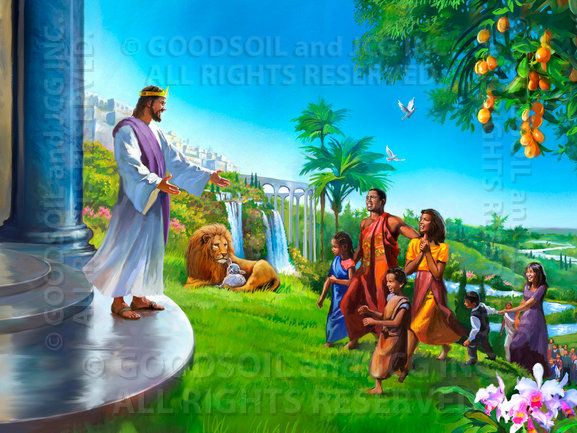
Fellowship is all about companionship and sharing things in common. In heavenly, Chrisitan fellowship, we first of all, have fellowship with the Father and the Son. And of course, we will share in our love for them and for each other.
Before our glorification believers’ fellowship embraced confession of sins and faults, with prayers. And we often meet together to encourage one another. But, of course, fellowship in heaven will not include these things. All that is over and not needed.
If I could describe heavenly fellowship, I would say it involves just being together, sharing heavenly experiences, and sharing the love we have in Christ. It sounds quite simple, but I’m sure that it will never get old. In fact, the thing that baffles me is that we will be fellowshipping with each and every believer throughout history. That will take a long time; but we have an eternity to do it. I count it a challenge to make my rounds, contacting and greeting each and every believer down through the centuries: “Hi John, remember me?” “Hey Noah? Have you built any arks lately?” Just kidding!
Now, on the question of marriage, as to whether we will maintain the same kind of fellowship in heaven with our present spouse, here are a few remarks:
1. The institution of marriage is a wonderful thing for now, but it is a temporary provision. It is one of those things that will be “passed away” (Rev. 21:1, 4), making room for all things that are new (Rev. 21:5).
2. As Jesus declared to the Sadducees, in the resurrection we will not marry, but will be as the angels (Matt. 22:29-30). This, I think, is mainly because, like the angels, we will not die, and therefore, will have no need to propagate.
3. In heaven the man will no longer require a helper because he will be perfect. Likewise, the woman will no longer need a protector.
4. If you have a good relationship with your spouse, you will no doubt continue to have it in heaven; and you will also have that same perfect relationship with all people forever. Being divorced, I sometimes grieve over not having a good married life. But I look forward to having great relationships with all people in heaven.
Besides the question of marriage relationships, we may also have questions regarding our loved ones who have died, whether we will see them again and recognize them. Well, good news, the bible clears that up quite well. Several times in the Old Testament when someone died it was said that he was “gathered to his people,” indicating that the first ones he would see in heaven would be those of his family that he loved.
Here are five examples of men who were “gathered to his people”: Abraham (Gen. 25:8); Isaac (Gen. 35:29); Jacob (Gen. 49:29); Moses and Aaron (Nu. 20:24); Joshua and all that generation who died (Judg. 2:10).
We also have three other accounts that confirm that we will see our dead loved ones. In 2 Samuel 12, when David’s infant child died, he confidently said, “I shall go to him…” Hence, David was assured by God that he would see his child when he also would die.
Then also, in 1 Thessalonians 4:16-18 Paul tells all believers that we should be comforted knowing that our dead loved ones will be raised up first and then all who remain alive when He comes will also be caught up with Him, so that we would be together with those who died.
A third group is Christ with His disciples. In Luke 22:17-18, Jesus promised them that He would soon meet with them in heaven to share a meal together.
Another question we may have, is whether we will see and recognize some of the great saints of the bible like Abraham, Isaac and Jacob. Well, once again, the bible confirms that we will see and recognize them. In Matthew 8:11, Jesus said, “I say to you [people who were following Him] that many will come from east and west, and recline at the table with Abraham, Isaac and Jacob in the kingdom of heaven.”
I guess we can’t be absolutely sure on this point, but I have a feeling that God will make all of us able to recognize each other.
And if you have any thoughts that you will feel lost and out of place in heaven, well, I don’t think you will. I believe that God wants to make all of us comfortable and at home. I have a feeling that heaven will feel more like home to you than any place on earth. We will love being there. After all, we have been looking forward to heaven for a long time.
The most precious thing about our fellowship will be Jesus’ presence, and also the presence of the Father. What will that be like? Pure joy. I know it. Here are a few verses that may shed some light on what our fellowship with God will be like.
1 John 1:3-4
What we have seen and heard we proclaim to you also, so that you too may have fellowship with us; and indeed our fellowship is with the Father, and with His Son Jesus Christ. 4 These things we write, so that our joy may be made complete.
It is clear that our fellowship with each other is based on and is nurtured by the fellowship we have with the Father and His Son. And in this fellowship our joy is made complete.
1 Corinthians 13:12
For now we see in a mirror dimly, but then face to face; now I know in part, but then I will know fully just as I also have been fully known.
Here is a good description of how things will change—with how we will see (or understand) things, including God. We see Him and His will now dimly, but after we are glorified we will see Him clearly (or face to face). God will always be pure spirit, so I’m not sure how we will see Him. Indeed, it will be through our spiritual eyes and in our glorified state; and it is beyond me now. But since I will be sinless, I know I will see Him clearly with glorified eyes—no doubt more clearly than I see anything now.
John 17:24
“Father, I desire that they also, whom You have given Me, be with Me where I am, so that they may see My glory which You have given Me, for You loved Me before the foundation of the world.
Some day in heaven we will see the full glory of the Son (with the Father, v. 2) and share in it. Yes, it will be wonderful. That glory, it seems, will be all wrapped up in the Father’s love.
John 17:21
That they may all be one; even as You, Father, are in Me and I in You, that they also may be in Us…
Backing up a few verses, Jesus has prayed for us that we (all believers) will be one as the Father is one with the Son; and so, we also together will become one with the Father and the Son. This is great fellowship. We will all, with the Father and the Son, be unified together in love.
John 14:1-3
Do not let your heart be troubled; believe in God, believe also in Me. 2 “In My Father’s house are many dwelling places; if it were not so, I would have told you; for I go to prepare a place for you. 3 “If I go and prepare a place for you, I will come again and receive you to Myself, that where I am, there you may be also.
This is absolute confirmation that we will always be with Jesus in the Father’s house. We will never be alone. We will always be with Jesus and with the Father.
In the wake of America’s new administration—a new President with new policies—many people are afraid. Some are afraid of being deported. Some are afraid of being jailed. Many are afraid of the new President’s extremism: on immigration, on his supposed anti-environment beliefs, and his anti-woke beliefs, on all his Bidden reversals, and on what he will do to our country, The outgoing President is so afraid, that he has preemptively pardoned his entire family and many of his loyal supporters, like Mark Milley, Anthony Fauci, and Liz Cheney.
While I was asking myself how anyone can overcome fears, I came across a number of Scripture verses that will give us a clear answer.
Scriptures That Will Help Us Overcome Fear
In the following five verses we will find that the reason we fear is because we lack something; we lack a relationship with God—a relationship that will give us a lasting peace with God, a trust in Him, a saving faith, a loving Heavenly Father, and an enduring love from God. Let’s look at these verses.
John 14:27
Peace I leave with you, My peace I give to you; not as the world gives do I give to you. Let not your heart be troubled, neither let it be afraid.
We need not be afraid of anything in this world if we have the peace that God gives us.
Psalm 56:11
In God I have put my trust;
I will not be afraid.
What can man do to me?
If you put your trust in God you need not be afraid of anything.
Psalm 27:1
The Lord is my light and my salvation;
Whom shall I fear?
The Lord is the strength of my life;
Of whom shall I be afraid?
If you will give your heart to Him to save you, you need not be afraid of anything. He will be your strength.
Romans 8:14-15
For as many as are led by the Spirit of God, these are sons of God. 15 For you did not receive the spirit of bondage again to fear, but you received the Spirit of adoption by whom we cry out, “Abba, Father.”
If you will give your life to Him, if you will trust Him to save you (if you will ask Him to forgive your sins and cleanse you and give you a new life), you will be His adopted child and will no longer have that spirit of fear in you. He will be your Father in which you can cry out to Him whenever you fear anything or have any needs.
1 John 4:18
There is no fear in love; but perfect love casts out fear.
If you are saved and are one of His children, you will abide in His love and will have no fear.







 Stephen Nielsen