Why Rome Is Babylon

When we think of Babylon we normally think of the ancient city of Babylon; and we think of the tower of Babel where Babylon originated. And, of course, we think of the great evil in its idol worship that eventually spread all over the world. And so, I suppose, when we read in Revelation of Babylon and the fall of Babylon, we may naturally think of that ancient city of Babylon, which has to be rebuilt.

But there is another option that I think is more probable. I think Babylon is Rome, and here are six reasons why:

1. After the ancient city of Babylon is destroyed by Cyrus of Persia in 539 B. C., the high-priest of the Babylon religion and his workers fled to Rome. Harry Ironside writes,

When the city and temples were destroyed, the high-priest fled with a company of initiates and their sacred vessels and images to Pergamos, where the Symbol of the serpent was set up as the emblem of the hidden wisdom.  From there, they afterwards crossed the sea and immigrated to Italy, where, they settled on the Etruscan plain.  There the ancient cult was propagated under the name of the Etruscan Mysteries and eventually Rome became the headquarters of Babylonianism.10

Then, as I point out in my book, After the Rapture,

Beginning with Julius Caesar, the Roman emperors seemed to share power with the chief priests. And then, under Constantine the Great, for the first time in history the emperor became both the head of state and the head of the church. Some say that Constantine became a Christian and was trying to Christianize the world. However, others correctly concluded that the devil was working through Constantine to corrupt the church… Hence, as it happened, idolatry was forced upon Christians and many of the pagan practices became part of the church.11

Thus, Rome became just as Babylon was. In fact, it is my contention that Rome, with the Catholic church, is, in fact, the Babylon of Revelation 17 and 18.

2. The false religious system (the harlot) is tied to the Catholic Church of Rome. When we read in Revelation 17:6 that “the woman [was] drunk with the blood of the saints, and with the blood of the witnesses of Jesus,” we have a direct link to Rome. It began with the Popes against Christians such as John Wickliffe and William Tyndale, and many hundreds of others; and it will continue in Rome by the Church of Rome in the future Tribulation period.

3. The harlot (in Rev. 17) looks Roman Catholic. Not only does the harlot act like the Roman Catholic Church in her murders (pt. 2), she looks like the Roman Catholic Church. The colors of the harlot’s purple and scarlet, as well as her jewelry of gold, precious stones and pearls, are the colors and the adornment of the Catholic Priests and Cardinals.

4. The woman sits on the seven hills of Rome (Rev. 17:9). From Revelation 17:7-18, we read that the beast has seven heads and ten horns; and the woman sits on the beast. In verse nine we read that the woman sits on the seven hills.

Many scholars say that the seven hills implies Rome—because Rome is known for its seven hills. A group called City Wonders Team has written,

The Seven Hills of Rome are on the east of the Tiber in the heart of the Ancient City and are said to be the origins of the empire. Back in the day (there is proof of civilization on the hills from as early as 1,000BC) the seven hills were inhabited separately, each with its own independent tribe. Eventually, the tribes came together to compete in sports, strengthening their bonds and uniting their villages. And thus, began the great Roman Empire.12

5. The ten toes as well as the ten horns are the ten kingdoms of the beast and represent the Revived Roman Empire (Dan. 2:33; Rev. 17:12-13). This Revived Roman Empire will most likely be ruled from Rome.

6. The city (of Babylon) will be located on a sea port (Rev. 18:17-19). Here is the most convincing evidence yet that Rome is Babylon: because Rome is located on the Mediterranean Sea; but the ancient city of Babylon is not located on the sea, but on the Euphrates river, which may still be dried up (Rev. 16:12).


10 Harry A. Ironside, “Babylonian Religion,” at http://www.biblelineministries.org/articles/basearch.php?action=full&mainkey=BABYLONIAN+RELIGION+%28By+Harry+A.+Ironside%29.

11 Stephen Nielsen, After The Rapture (Saint Paul, Minnesota, published by Stephen Nielsen, 2020), p. 84.

12 City Wonders, “Could you walk the seven hills of Rome?” at https://citywonders.com/blog/Italy/Rome/could-you-walk-the-seven-hills-of-rome#:~:text=The%20Seven%20Hills%20of%20Rome%20are%20on%20the%20east%20of,the%20origins%20of%20the%20empire.
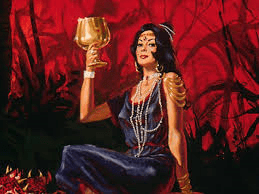
The Fall of Babylon: Religious Babylon

The fall of Babylon, very simply, is the destruction by God of the Antichrist and his domain of evil in the world. It will be a display of God’s authority and dominion. It will be the toppling of an evil kingdom so that a new righteous kingdom can be put it its place.

In tackling this great subject, we will first deal with the fact that there are two Babylon’s: a religious Babylon and a commercial Babylon. In this section we will look at religious Babylon, from Revelation 17; then, in a second blog we will look at commercial Babylon, from chapter 18. Also, along the way, we will show how the two are linked and how we really can’t speak of either of them without there being a connection to the other.

I think there is no better way to study this subject than to work our way through chapter 17, one verse at a time. So, from the first two verses we see that there is a “great harlot who sits on many waters,” and the kings of the earth are allied with her in her evil doings, and all who dwell on the earth are “made drunk with the wine of her immorality.” The great harlot symbolizes the false religious system of this religious Babylon; and it is termed a harlot because of its deceptive, sinful nature—as a prostitute. The term “sits on many waters” is explained in verse fifteen—that she has a ruling power over all the nations of the world; and it seems that they are glad allies with her; moreover, all the worlds people are intoxicated with her teaching.

In verses three and four we read that the woman (the harlot) is sitting on a scarlet beast. This is the first place we see that the woman (religious Babylon) is linked to the beast. And we also read that she is scarlet (v. 4). I have two observations. First, the riding of the beast indicates that she has some control over him. Second, the fact that they both are dressed in scarlet shows us that they both are of royalty and powerful, and they also are tied to the Roman Catholic church (more on that later).

In verse four we are given a picture of this harlot: she is clothed in purple and scarlet, adorned with gold and precious stones, and has in her hand a gold cup full of abominations; then also, in verse five we see that on her forehead is a name written, “BABYLON THE GREAT, THE MOTHER OF HARLOTS AND OF THE ABOMINATIOINS OF THE EARTH.” So, what can we make of this?

First of all, her clothing and expensive jewelry tell us of her great wealth, and also that she is of the Catholic Church. We see this in the colors of purple and scarlet, and also in the precious stores that are worn by priests. The gold cup full of abominations is, I think, the wine of immorality and sin that she partakes of and also offers to all others in the world (v. 2). Then in verse five, the name on her forehead tells us that she (this false religious system out of the Catholic Church) does not hide its abominations, rather, she parades them to the world as something she is proud of.

What we see in verse six, that the woman was drunk with the blood of the saints and with the blood of the witnesses of Jesus, is a further proof that this religious Babylon is of the Catholic Church of Rome; for it has a long history of persecuting and killing Christians in the most barbaric way. And when Rome is established in power, we will see the same practice and with the hearty approval of the Antichrist.

Now there are two more things in this seventeenth chapter that we will mention, which pertains to this harlot—the religious Babylon. First, from verse nine, where John says, “Here is the mind which has wisdom. The seven heads [of the beast] are seven mountains on which the woman sits…” Besides the seven great world empires (Egypt, Assyria, Babylon, Medo-Persia, Greece, Rome, and the Antichrist kingdom), the seven mountains (or hills) also means Rome—which sits on seven hills. I may be wrong, but I can’t help feeling that God wants us to know that the woman sits on and rules from Rome.

Also, from verse sixteen, we should know that at the midpoint of the Tribulation, the Antichrist, with his ten kings, will destroy the harlot (or make her desolate)—and they will do it by the inspiration of God (He will put it in their hearts to do it).

It is also important to know that from this point on, her wealth and the power of her control will be transferred to the beast. Hence, he will now hold all worship for himself. Thus, looking ahead, we must realize that when God destroys Babylon, it destroys not only commercial Babylon but also religious Babylon; for during the last half of the Tribulation, until the end, Babylon is not completely secular but is full of idolatry in its nature—just as it was earlier with the harlot. Hence, at the end all evil is destroyed.

Foxe’s Book of Martyrs: Events following Christ’s Crucifixion

I have read the book before—a while ago. Now I’m reading it again, this time more carefully. I may give a series of blog posts on it, hoping to inspire some of you. Parts of it are gory, but I would focus more on the strength and boldness of the precious martyrs who loved the Lord. They were all so willing and even joyous in their suffering and death, as cruel as it was.

I will start with what happened after the crucifixion of Christ. According to the research of John Fox in 1516, Pontius Pilate was so moved by Christ that he may have become a Christian and tried to convert the whole Roman senate. But Tiberius Caesar would have none of it, and, as Foxe points out, almost all the senators were destroyed and the whole city of Rome was “most horribly afflicted” for almost three hundred years. As for Pilate, he was “sent to Rome, deposed, then banished to the town of Vienne in Dauphiny, and at length did slay himself.”

So, as it appears, Christ was the first of the martyrs. It was his death that so stirred up all of Rome either to believe and not to believe. But it was the evil emperors that were so full of the devil that started the flames of persecution and martyrdom. After Tiberius it was Caligula, Claudius Nero and Domitius Nero who began the reign of terror on the Christians.