Standing at Attention

I had a dream last night. I was in boot camp. As dreams usually go, it was sort of disjointed; but anyway, I remember that I was sitting back, sort of rambling on about something. And then I was asked by a stern voice behind me why I was not standing at attention like everyone else. It was sort of a Gomer Pyle incident. Well, suddenly, in my embarrassment, I realized that I was not at attention as I should be, and I quickly snapped to it.

When I woke up from that short dream I immediately wondered what God was showing me—maybe that I am too lax in my life, and that I am not serious enough and steadfast enough in His program; that I need to get with it.

I was in the Marine Corps from 1969 to 1971 and I never had trouble standing at attention. In fact, I think my conduct was good. I was a good Marine. But lately, now in my old age (at 72) maybe I am becoming a little lax. Maybe I am letting things slide. I think I need to ‘get with the program” more (God’s program).

When I think of standing at attention these words and phrases come to mind: being still, rigidness, readiness, alertness, being cautious, watchfulness, not being lax or slack or laidback or careless, looking my best, being fearless, bold, steadfast, courageous, resisting evil.

And usually, when you think of standing at attention you think of standing with other solders in straight lines—all ready for inspection. So, the picture is of the readiness of a combat unit ready for war.

I think God wants me to understand my dream as how I can be better prepared for the war against the flesh and all evil. He is telling me that I am too lax, too slack, too laidback, undisciplined, too unprepared to do battle against the enemy and evil.

Here are a few verses that come to mind as I think of standing at attention.

Matthew 26:41. Keep watching and praying that you may not enter into temptation; the spirit is willing, but the flesh is weak.

I remember those days in boot camp while standing at attention. It was the perfect opportunity to be still and pray and listen to the voice of God—and my drill instructor!

Isaiah 50:7. Because the Lord helps me, I will not be dismayed. I have set my face like a flint to do His will; and I know that I will triumph.

I remember wearing those wool dress uniforms. They were very itchy and uncomfortable. Standing at attention very still was helpful. I was determined to be strong through the discomfort. Now, 53 years later, I also need to be strong and determined, and to resist all evil and trouble.

Joshua 1:9. Have I not commanded you? Be strong and courageous! Do not tremble or be dismayed, for the Lord your God is with you wherever you go.

Standing at attention is taking a position of strength and courage. Showing fearlessness.

1 Corinthians 15:58. Therefore, my beloved brethren, be steadfast, immovable, always abounding in the work of the Lord, knowing that your toil is not in vain in the Lord.

When we stand at attention in our mind in the army of God we demonstrate to the world and to the angels that we are steadfast and unmovable in any work for the Lord. We will be steadfast to resist all evil and continue in the work of God as He has planned for us to do, knowing that our labor for Him will not be in vail.

After Vietnam: Camp Lejeune and Church Bells

A protestant church at Camp Lejeune.

During the day, every day we would be training for war. Even though I just got back from Vietnam and only had six months left of my enlistment, they kept us fit and ready for combat. Because you never know, they told us, when we would be called back again. After all, we were Marines, and a Marine is always ready, “always faithful.”

But after every day of training, my mind was focused on higher things—on what God had in store for me after my enlistment. I remember wanting so badly to saturate my mind with the word of God. I wrote down all the verses that I knew from memory, like John 3:16-17, 1 John 1:9, Matthew 7:7, and a few others. I had about ten verses on my list. I would start with those. It was my plan to review them daily and then to add to them.

I also had a growing desire to meet God in prayer. After it was dark, I went for walks. I found a place way back behind our barracks, through some trees and by a water bay. It was a secret place that only I knew about. There I sought the Lord. I didn’t ask Him much, I just wanted to be in His presence. Now that I think about it, I think He was seeking me more than I was seeking Him. And every day was the same. He kept drawing me to Himself and wanting me to come to Him.

One day, it must have been a Saturday or Sunday, I decided to go for a walk around the Marine base. My mind was on seeking the Lord for Christian fellowship. I thought it would be good to meet some Christians that I could have fellowship with. As I walked, I quoted Matthew 7:7: “Ask, and it shall be given to you; seek, and you shall find; knock, and it will be opened to you.”

From that verse I ask Him to show me a church where I would find Christians to fellowship with. I continued to walk, and then I heard what sounded like church bells. So, I said to myself, I’ve got to check this out. I walked toward where I thought the sound was coming from, and then I saw the church. I came up to the doors. They were open so I cautiously entered. The pews were all empty, but then I saw a few guys gathered around in front by the church altar. I boldly walked toward them. An older man, about in his 30’s, was reading to the guys from a little booklet. Soon I recognized that it was a gospel track. He was presenting the gospel to these guys, which I assumed were Marines.

After his presentation the leader approached me with a smile and a handshake. He told me that he knew I was a Christian by my smile. God had answered my prayers according to His word. I asked Him to directed me to Christian fellowship and He did. I sought for it and I found the church. I came to the door of the church and it was open and I walked in—I didn’t even have to knock.

I found out later that the man who was sharing the gospel with the Marines in the church was a representative of a group called the Navigators. I would soon be a part of that group.

After Vietnam: Okinawa, Home, and Camp Lejeune

Marine Corps barracks in Camp Lejeune, North Carolina

Looking back at my Vietnam experience, there is one thing that I keep thinking about: the fact that God was watching over me and keeping me from harm. As I previously wrote, I put in for a transfer from my first infantry unit to go to a village unit, because I thought I would have a better chance of being involved in battle. Well, as it turned out, I was in no battles at all in the village unit. And I also found out from a friend that the unit I had transferred out of, at hill 52, had been almost overrun by the Vietcong, and many of the Marines there were killed. So, as it turned out, all the action I took to put myself in harm’s way, God seemed to turn it around to put me in a safe place. That has made me wonder what God has in store for me. What purpose does He have for me?

After Vietnam I was to be sent home for just a week; and then, after that, I had 6 more months to serve on the Marine base in Camp Lejeune, North Carolina. But my first stop was Okinawa. I had a large duffel bag full of clothes and uniforms locked up safe in a storage ben there—so I thought. As it turned out, after looking for a while, the supply clerk told me that there was no duffle bag there with my name on it. Of all the luck. I had a brand-new set of dress blues in that bag that I never got a chance to ware. I wouldn’t have felt so bad about it if the clerk would have been just a little sympathetic toward me. He didn’t seem to care, nor did he seem the least bit interested in trying to recover my stuff. Well, so much for that. I put it out of my mind. Next stop, Minneapolis.

When I arrived at the airport in Minneapolis, I didn’t bother to call home. I just took a taxi home. It was about noon and my mom came to the door. She was quite surprised and glad to see me. For some reason I don’t remember too much during my week off at home. Things were a little different with my mom. She had recently divorced my dad, and so, I hate to say it, but everyone was feeling relieved and more at peace. I suppose the only thought my mom had about the divorce was that she probably wished she’d divorced him sooner. I think we all had the same feeling.

I don’t remember clearly how things were with me and Joy, but I think during this week was when I saw her one last time. I did love her, but I knew the relationship was wrong or would not work. Yet I kept praying for her salvation.

My week off at home went by fast and I was back with Marines again, in a new Marine unit in Camp Lejeune, North Carolina. I had only 6 more months to serve, and I was a little surprised by what they had me do: more combat training. Why? Why was I put in a training unit when I just got back from Vietnam? Well, I can’t remember if I ever asked any of my commanders that question; but I reasoned…what else would Marines do? A Marine trains for war and goes to war. That’s his purpose. Possibly they may have expected that I would re-enlist. In fact, at the end of my two-year enlistment they offered me a promotion if I would re-enlist. I said no. I had been to Vietnam so what else was there for me to do?

Vietnam: On a Hospital Ship

This is probably the Navy hospital ship I was on, the USS Sanctuary.

During my entire Vietnam experience, I was never shot or wounded and I never got a purple heart. But I did have dysentery the entire time, probably from drinking unclean water (everyone else had dysentery too); and I somehow got a bad infection my left arm so that my entire arm swelled up, down to my fingertips. Our platoon corpsman tried to squeeze the puss and infection out, but that didn’t work; it just got worse. And I began to feel weak and nauseous and had a fever. So, they sent me to a Navy hospital ship by helicopter.

Well, those Navy boys worked a miracle on me. They gave me a couple of pills and my arm was back to normal in just two days.  And because of the stool sample that I gave them, they also found that I had hook warms. And that was probably the reason why I was feeling weak and a little nauseous. So, they gave me some terrible tasting white liquid to drink. I think I drank two full glasses each day for a couple of days—and that seemed to kill the warms. More praise for the Navy doctors!   

Being on the ship was a little relaxing and a break from the war. But most of the time, even though I was healing and feeling better, I didn’t feel very good, and was a little sea sick. I remember standing on the ship deck, leaning over the railing, watching as helicopter after helicopter came to deliver the wounded to be bandaged up. Some of them were badly wounded and had lost limbs. I was under the impression that the war was almost over! I guess not. Not yet. The wounded just kept coming in: a constant flow every day during the day time and also during the night. I felt lucky to be alive and in fairly good health. What I had was nothing compared to what I saw.

In just a few days’ time they sent me back to my unit. Some guys seemed glad to see me and that I was all healed up. Others jokingly asked if they gave me a purple heart. I said no. Well, guess what? In a couple weeks I felt sick again, and they sent me back to the hospital. I had the hook warms again! I remember asking the doctors how you get hook warms, and they said that they usually come into your body through the pores in your feet. Then one of them said to me, “But you don’t walk around barefooted do you?”

Well, I guess I wasn’t your typical Marine that left his boots on all the time. I wore them at night when I was on patrols, but during the day I usually lounged around without them. In my defense, if they would have told me on my first hospital visit how you get hook warms, I would have been more careful, like maybe waring flip flops. Also, by going barefoot, there was no chance of me having smelly feet and getting gangrene—as some Marines did.

This is the look of most of the older Vietnamese people. They love their betel nut.

I began to think about all the Vietnamese people who walked around all the time barefooted. Either they found a cure for hook warms or they had gotten immune to it. Now I’m thinking that maybe all the hot sauce they usually ingested took care of them. And the older people were always chewing on betel nut, which is made up of area nuts, and lime and tobacco, wrapped in a betel leaf. This chew is a long-time tradition of the people, but is also a nasty habit. Yes, it is habit forming, it has been known to give them oral cancer, and it stains the teeth and mouth red. Most of the people really like chewing it, and it has some benefits: it numbs the mouth and teeth, and it will save you from the pain of a tooth ache. Now I’m thinking that maybe it helps to kill hook warms too. Maybe.

After my two hospital stays, I only had a month or so to be in Vietnam. I was counting the days. I would leave on August 21, 1971. But wouldn’t you know it, my ride home didn’t come. I was getting nervous. When I complained, they assured me that I was going home soon. They were right. On August 22nd I left. What was next?

Vietnam: Night Patrols

During the day in the village, life was pretty good. But at night things were different: we went on night patrol almost every night; and when we didn’t have night patrols, we usually just camped out in a perimeter outside of the village. When I say camped out, I don’t mean we pitched a tent. We always just sat on the ground somewhere out of sight. Sometimes we would hide in the middle of a rice patty in a foot of water and stayed there all night under the stars with the mosquitoes. And we were not to swat the mosquitoes or use repellent. Our purpose at night was to guard the village and also to intercept any enemy intruders. We were to hide ourselves and stay out of sight. We didn’t want the enemy to see us, hear us, or smell us. If they came through, we wanted to surprise them. We would capture them if possible.

Actually, we didn’t have many encounters; I suspect they knew we were vigilantly on guard and so they stayed away. But one night we did encounter someone. While we were quietly sitting in the dark, soaked in a rice patty, he walked right into us. He was so surprised that, as soon as he saw us, he just took off running. We put up a flare and saw him for just a second, and he was gone. We suspected that he was either a Vietcong that was coming to the village to steal some food, or perhaps he was a VC sympathizer (someone in the village that would bring food out to the Vietcong because they felt sorry for them). And I can understand that, because the Vietcong were just doing what they were ordered to do and sometimes they were barely surviving out in the jungle without much at all.

Our unit, as well as our patrolling, was different than a regular Marine unit. A regular unit, like where I was previously, on hill 52, had bunkers and barricades and was generally more visible; and most of our patrolling was during the day.  But in the village unit, we tried to be invisible. We had no bunkers or barricades and we tried to blend in with the Vietnamese people. All our patrolling was at night under cover of darkness. Our mission wasn’t to seek and destroy; it was to guard the village and to secretly catch enemy invaders by ambush.  

And sometimes it was so dark and quiet that when we heard anything, we were a little uneasy. I will never forget the time when I was scared out of my boots. We were set up in the village in between a couple hutches, and I heard something. So, I drew my 45, and creeped around the hutch looking for whoever it was. I didn’t see him the whole night, yet I heard someone. It was like chasing a ghost. That morning I discovered that there was an ARVN (a Vietnamese military person) at home on leave moving around in the hutch we were guarding—and he had a weapon with him. I don’t know if he knew that we were there, but if he would have gone outside carrying his weapon, I might have shot him. That was a crazy war, and many times the wrong people were shot.

Vietnam: Transferred to A Village Platoon

This is where I stored my gear and shared meals with a Vietnamese family. It was your typical bamboo hutch. I never slept here though. Every night we went on night patrols, and that is where we slept–under the stars.

The more I thought about what was going on down below in the village—how they were under attack every night from the Vietcong (Communist guerillas)—the more I wanted to be down there to help out. And I have to admit that it wasn’t just my compassion and good will showing; it was also my desire to fight. I had been in Vietnam for almost six months and I hadn’t been in a good battle yet. I wanted more out of that war. Maybe I was guilty of being too aggressive and a war monger. But then, I think God has gifted some of us with that war-like desire—in order to fight the enemy.

So, anyway, I prayed about it; and I felt a peace to put in for a transfer from where I was, at hill 52, to the Marine unit below us in the village. And to my surprise, my transfer came through very quickly, in about a week. I don’t remember how I got there, but I probably just walked; the village was only about one-half mile away by the main road (a gravel road).

The Marine unit in the village was a lot different than on hill 52. They weren’t all dug in and they didn’t have bunkers or barricades of any sort. Most of them were living in their own make-shift shelter in the middle of the village, and a few of them were scattered around among the village people.

While I was pondering where I would unload my gear (the little I had), a young Vietnamese girl grabbed my hand and started to pull me. She wanted me to come to her hutch. I could see that there was no objection among the Marines to go where I wanted, so I followed her to where she lived. There I met her mother and father and they gladly welcomed me. It was immediately apparent that they wanted me to stay with them. Communication wasn’t the best with the older folks, but I surmised that they felt comfortable having Marines living with them; maybe they felt safer. The little girls name was Sum. She was friendly, but at the same time very shy. Her mother and father were also very friendly and welcoming; but, unlike Sum, they hardly knew a word of English.

Since servicemen, both Marines and Army, had been in Vietnam for about ten years, the kids knew English almost as well as their own language.  All the older folks didn’t bother to learn English; but of course, they had the kids to translate for them. We also depended on the kids to help us communicate to their parents. And that was helpful when we needed to relay important messages to them, like when we needed them to stay in their homes at night and not to go roaming around. That was critical, especially when we knew that the enemy was close by. We didn’t want any of the villagers to be hurt. And that was the main function of our unit—to protect the village.

This is Leam. What a great kid.

Besides Sum, there was also a boy about the same age (about 10) that came up to me asking if I needed any help. His name was Leam (pictured). He was also kind of shy, but not as much as Sum. I didn’t need too much help, but he did help me wash my clothes and a few other things.  Of course, the kids all wanted to be paid for their work, and I was glad to pay them.

One of the greatest blessings I received from my transfer to that unit and from my stay with Sum and her family, was my fellowship with them at meal time and the sharing of food. Typically, most of what they ate was white rice (which they grew in their own rice patties) and just a very little bit of fish or some kind of meat mixed in a hot fish sauce called nuoc mam. Well, since they have so very little meat, they were quite grateful to me when I offered some of my meat from my c-rations to them. Eventually, I decided to just share all of my meat (whatever it was) with everyone, and they in turn gave me as much rice as I wanted. I felt so blessed to share meals with them.

A Marine getting help washing his clothes in the river.

Vietnam: Glasses, Chaplain and Coke

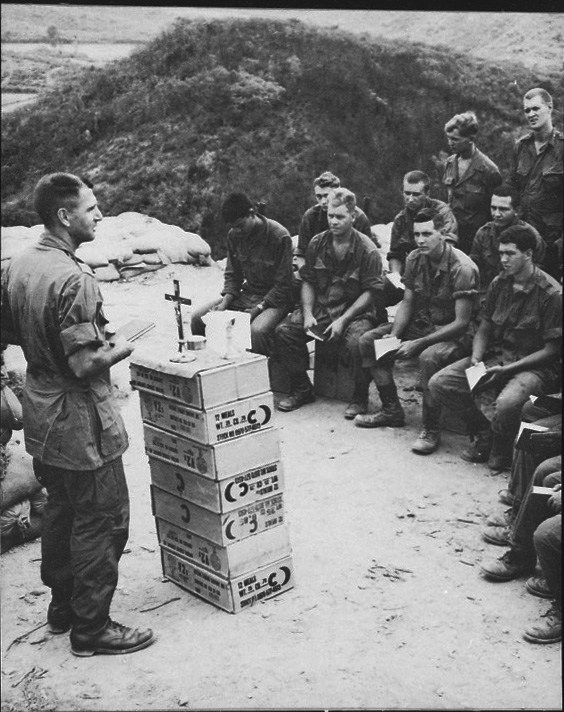
A Chaplain holds a service in Vietnam.

There was always something to take you away from your regular duties. My diversion was that I needed glasses. I can’t remember what happened to them. Either I lost them, or they broke. Anyway, after going without them for at least a month, I finally realized that I should try to get them replaced—mainly, so that I could see what I was shooting at.  Yea, that might be important. So, I reported my situation to the commander and they sent me to hill 65, right down the road. I don’t remember exactly how I got my glasses, only that it took a while. I was on that hill for about two weeks waiting for them to come.

But while I was waiting, they put me to work. I remember so well what happened on the first day I arrived. An older high-ranking Marine came to me and said, “We need someone to make salads in our kitchen, You’re our man.” He didn’t ask me if I thought I could do it; he just assumed I could. Next, he led me into the kitchen, showed me the weekly menu and what time to have the salads ready. I was a little surprised that he had so much confidence in me, without really knowing me. It was almost like he was commanding me to do it, and at the same time believing that I could. Well, just because he had so much trust in me, I felt motivated and empowered. And you know what? I made some pretty good salads. Every day of the week I made a different kind of salad. Monday was shredded carrots and raisons. Tuesday it was coleslaw. And Wednesday it was something else. Hey, I was a cook! Hard to believe. And no one complained. Oh, by the way, in case you’re wondering, hill 65 was more than your typical fighting unit, hence the hot chow and even a kitchen.

Another memorable experience on hill 52 was when the Chaplain came and brought hot food and a bag of gifts for everyone. The hot food: turkey, mashed potatoes and gravy, etc., was so good, but I wasn’t use to it and it made me sick. Everyone in Vietnam had dysentery, but the hot food made it worse. Oh well, I guess it was worth it. I also really liked the gifts the Chaplain brought: a little living New Testament, some stationary, and a few other things. Everyone like it when the Chaplain came. He was like Santa Claus. And they liked it also that his sermons were short.

Another vivid memory was one day when our squad was out in the middle of nowhere on a very hot day on a security detail, and along came a Vietnamese boy on a bicycle with a case full of ice-cold cokes. At that time a can of coke was only about 5 cents, but he was selling them for 50 cents. He was making quite a prophet, especially since it was so hot and everyone was buying them. I remember marveling at his salesmanship and shrewdness. And there were also, occasionally, girls coming by, selling their bodies. Surprisingly, most of the guys gave in, but not me. God had shielded me from that particular temptation.

I want to mention one more memorable thing that was constantly going on within visual range of hill 52: the day time bombing missions in the air, and the evening fire fires on the ground. I remember watching the fighter jets sweep down on a target, and then, when they almost hit the ground, turn sharply at about a 90% angle, and head up to the sky again. It was quite a show. And they were doing that constantly it seemed. But I never knew what they were shooting at. Maybe nothing. Maybe it was all practice, or just to give us a show.

As far as the fire fights below, that was not just a show. We could see intermittent tracer rounds going back and forth across a field (On a machine gun, usually every fifth round was a tracer round: a round that appeared as a red streak, with the purpose of gauging how close you were coming to your target). On one side, to our right, the bullets were coming from Marines guarding a Vietnamese village; and on the other side there was a tree line where the Vietcong were hiding. I often wondered how the Marines were doing, and if they were suffering casualties.

Vietnam: Letters, Cards and C-Rations

This is me writing a letter. “Dear mom, I’m getting ready to go out on patrol. Please pray.”

Contrary to what some people probably think about the Vietnam war, we weren’t always in battles, fighting for our lives. There was actually a lot of down time in-between patrols. And as I remember, our platoon commander was fairly easy-going and didn’t give us a lot of extra duties; just the necessary things like outhouse duty, consisting of burning and dumping the sewage barrels.

During most of my down time, I wrote letters. Most of the guys didn’t do that so much, but I would write at least one letter a day. My pen pals were mainly my mom, a man from my church, and about three or four different girls. Now don’t get me wrong; I’m not some kind of a lady’s man. I was just trying to stay somewhat sane, and I guess I liked people (girls) telling me that they were thinking of me and praying for me. At first Joy, the one I was so crazy about in high school, would write me quite often.  But after about 3 or 4 months, she didn’t write quite so often. I actually felt relieved, because I didn’t feel that our relationship was right—of the Lord. Then this other very young girl (about 14 years old) started writing me and even sending me packages of cookies, etc. As I wrote previously, she got my address in Stars and Stripes, a military newspaper. Anyway, she wrote me very consistently all through Vietnam and sent goodies. What a ministry she had to me. I remember witnessing to her and she actually became a Christian, but I’m not sure how that happened or what influence I had on her. After I got back from Vietnam and was discharged, I went to visit her and met her mother. I was praying that maybe we could make a connection (a date), but it never happened. I wish I could remember her name. The other couple of girls that I wrote, it wasn’t as often, but I was glad to get their letters and their appreciation of my service.

Sometimes I would join in a game of cards. We always played the same game. I think it was called “back alley.” It was fun and helped to get our mind off of whatever was bothering us. Some of us were just bored. Some of us, like me, would almost rather be patrolling—doing what we came there to do.

Our meals came every day with the mail and supplies—from a helicopter. Generally, it was 2 C-rations a day. One meal consisted of a can of meat and potatoes or something similar, a can of some kind of fruit, a small can of crackers with a chocolate patty, and a small carton of cigarettes (about four in each carton). Every meal had cigarettes in it, so if you weren’t a smoker when you came to Vietnam, there was a good chance that you were a smoker when you left. I smoked for a short time, but not enough to give me the habit. Besides, I didn’t want to have one more thing to make my mom upset about.

Heating up some ham and eggs. Yum!

Oh, each box of C-rations also included a heat tablet, some matches, a plastic fork and spoon, and a package of instant coffee. Some guys chose to eat their food cold, but I was more civilized and always heated mine up and made coffee too. I think Vietnam is where I got the coffee habit. Now the way I would heat my food up is to make holes in my empty cracker can, turn it over, and put the heat tablet under it. It made a great stove. The heat tablet we had for each meal would burn just long enough to heat up your food and make coffee. I really got to like C-rations.  Mmm good!  Can you tell that it doesn’t take much to keep me contented? Thanks to God, I seem to learn very easily how to be content in every circumstance.  

Vietnam: Security Watch

Me and this Marine made the most of the day under this sun shelter.

In addition to weekly platoon patrols, we almost daily went on squad patrols, mainly just for security around our location—hill 52. The patrolling never lasted more than a couple hours, but once in a while the squad leader decided to cheat. That is, we didn’t really go where we were expected to go. I remember, on one occasion we went over the first hill to our first check-point, and just sat there for the entire time. We were always required to call in at every check-point to report. Well, we called in every 15 minutes or so and pretended that we were at the next check-point. I wasn’t in favor of it, but most of the squad justified it, explaining to me that it wasn’t worth the risk of someone getting killed. I could understand their reasoning, but yet it still didn’t sit right with me. And I hated just sitting there doing nothing.

In addition to patrolling—and fake patrolling—we also occasionally just sat and watched. I don’t remember what the exact reason was, but on one occasion 4 or 5 groups of 2 Marines per location sat alongside a gravel road. We sat there most of the day doing nothing. I suppose we were there just to let people know that there were Marine in the area. And it was hot. So, I found a couple long branches and made a shelter for shade out of my poncho liner (pictured). Some of the guys never thought of doing anything like that, but for some reason I was always thinking of ways to make the most of the situation.

Night watch was most important. Whether we were away on patrol or at our home base, it was so important to have at least one guy awake and watching. The enemy would often strike at night when most were asleep. And if the watchman fell asleep, which occasionally happened, that put the squad in grave danger. I remember many a time while on watch, I struggled to stay awake. I often used the time to pray and quote Scripture. Here’s one that I probably thought of:

Watch and pray, that ye enter not into temptation: the spirit indeed is willing, but the flesh is weak (Matthew 26:41).

Vietnam: Large Patrols

Here our entire platoon was getting ready for a major patrol.

I arrived in Vietnam in February of 1970. I had just missed most of the fighting, which mainly occurred during the Tet Offensive in 1968. So, I guess you could say that I was part of the clean-up crew. We were there to mainly watch over the area and stop any insurgency groups. Very rarely were we called on for any major offensive missions, but we went on patrol almost daily, just to look around and kill or capture any of the enemy forces that were still there—many of which were dug-in, hiding in underground bunkers and tunnels.

Our patrols were both by the entire platoon, made up of four or five squads—about forty Marines; and by squads—there were about eight in our squad. The larger, platoon patrols happened less often, maybe about once a week at the most. But the smaller squad patrols went out almost daily.

This is Che taking a rest. We were on patrol in the “Arizona Country.”

The platoon patrol always had more of a mission and sometimes lasted more than a day, and sometimes up to a week. The mission I remember most was when we went to the “Arizona Country.” I don’t know why they called it that; probably because it was always very hot there due to the tall elephant grass that would block the wind, but yet the sun would beat down on you. I remember that a couple guys fainted from heat exhaustion. I think those were the only casualties we had, even though, for a time, the enemy had us surrounded. It was kind of surreal. We didn’t know exactly where they were, because of the tall grass that was blocking our vision. Yet their ak bullets (from the AK 47) were zooming over our heads from all directions. I suppose we could have gone out to get them, but we weren’t that eager—or stupid. So, we just got very low and crawled away to safety.

Now that I think about it, there was another platoon mission that was equally memorable. I don’t remember exactly where we were patrolling, but at the end of the day we stopped at a clearing and were told to dig in. Sometimes we weren’t given the details of the mission; we were just given orders and were expected to follow them. So, the platoon made a perimeter and dug fox holes big enough for two or three guys each. That night we were fired on, but we didn’t see them. And a couple of grenades were also thrown our way, but not close enough to hurt anyone. Strangely, some of the rounds were coming from above, like they were in the trees. In one case we could see automatic tracer rounds coming from one location, but hitting in only one spot. There was only one explanation I could think of: there was a machine gun planted up in a tree and a guy below was pulling a string that was tied to the trigger.

As soon as it was light, the enemy fire seemed to end. So, we very cautiously gathered up our gear to depart. I remember that one guy who was not even in a fox hole, but was lying in the nearby grass, just stood up and stretched as if he was waking up from a deep sleep. We all quietly yelled, “Get down, are you crazy.” The truth is, he had probably been smoking Marijuana and had apparently slept through the whole night not knowing what went on that night.

The only casualty came just before we left. I don’t remember who it was, but he was sitting right next to me; and he stood up, took just two steps, and boom! He stepped on a small booby trap. It didn’t kill him, but the shrapnel cut him up pretty bad. We tried to comfort him by telling him, in between his cries of pain, that he would get a purple heart and would be going home. A metevac helicopter came within about fifteen minutes and took him away. I was so impressed at how fast they came.

Before we left, we called in napalm. That means that an airplane flew over and bombed the area all around us with napalm, which is a very hot incendiary explosive used to quickly burn out the enemy. It was standard practice to use napalm in Vietnam after such missions, especially if we knew that there were underground tunnels around, which we suspected there were.