What is the source of every Christian’s authority? Well, first of all, let’s examine this authority.
Nelson’s Illustrated Bible Dictionary describes authority as “The power or right to do something, particularly to give orders and see that they are followed. The word authority as used in the Bible usually means a person’s right to do certain things because of the position or office he holds.”
In view of this definition we can see that in a general sense everyone from a king to a small child has some degree or level of authority. While a king has authority over many people, a child also has authority, even if it is only over a small puppy. But there is one who has absolute authority over all things. His name is Jesus. He has authority over all people. He has authority over all the creatures on the earth and in the…
This is an excerpt from my book Principles of Prayer.
1. Authority to pray for the lost. Since God desires all people to be saved (1 Tim. 2:4) He must also want us to pray for their salvation. Here are three things that God desires us to pray for the lost: (1) that their hostility or indifference for the gospel would be broken down and that God would grant them repentance (2 Tim. 2:25); (2) that the soil of their hearts would be prepared for the seed of the Word of God so that His Word would not return void, but would accomplish what He desires (Is. 55:11); and (3) that they may be liberated from the power of Satan—delivered out of darkness and into God’s marvelous light (2 Tim 2:26).
These are just a few things we could pray for the lost. I would encourage you to claim in…
Our power and authority is in Jesus Christ. If we position ourselves so that we are always abiding in Him we will have His authority. And it will come to us (as we are abiding) with the help of the Holy Spirit. When we ask Him to fill us and empower us He does it—and He gives us the holy life of Christ and exerts Christ’s authority in us and through us with power.
We do it in connection with prayer. Prayer is the normal means that God has bestowed on us to communicate with Him and to ask for His help in all things pertaining to our authority over our enemy. Here are three ways, in connection with prayer, in which we must execute our authority with power:
1. By prayer in the Holy Spirit.Prayer must always be in the Holy Spirit (Eph. 6:18). He helps us to…
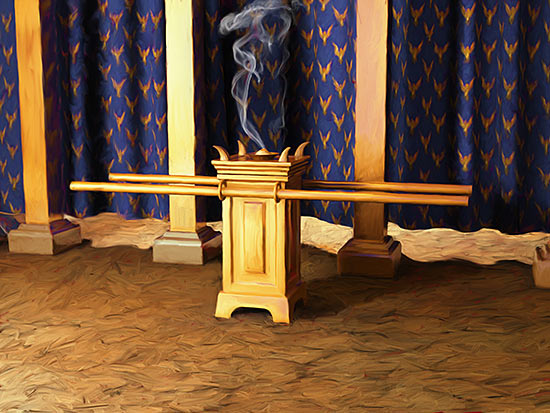
Unceasing prayer is so important and also very possible. The following discussion, centered on the Old Testament Tabernacle and the burning of incense, will help explain how we can pray unceasingly.
As we approach the important topic of burning the incense, which is symbolic of praying, let us consider how to answer the following four questions:
What makes the incense burn? As we have discussed in a previous post, the incense upon the golden altar was symbolic of Christ and His prayers. And the aroma of those prayers rose up to God only by the burning coals of the brazen altar, which prefigured His death for our sins on the cross.
But the question before us now is: what started (or ignited) the incense (which for us is the prayers) on the golden altar? And what kept the prayers going? Well, I believe it was, and is, the Holy Spirit. …
In order to get the full benefit of Christ’s work for us on earth and in heaven—which would include receiving forgiveness of sins and answers to prayer—we must come to faith in His blood, rather we must trust Him and believe in the value of His shed blood for us.
I like what Charles Fuller has said:
You can never benefit from Christ’s work, typified by the Golden Altar, until you accept what He has done for you at the Brazen Altar. You can never have the confidence that Christ intercedes on your behalf, until you have accepted his atoning death for your sins. Remember, to get to the Golden Altar you must first pass by the Brazen Altar where the sacrificial lamb was slain and offered up. So likewise, to know Christ’s constant watch-care over your life, you must first humbly kneel at the foot of the Cross, confess…
In Psalm141:2, David prayed, “Let my prayers be set before You as incense…” What a prayer! David really had a heart for God, and he wanted to please Him with his prayers—he wanted his prayers to be as the sweet smell of incense that rose up to God continually in the tabernacle.
It is my prayer that we would desire that our prayers—and really, our whole life—would be as incense to God.
Consider what the writer to the Hebrews said in Hebrews 9:24: “For Christ is not entered into the holy places made with hands, which are the figures of the true; but into heaven itself, now to appear in the presence of God for us.” M. R. DeHann comments on this verse:
The writer of Hebrews, therefore, leaves no doubt whatsoever about the typical significance of the tabernacle…the Holy Place (the tabernacle) was a ‘figure of the true’…
In order to get a clear picture of what was happening in the tabernacle and to know how the incense was made to have true value, we must go back and a look at the brazen altar. For there the work of Christ began, where He suffered and shed His blood and died, purging our sins. Thus the brazen altar is a type of the cross, which was Christ’s first work in God’s whole plan for our redemption.
The brazen altar, the place where animals were sacrificed, was made of brass and had no crown; thus it speaks to us of the suffering and humiliation of our Lord on earth. But the golden altar, with a crown of gold, speaks to us of the reigning of Christ in heaven.
The blood from the sacrifices of the first altar was symbolic of the blood of Christ; the incense of the second…
Faith is that element in abiding that I think is most dominant. Also, it is that element that ties all the other parts of abiding together, for we cannot meditate on the Word, bear fruit, obey God’s commandments, or please Him without faith.
Here are eight things that the abiding Christian does to build his faith in order to keep him abiding:
1. He makes it his habit to meditate on the Word every day. This daily meditation time helps him to see things from God’s perspective, gives him a desire for God, and helps him to adjust his desires to God’s desires.
2. He obeys God and keeps himself busy with His work. The abiding believer knows that faith isn’t really faith without obedience and work. In fact, he is convinced that his faith is perfected by obedience (Ja. 2:22). Therefore, he is always diligent to listen to…
We have been studying Jesus’ Sermon on the Mount, and following D. Martyn Lloyd-Jones teaching from his Studies in the Sermon on the Mount. We have now come to the section following the Disciples Prayer outline, verses 19 -20, where Jesus tells us,
“Do not lay up for yourselves treasures upon earth, where moth and rust destroy, and where thieves break in and steal. 20 “But lay up for yourselves treasures in heaven, where neither moth nor rust destroys, and where thieves do not break in or steal.
So here, we come to the problem of living the Christian life in the world and therefore how to overcome to world while living in it. Jesus gives us two points to follow: 1) we are not to store up for ourselves treasures upon earth, but 2) we are to store up treasures in heaven.
We Are Not to Store Up for Ourselves Treasures Upon Earth
Here are a few notes from my reading:
Jesus wants us to be concerned not so much with having wealth and possessions, but with our attitude toward them.
We are to be concerned with our whole attitude toward life in this world. That is, we ought not to get our total satisfaction in life from things in this world.
A person’s treasures are the things that mean everything to him—what he is living for.
Here are some things in this world that can become our treasures: love of money, of honor, of position, of status. We are not to be so concerned with these things that they take up our entire life. These things will all pass away in the end.
We Are to Store Up Treasures in Heaven
Use your riches to prophet you for the next life.
Do not labor for what will perish but for what will endure to everlasting life.
Have a right view of life. In this world we are pilgrims. We walk under the eye of God, toward our everlasting hope.
Our attitude must be that I am not the possessor of my things. They really do not belong to me. I am but a custodian of them.
I should always be using my things for the glory of God.
I am a child of God placed here for His purpose.
I must hold my things loosely; I am to be in a state of blessed detachment from them; and I should always be considering how I can use the things that God has entrusted to me for His kingdom.
Pleasing God is the element in abiding that we will consider here. I have called it holiness because that is exactly how we please Him—by our holiness.
In 1 John 3:22 we find that the promise of answered prayer comes to us when we keep His commandments and do those things that please Him: “And whatever we ask we receive from Him, because we keep His commandments and do those things that are pleasing in His sight.” Notice that the requirement of pleasing God is not by itself; it is coupled with the requirement of keeping His commandments—the chief of which is to love God and others. This tells us that the two go together and that they cannot be separated. We cannot please God without obeying Him and we cannot truly obey Him without pleasing Him.
But the fact that the two requirements are separated tells us also that…








 Stephen Nielsen