“Beware of the false prophets, who come to you in sheep’s clothing, but inwardly are ravenous wolves. 16 You will know them by their fruits…”
The most dangerous person is not the one who is a persecutor of Christians, but those who pretend to be Christians but are not. Even more, it is the pagan who seeks to make money as a preacher and to seek out those gullible young Christians to profit off of them. Jesus knows this kind, that will steer people away from the narrow way into the broad way—the way of the world. Hence, he says, Beware of them! Beware of these false prophets, who come to you in sheep’s clothing. You will know them by their fruit.
What is meant here is that the true nature within a person is bound to express itself. It is bound to show up in his teaching and life. That is, what is in the center of the heart (what a man really is) is certain to proclaim itself. So, as a man thinks, so he is and does.
It is D. Martyn Lloyd-Jones’ opinion that we should discipline ourselves to look carefully for the fruit—in ourselves and in others. Otherwise, why would Jesus insist that we can know them (the false prophets) by their fruit. I think we too often, when we come into a church, just accept the pastor for whatever he says, and believe that he is a good man. I think we should observe carefully to see if he is a true prophet of God or not. And we can do this for everyone—even ourselves. In my reading of Lloyd-Jones sermon on this passage, I collected the following ways to check the fruit in people, especially preachers, to see if they are true Christians or false.
Try to identify a person’s motives. If he tries to live a good life for any reason other than for Christ than he is false.
The false prophet does not have the character of a true Christian. Their outlook on life is secular, their entire attitude is worldly, and they lack the joy of the Lord.
The false prophet does not exemplify the beatitudes: being poor in spirit, mourning over sin, being meek, hungering and thirsting for righteousness, etc.
The false prophet does not have the fruit of the Spirit: love, joy, peace, etc.
The false prophet does not have the same joyful appearance of a Christian. For what is in the nature of a Christian will show in his whole personality. He has the joy of the Lord that is easily shown on his face. (Of course, if a Christians is not walking in the Spirit, that inner Christian nature will be hard to see.)
The true Christian is humble, but the false prophet is full of the pride of life and is full of worldliness.
The false prophet, and generally the non-Christian has idle words. When he is off guard (when he is joking with his friends) he may show who he really is; his real ungodly nature comes out.
The way in which a preacher preaches is more significant than what he says. If he laughs and jokes about serious things as God’s holiness and the judgment, this will reveal his nature. We give ourselves away by our unguarded actions and words.
“Beware of the false prophets, who come to you in sheep’s clothing, but inwardly are ravenous wolves.
This verse (and the following few verses) follows directly after where Jesus spoke on entering by the narrow gate and walking along the narrow way (v. 13-14). Hence, what Jesus is suggesting here is that we beware of those who will try to persuade us not to enter at the narrow gate and walk in the narrow way. These are false prophets.
We will now take a closer look at these false prophets, according to what D. Martyn Lloyd Jones has preached on in his Studies in the Sermon on the Mount. In my reading and note taking, I have come up with ten descriptions of the false prophet.
1. They will appear as Christians. They will come to us in sheep’s clothing, but inwardly they will be ravenous wolves. Therefore, they will look like good people and no one will suspect anything false from them. They will be nice and pleasant and appear to be Christians. They will use Christian terms and talk about God, and Jesus, and about the cross, and about the love of God, etc.
2. We will know them by their fruit. When we really get to know them, we will discover that their teaching is wrong and also their life (their conduct).
3. We may recognize them by what they do not teach. As far as recognizing the falseness, it is not so much recognized by what they say, but rather by what they do not say. They will tend to leave out or pass over certain important biblical teachings. And they do this in order to not offend you or to be more popular.
4. His teaching is absent from doctrine. His preaching is almost entirely absent from doctrine. He does not like doctrinal preaching, and when he does preach doctrine, it is vague and in error.
5. He does not speak on holiness. The false prophet rarely speaks about holiness and righteousness and justice and the wrath of God. He will not say that he does not believe these things, yet he says next to nothing about them.
6. He leaves out bible prophecy. The false prophet fails to talk about bible prophecy and future things. This is true of most preachers these days. But I have a remedy for them. If they would just preach through the bible one verse at a time, they would be forced to preach on bible prophecy, since almost one-third of the bible is prophetical.
7. He fails to preach on sin. He will not emphasis the doctrine of sin and the sinfulness of sin.
8. He will not preach on what Jesus did for us on the cross. He will talk about the cross and about the death of Christ, but he will fail to preach on what Jesus’ death did for us—that God made Him to be sin for us (2 Cor. 5:21) and that He paid the penalty for our sins.
9. He dislikes self-examination. He will not emphasize the necessity of entering the narrow gate or walking in the narrow way. He is not interested in true holiness; thus, he dislikes the process of self-examination and the mortification of sin as taught by the Puritans.
10. They reject the idea of being a Christian warrior. They reject talk about fighting the good fight of faith, and they do not see the need for putting on the armor of God. They would rather practice easy salvation and living an easy and prosperous Christian life.
As I mentioned previously, I am writing a book now on THE TRIBULATION, and I will be blogging it as I go along. I have written the first chapter entitled Leading Up to the Tribulation, and I presented six points: 1) Dealing With, Or Not Dealing With, 2) The Aftershocks Of The Rapture; 3) Setting Up A Global Government; 4) Seeing The Beginnings Of A New Global Religion; 5) The Ezekiel Invasion; The Rise Of The Antichrist; and 6) World Peace, Temple Preparation And The Peace Covenant.
I have already blogged the first point, and today is the second. I will present it just as it will be in the book—uncut.
SETTING UP A GLOBAL GOVERNMENT
As the world tries to deal with the aftershocks of the Rapture, key leaders of many countries will begin to meet together to find global solutions. And we know, according to Scripture, that the world will come to a unified agreement on the establishment of a new global government—as well as a new global religion. It is likely, however, though many ideas will be discussed and agreed upon, that the new government won’t actually begin until the commencement of the signing of the peace accord with Israel, which will mark the beginning of the Tribulation.
There is no way of knowing the details of what will be discussed when the key leaders come together, but the topic of a new global government will probably be the most immediate. Under this major topic they will likely discuss and seek to make decisions on a global currency, the form of government and controls of the government.
It seems that the world has already made huge strides with currencies, or with many new methods of payment, especially with credit cards and also by bank transfers. I don’t see that there will be any problems with converting to a global currency or maybe with on credit card used by all.
As far as the government itself, most bible scholars agree that the new world government will be a revived Roman Empire. Biblical proof of this is taken from three Daniel passages.
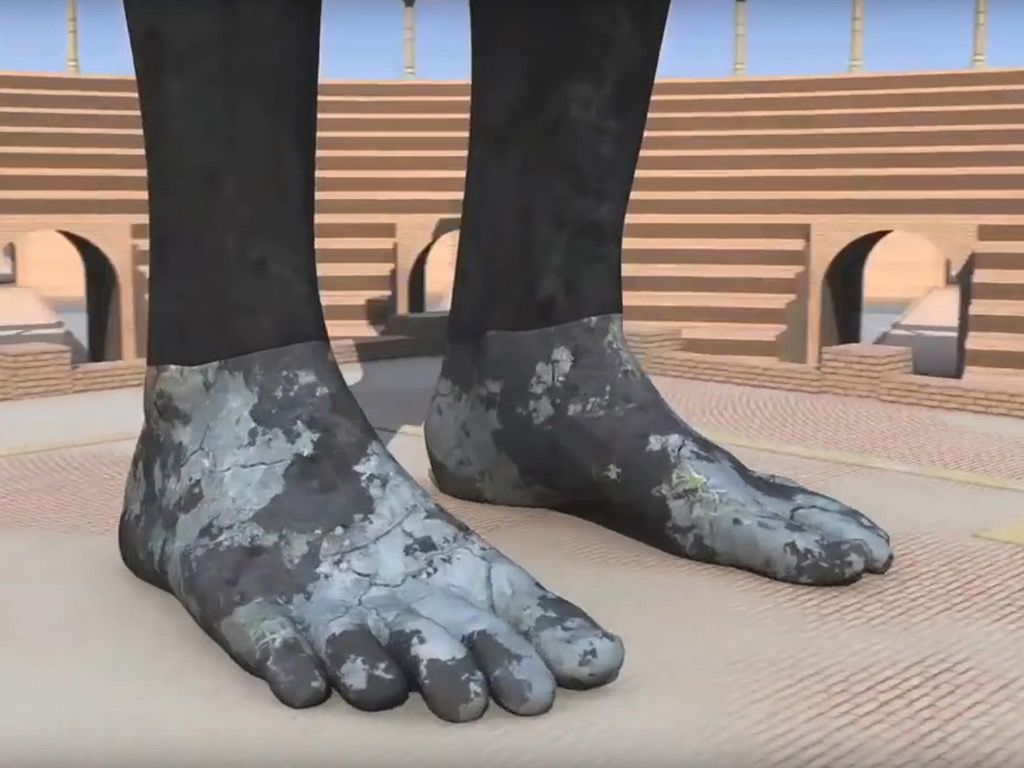
Daniel 2:32-40. This passage gives us the familiar story of king Nebuchadnezzars’ dream and Daniel’s interpretation of it. He saw in his dream a huge statue of a man with a head of gold, its chest and arms of silver, its belly and thighs of bronze, its legs of iron and feet of both iron and clay. Along with Daniel’s recognition of the four different world kingdoms, scholars now recognize these kingdoms as such: the head of gold as Babylon, the silver breast and arms as Medo-Persia, the belly and thigh of bronze as Greece, and the iron legs and feet as Rome.
Our focus in these last days are on that forth empire of Rome, and particularly on the feet which, in the dream, were made of a mixture of iron and clay. The strong legs of iron we reason represents the early historic Rome, and the feet represents the revived future Rome. And we must take note that since the feet are of that mixture, that the coming revived Roman empire will be somewhat weaker than the early Rome.
Daniels 2:41-42. From these verses the writer of Daniel does not say that there are ten toes on the feet of the statute, but we can make that assumption. Hence, we may surmise that the ten toes symbolize the same as the ten horns of the fourth beast of Daniel 7:24, which, as we are told, represents ten kings—ten kings that are in our future and which will be a part of the future Roman empire.
Daniel 9:26. In this verse we see a timeline of events from the Messiah’s death to the beginning of the Tribulation. Our focus is now on the phrase “and the people of the prince who is to come.” “The prince” here refers not to Jesus but to the Antichrist, the “he” in verse 27. “The people” of the prince are the Romans, because, according to history, they destroyed “the city and the sanctuary” (Jerusalem and the temple).
So, we see from this passage that the Romans are called “the people of the prince,” which are the people of the Antichrist. Hence, this gives us proof that the Romans will be revived during the days of the Antichrist.
Now besides this evidence of the Revived Roman Empire, there is also evidence that its government headquarters will be located in the European Union. Here are…
Seven Reasons why the European Union will becomeThe Revived Roman Empire
1. The EU has the dimensions of an empire in the same area of the old Roman Empire.The EU presently has 28 countries and it has the goal of enlisting a total of 50 countries, including North Africa, North and South America, and Israel.
2. The EU has a power structure that will work for the Antichrist.They have a federalist ideology that is divided between a strong undemocratic central authority and individual units. Hence, it would be very easy for them to give way to a dictatorship and also to set up ten main divisions of power—which will happen in the Revived Roman Empire under the Antichrist (Dan. 2:41-42; 7:24; Rev. 17:12).
3. The EU is preparing its people for the Antichrist.In the last few years, they have been using devious means to make the nation states less autonomous, less powerful, and more willing to be controlled by a central leader.
4. The EU has a goal to unite the world in peace. This goal fits well with what the Antichrist will accomplish during the first few months of his reign.
5. The EU has peaceful plans for Israel. It is in their plans to offer Israel free trade, protection and peace. This Israeli friendship may be the key element confirming the EU as the Revived Roman Empire.
6. The EU’s conflicts of authority.we are seeing a growing problem in the EU between the central power and the weaker national powers. It seems to me that the conflicts have to do with allowing too many people of different cultures to enter their countries without properly vetting them. In any event, this problem matches well with what we see in Daniel 2:431-43: the problem with the iron and the clay.
7. There are some reports that the EU is moving closer to a ten-nation federation.The ten toes and the ten king’s prophecy are coming into view.
“Enter by the narrow gate; for the gate is wide, and the way is broad that leads to destruction, and many are those who enter by it. 14 “For the gate is small, and the way is narrow that leads to life, and few are those who find it.
If you have been following along you know that I have been using D. Martyn Lloyd-Jones’ sermons from his Studies in the Sermon on the Mount as my reference. Hence, the main points and teaching are from his book (which are his sermons); and then I bring some of my own ideas into it. This sermon is much like the previous one, using the same text, but we go deeper into the meaning of it. In these two verses of Jesus’ sermon, we will discuss now the meaning of entering into the Christian life, based on His description here of the narrow gate as well as the narrow way. And we will also discuss a few things that will go along with the entire process of becoming a Christian. Please be attentive now to the following four principles on this subject.
1. Becoming a Christian demands a decision and a commitment.
When a person begins to understand some of the teachings of Christ and when God begins to tug on his heart so that he desires to follow Him, the gospel demands that he make a decision right then to leave whatever he is doing (and all of the old life) and go follow Him. You may remember how it was with Jesus’ first followers. Jesus met Peter and his brother Andrew on the beach of the Sea of Galilee as they were casting their nets into the sea. And He said to them, “Follow Me, and I will make you fishers of men.” What did they do? Did they think about it? No! Scripture says, “Immediately they left their nets and followed Him.” Apparently, they knew enough about Jesus and had heard enough of His words to know that they wanted to be around Him and to learn more of Him. So they were not hesitant when the opportunity came to follow Him.
2.Look for the narrow gate and go through it.
Having made a firm decision to be a Christian, the next step is to look for the way of entrance. It is described by Jesus as a strait (or narrow) gate. And so, it is not very public or visible or even desirable by many. It is small and unpopular; yet to the one seeking it, it will be desirable, because Jesus will be there, waving at him to come in. and he will be excited to enter.
Now there have been many who think that they want to be a Christian and they have somewhat committed themselves to that goal; yet when it came to actually entering into it (the Christian life) they did not. Why? Because they did not put the effort into looking for it—for the narrow gate. As verse 14 says, “Few are those who find it.” This implies that they were not looking very intently—or maybe not at all. Perhaps they were looking for the wrong kind of gate. They may have envisioned it as a very large and majestic gate. Hence, they may have passed by the narrow gate without even knowing it.
3. Talk to yourself regarding what you have done and what things are different.
(This is something I wouldn’t have thought of, but Lloyd-Jones includes it; and now I think it is a good thing to do.) So, after a person has decided to enter, and he does find the way and enters in, and so gives his life to Christ, he will probably begin to ask himself certain questions: what did I just do? Who am I now? So, the point is that a new Christian should be always reminding himself every day that he is a child of God, a unique person and belonging to the family of God. Also, he should remind himself that Christ has died for him and that he is going to heaven and that he is just passing through this world, with its many temptations and trials.
4. For those who are disbelieving and doubtful.
Here in our text Jesus shows us two different ways and where they lead to. He is trying to take away the reasons for not entering in by the narrow gate. The obvious reason He gives is that the broad way leads to destruction—hell.
Some may reason that there are two choices to make: to take the narrow way or the broad way. However, if you examine other Scriptures, you will discover that by man’s nature he is already on the broad road, and God’s wrath is already on him (Jn. 3:36).
Another thing to consider is that since all (all those who have not believed) are already traveling on this broad road leading to destruction, that they know nothing of the narrow way that leads to life. And so, they may be satisfied with their life, having seen no other way. For this reason the Christian must do all he can to warn the unbeliever to where he is going, also he must tell him about a better way, a narrow way, yet a way that leads to life.
If we study the meaning of each part of the Ark of the Covenant we will receive a wonderful salvation message.
The Ark of the Covenant with the Mercy Seat and the Cherubim was located on the other side of the veil in the Most Holy Place. There the High Priest entered only once a year to sprinkle sacrificial blood on top of the Mercy Seat.
The appearance of the Ark was quite awesome, not only because of its brilliant gold, but also because of the mysterious light that hovered over the center of it—the Shekinah Glory, which was the glory of the very presence of God.
The Ark itself (without its lid) was just a box, 3 ½ feet long, 2 ½ feet wide and 2 ½ feet deep. It was made of acacia wood overlaid with gold. The wood represented the humanity of Christ, and the gold, His…
Beginning in Matthew 7:13 and 14 we come to the application of Jesus’ Sermon. The main part of the sermon ends at verse twelve, and here in verse thirteen Jesus begins to point to the application—how we are to apply it.
“Enter by the narrow gate; for the gate is wide, and the way is broad that leads to destruction, and many are those who enter by it. 14 “For the gate is small, and the way is narrow that leads to life, and few are those who find it.
So Jesus tells us that there are two different applications, or ways we can proceed: through the narrow gate or through the wide gate.
Well, Jesus beckons us to go through the narrow gate, because, He says the wide gate leads to destruction, the way most people are going. But the narrow gate, though it is difficult, leads to life.
Now why do you suppose the way of life is narrow? And why is the way of destruction wide?
Well, what is most obvious to me is that the size of the gate (and the way) has to do with the amount of people who will enter there. I think the narrow gate, the way of the true Christian, is narrow mainly because God knows that not too many will be coming through it. And the wide gate is wide because God knows that many will be coming thought it.
But there are a few other reasons for the size of the gates (and for the size of the path). For the Christian, he does not require a wide gate because he is called to a life of holiness and suffering and difficulty just like Jesus was. He does not have many possessions—Jesus had no where to lay His head. Yes, the Christian is called to leave the world behind. But the non-Christian carries many worldly goods with him. He is full of love for self and all his possessions, and so he needs a wide gate and a wide path to make it through.
Another way to look at is to see the gate as the kind of people we are, or that we are to be. A Christian is called to narrowness, which suggests someone who is different, peculiar, or exceptional—just as Jesus was. But the non-Christian is drawn to the broad way because he would rather be more acceptable to all and popular and comfortable and as normal as can be.
Narrowness here may also point to the fact that the teachings of Jesus are narrow, or, as some would say narrow-minded. They don’t allow for any other view. After all, Jesus said, “I am the way, and the truth, and the life; no one comes to the Father but through Me” (Jn 14:6). And the wide way may indicate the way of those who are less narrow-minded, and more tolerant of many other views, even other religions.
Prayer helps in these four areas of spiritual growth:
1. Growth in understanding God’s ways.In James 1:5 it says, “If any of you lacks wisdom, let him ask of God, who gives to all liberally…” It seems from this verse (and the previous verses), that wisdom, which is really an understanding of God’s ways, is gained through prayer as well as through experience; for as we encounter various trials (verse 2), we pray and ask God for an understanding of what to do (verse 5). Therefore, both experience and prayer are needed.
Experience (including all the trials we go through) keeps us in touch with reality, and prayer keeps us in touch with God, who in turn helps us understand all that we experience—which is wisdom.
Experience allows us to grow in endurance as we encounter various trials, and prayer keeps us trusting and in touch with God—who is really the source of all our help. As we encounter various trials through our experience, they will serve to move us toward prayer. But unless we pray, all the experience and all the trials will do us no good; that is, they will not produce in us true wisdom. The old person, who says, “I am wise because of my many years of experience,” is nothing but an old fool if he has rejected God. True wisdom, no matter how much experience one has, comes only to those who pray and ask for it.
2. Growth in understanding God’s Word.In Psalms 119:18 we read, “Open my eyes, that I may see wondrous things from Your law.” Here the Psalmist prays to God that He would open his eyes and cause him to understand wonderful things from His Word. As we may observe in this verse, there is nothing said about any personal effort of study to gain understanding. The Psalmist expects all his understanding of the Word to come directly from God through prayer.
Now we know that the Bible tells us to study and meditate on the scriptures (2 Tim. 2:15, Ps. 1); therefore, our effort should not be disregarded. All our effort in study, however, will prove vain and worthless without prayer. But by prayer all that we have studied and pondered will make sense.
3. Growth in developing a hatred for sin and a love for righteousness. This time we will turn to Psalms 51. Here we see that David was intensely grieved over his sin. In verse four he prays, “Against You, You only, have I sinned, and done this evil in Your sight…” Then in verse 10, he prays, “Create in me a clean heart, O God, and renew a steadfast spirit within me.”
As we see in this chapter, David believed in prayer; he counted on God in prayer to clean up his heart and restore his relationship with Him.
We can count on God in prayer just as David did. And the more we pray for purity in our life, the more God will give it to us, and thus the more we will grow to hate sin and love righteousness.
4. Growth in becoming more like God’s Son. In Romans 8:29 it says, “For whom He foreknew, He also predestined to become conformed to the image of His Son.” At first glance we may think that we don’t need do anything to bring about our transformation, that since it is already predestined to happen, God will make it happen without our effort. Well, ultimately, I suppose that is true. But, along the way, God chooses to involve us in the process.
No, we cannot idly stand by and think that God will handle it all. Transformation comes with the hard work of renewing our mind (Rom. 12:2)—which includes Bible study, meditation, and prayer.
And the more we give ourselves to the work of study and prayer, the more we will behold Him as He really is. Hence, in our beholding Him we are being transformed from one degree of glory to another (2 Cor. 3:18).
Therefore, however you want people to treat you, so treat them, for this is the Law and the Prophets.
There are certainly tragic results of mistreatment on both sides: others mistreating me, as well as my mistreatment of others. And that mistreatment affects not only the one being mistreated, but also the one who is causing the mistreatment.
For this post today, I want to write on how others, as well as myself, have been mistreated. I will start with myself. I couldn’t have been more than seven years old, first grade. My dad had helped me make a boat, really an old clipper ship. It was a great project. We carved it out of a four-by-four block of wood, then we gave it three masks made of dowels, we made sails made of white cloth, and then we tied strings all over it—which were to be the ropes holding the sails in place. I was surprised at how good it looked when it was finished. It was the first project I had ever attempted before—even though Dad had done most of it. Nonetheless, I really felt good about it and proud of myself.
But the very next day after it was finished, I discovered that all the strings (the ropes) were cut. Someone had cut all the ships ropes. Who would do such a thing? I was devastated. At the time I didn’t give much thought on who could have done it. Or why. It didn’t matter to me. The only thing that mattered is that my ship was destroyed.
Obviously, whoever did it didn’t stop and think how they would want to be treated and then how they should treat me. They were thinking only of themselves.
Another victim of mistreatment we often think of is the biblical character Joseph. The story is found in Genesis 37:2-36. He was his father’s favorite son, and so he gave him a beautiful coat of many colors. Well, as the story goes, his brothers were extremely jealous of him, and one day they threw him in a pit and left him for dead. How tragic. As we know, God made things work together for good, and Joseph became the great savior of the Jewish nation. But even so, think of all the pain Joseph went through because of those brothers who thought only of themselves.
Another character we could think of is David. He was such a man of God; he had a heart after God’s own heart. Yet think of how he was abused by others. The Psalms are filled with the prayers of David—how he was chased and was fearful of his enemies—those who certainly were not following the Golden Rule.
The ultimate example of mistreatment by others was our Lord Jesus. And we are all guilty. But the Pharisees seemed to be the ones who were after Him the most—to be rid of Him. And Scripture tells us that they handed Him over (to be crucified) “because of envy” (Matt. 27:18). Think of it. Their sin of envy was so strong that it blocked out any thought of how they should treat others.
Of course, they were not believers, and that is the entire problem. The Golden Rule makes no sense to a non-believer. Only true believers will carry it out. And only a true believer can carry it out. If you want to make a huge impact on peoples lives, if you want to really love them as God loves them, give your heart and soul to God and then practice this Golden Rule. I think it is how we can really begin to love others.
This Golden Rule is so simple, yet profound. It is simple because there is only one thing we are required to do—think how I would want to be treated by others and then treat them that way. It is profound because it works. And it starts with us. We start this process of love, and other will pick it up and carry it on.
And when a non-Christian sees how we lovingly treat each other, they will be curious and will want to join us. I think so. I pray so.
This is our fourteenth study. Please click HERE for an intro to this study. Today we see how Jesus turned the tables on the Pharisees—how He tested their weak faith.
Matthew 22:34-46
Hearing that Jesus had silenced the Sadducees, the Pharisees got together. 35 One of them, an expert in the law, tested him with this question: 36 “Teacher, which is the greatest commandment in the Law?”
37 Jesus replied: “‘Love the Lord your God with all your heart and with all your soul and with all your mind.’ 38 This is the first and greatest commandment. 39 And the second is like it: ‘Love your neighbor as yourself.’ 40 All the Law and the Prophets hang on these two commandments.”
41 While the Pharisees were gathered together, Jesus asked them, 42 “What do you think about the Christ? Whose son is he?”
“The son of David,” they replied.
43 He said to them, “How is it then that David, speaking by the Spirit, calls him ‘Lord’? For he says,
44 “‘The Lord said to my Lord:
“Sit at my right hand
until I put your enemies
under your feet.” ‘
45 If then David calls him ‘Lord,’ how can he be his son?” 46 No one could say a word in reply, and from that day on no one dared to ask him any more questions.
Observations
After the Pharisees tried to stump Jesus by asking Him which was the greatest commandment in the Law (and Jesus not only told them which was the greatest, but also the second greatest), He then had a question for them. He asked them whose son was Jesus. They answered correctly: the son of David. He them asked them, why then did David in the Spirit call Him Lord (in Ps. 110:1). It is obvious here that Jesus was pointing out His own deity. But still the Pharisees would not accept it. They understood what He was saying, but they refused to believe that He was the Son of God.
Application
The application for the Pharisees is to believe. The application for us today is the same. We must believe that He is the Son of God—the Lord, our Lord.
“Ask, and it shall be given to you; seek, and you shall find; knock, and it shall be opened to you. 8 “For everyone who asks receives, and he who seeks finds, and to him who knocks it shall be opened.
Here is an absolute promise made by the Son of God. It tells us very directly and strongly that God wants to and will answer our prayers. But there is a right way to ask and a wrong way.
How Not to Ask
1. I think, generally speaking, we should not ask Him to remove our problems from us or take us out of a bad situation. It is always better to ask Him to help us deal with our problems where we are.
2. Never use these verses as a psychological treatment or a way to comfort ourselves. The Lord has given us an absolute promise. If we ask correctly, He will answer us—give us what we need.
3. We must not take verses 7 and 8 out of context. They have a connection to verses 9-11. Verses 7 through 11 all go together.
What to Ask for and How to Ask
1. we should always try to ask for what we think is His will in any given situation. Ask for His wisdom.
2. Ask with persistence. The words ask, seek, and knock indicate persistence and importunity. And if we are truly praying with persistence this attitude will also be a part of our life—we will be persistent and diligent in our work and in our holiness.
3. Ask realizing that God is our Father and that He wants to give us only what is good (verses 9-11).
4. Ask for the Holy Spirit. In the parallel passage in Luke 11:9-13, Luke adds the Holy Spirit (in verse 13). So, whatever we are asking for we ought to include the Holy Spirit. He is the ultimate good thing that the Father offers us. And the Father will never deny us the Holy Spirt.