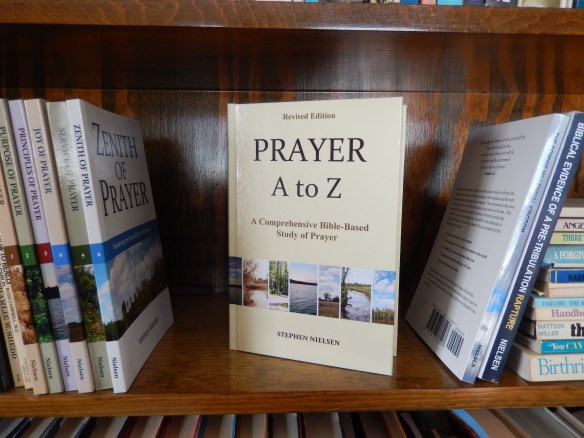
Prayer A to Z: A Book of 52 Chapters

Prayer A to Z: A Comprehensive Bible-Based Study of Prayer, is indeed comprehensive. In this post I will give you a brief breakdown of the book, chapter by chapter, 52 chapters in all.

When I began thinking of what I wanted the book to be like, my thoughts were drawn to some of the classic books on prayer I have read, books by E. M. Bounds, Andrew Murray, Hudson Taylor, R. A. Torrey, and Charles Spurgeon. I considered these authors to be powerful and holy men of God, and so I wanted to follow in their steps.

What would I do? How would I form its content? The first thing I did was to look through all the books I had (about 30 book) to get ideas. I wrote down all the possible topics or chapter titles. I came up with about 80 topics; and I also decided that I would take some time to read through the bible to find all the prayers of the bible. It took me over a year; and during that time, I also worked on the formation of the chapters. Eighty chapters was way too many. I eventually narrowed it down to 52 chapters, including five chapters on the prayers of the bible.

Then I had a brilliant idea. If a person would read and study one chapter a week, that would make a good year-long study. I also got the idea of trying to put all the chapters in alphabetical order. That took some doing, but it came together. Well, after I was done patting myself on the back for my brilliance, I suddenly got the thought that maybe God had something to do with it.  And the more I realized how everything came together, I was sure of it. It was all His doing!

Okay, here are the fifty-two chapters, with just a short comment on each chapter.

  1. Answers to Prayer. Seventeen pages on this topic. A great start.
  2. Aroma of Prayer. This is a favorite to many readers.
  3. Authority of Prayer. All our authority is in Christ.
  4. Burden in Prayer. In this chapter you realize God’s heart of compassion.
  5. Confidence in Prayer. Discover God-confidence in prayer.
  6. Definition of Prayer. Discover here what prayer is.
  7. Desire in Prayer. It is important to pray with desire.
  8. Earnestness in Prayer. Earnest prayer grows out of desire.
  9. Evangelism in Prayer. How to pray for the lost.
  10. Failure in Prayer. Why we fail in prayer.
  11. Faith and Prayer. Why faith is necessary in prayer.
  12. Fasting and Prayer. Instruction and guidelines for Fasting.
  13. Forgiveness and Prayer. Why forgiveness is so necessary for prayer.
  14. God’s Idea. Prayer is God’s idea.
  15. Holiness and Prayer. Holiness always goes with prayer.
  16. Holy Spirit and Prayer. Prayer and the Holy Spirit work together.
  17. How to Pray – Part 1. Eight of Jesus’ Teachings on Prayer.
  18. How to Pray – Part 2. A study of the Lord’s Prayer.
  19. Importunity in Prayer. Persistent and urgent prayer.
  20. Intercession – Part 1. The Father, Son and Holy Spirit’s Intercession.
  21. Intercession – Part 2. The definition of intercession.
  22. Intercession – Part 3. How we intercede for others.
  23. Jesus’ Name. Prayer in Jesus’ name.
  24. Kneeling in Prayer. Prayer posture.
  25. Length of Prayer. How long should we pray for.
  26. Ministry of Prayer. Practical help on how to have a prayer ministry.
  27. Necessity of Prayer. Nine reasons why prayer is necessary.
  28. Obedience and Prayer. Being obedient to God is so necessary in prayer.
  29. Possibilities of Prayer. Praying for big things.
  30. Power in Prayer. How to have power in your prayers.
  31. Praise and Prayer – Part 1. Praise as a vital part of prayer.
  32. Praise and Prayer – Part 2. Biblical examples of praise.
  33. Prayerlessness. The sin of prayerlessness.
  34. Quietness in Prayer – Part 1. Hearing God’s voice.
  35. Quietness in Prayer – Part 2. Our quiet time with God.
  36. Quietness in Prayer – Part 3. The importance of solitude.
  37. Quietness in Prayer – Part 4. How the Devil perverts our prayers.
  38. Revival and Prayer. What part prayer has in revival.
  39. Specific Praying. How to pray specifically.
  40. Survey of Prayer – Part 1. Prayers of the Bible, Abraham through Moses.
  41. Survey of Prayer – Part 2. Prayers of the Bible, Joshua through Samuel.
  42. Survey of Prayer – Part 3. Prayers of the Bible, David through Jehoshaphat.
  43. Survey of Prayer – Part 4. Prayers of the Bible, Elijah through Daniel.
  44. Survey of Prayer – Part 5. Prayers of the Bible, Ezra through John.
  45. Travail in Prayer. Why we need to travail in prayer.
  46. United Prayer. Praying together in agreement.
  47. Vigilance in Prayer – Part 1. Why vigilance is necessary.
  48. Vigilance in Prayer – Part 2. Overcoming the enemy through vigilance.
  49. Word and Prayer. The use of the word in Prayer.
  50. Xanadu. Experiencing the beauty of prayer.
  51. Yielding in Prayer. Why we must yield to God when we pray.
  52. Zenith of Prayer. This last chapter of 93 pages summarizes the entire book.

My Book, Prayer A to Z: Why A Book on Prayer?

In this blog post, and the next few, I will be writing about my books. I have written nine books and will soon be completing a tenth book. Today I will start with Prayer A to Z: A Comprehensive Bible-Based Study of Prayer. I began putting it together in 1992 and it was published in 2013. So, it took me a while to write it. But it’s long, 735 pages.

As you can tell by the title, it’s a book on prayer and was meant to be very comprehensive. Some may ask, why do I need to read a book on prayer? Especially a book of that length? I remember one person saying to me, just as I was beginning to write the book, that he didn’t need to be taught how to pray; he just needed to pray more. He was saying, in effect, that just by his practice of prayer, that, in itself, would make him better at prayer.

Well, I agree that the more we pray the better at prayer we will get and the closer our relationship with Him will be. But I also think that some instruction is necessary. In fact, we know that from what Jesus taught His disciples. He took the time to instruct them on how to pray. In chapters 17 and 18 of my book, I point this out. In chapter 17, I give eight of Jesus’ teachings on prayer. Then in chapter 18 is my study of the Lord’s Prayer, which is really Jesus’ lesson plan (or tutorial) on prayer to His disciples—and to us.

So, we really do need to be taught how to pray, and we especially need to pay attention to Jesus’ teachings on prayer. And really, all through the bible we can find prayer help and instruction. I especially like the Psalms.

And for those who think that all we need to do is pray, I want to give this warning: if you do that, you will be fighting against the Holy Spirit and your praying will not be according to His will or what He desires. For if He has given us instruction on prayer in His word, and we choose not to follow it, then we are being disobedient to the Holy Spirit and all our efforts at prayer will fail and may even cause us to be misled.

In my book, I not only present all the biblical teaching I could find on prayer, as I searched the Scriptures; I also read from about 100 books and articles offering their biblical studies on prayer, being careful not to include any material that was not biblical. I think there are too many books out there already that offer only people’s experiences. In my opinion, those kinds of books will do more damage than good. In terms of prayer, the only thing we need is God’s word and the testimonies of those who followed His word. Anything else is simply speculation.

I think this is enough for this post. Next time I will try to summarize the book by briefly going through the chapters.

The Righteous and the Wicked: Fruit Trees and Chaff – Psalm 1

I’ve been thinking lately about the first Psalm—mainly about chaff. In this Psalm the Psalmist compares the righteous man to the wicked man.

Here is what is said about the righteous man:

How blessed is the man who does not walk in the counsel of the wicked,

Nor stand in the path of sinners,

Nor sit in the seat of scoffers!

2 But his delight is in the law of the Lord,

And in His law he meditates day and night.

3 And he will be like a tree firmly planted by streams of water,

Which yields its fruit in its season,

And its leaf does not wither;

And in whatever he does, he prospers.

(Psalm 1:1-3)

Here are my observations on the righteous man:

  • He does not listen to the teaching of the wicked or even spend much time with them.
  • He meditates on the word and delights in it all the time.
  • He is like a fruit tree. He is fruitful and prosperous.
  • Like a tree, his life is stable and is firmly planted.
  • The Lord knows him and will be with him for eternity.

Here is what the Psalmist says about the wicked, unsaved man:

The wicked are not so,

But they are like chaff which the wind drives away.

5 Therefore the wicked will not stand in the judgment,

Nor sinners in the assembly of the righteous.

6 For the Lord knows the way of the righteous,

But the way of the wicked will perish.

(Psalm 1:4-6)

Here are my observations about the unrighteous man:

  • He is like chaff. He has no fruit, no stability, no real prosperity.
  • He has no hope of eternal life. In the final judgment he will be found unrighteous and will be cast into the lake of fire for eternity (Rev. 20:11-15).
A farmer tosses the wheat into the air so that the wheat chaff will be blown away.

More on the Chaff

How would you like to be compared to chaff? Well, the Psalmist compares the wicked to chaff in verse 4. Think of it. Chaff. Chaff has absolutely no value, no worth. Wheat chaff is the outer casing of the wheat kernel that has gotten old and is coming off. That outer shell is so flimsy that when you would throw the wheat into the air, the wind would blow the chaff away.

Think of that.  Think of being blown away. The non-Christian is in a state of constantly being blown away. He is blown wherever the wind happens to blow. He has no strength of will.  He lets the evil world blow him wherever the devil and the world want him to go. Just like the chaff, the unbeliever has no fruit, no value, and no real prosperity. Oh, he may have momentary desires and delights of the flesh, but nothing that will last and nothing that has any lasting (eternal) value. And he has no stability. He is not like a stable tree. He has no roots. He is just chaff that is blown from place to place with the wind—with the evil world.

The Chaff Compared to the Unformed Earth

As it happened, on the same day (yesterday) that I read Psalm 1, I also read Genesis 1. As I was thinking of the chaff, I also thought of how the earth was in the beginning.  The bible says, “And the earth was formless and void.” (I’m not sure how to interpret this. I tend to think that God first created an unformed earth—like a big lump of clay—out of nothing; then later He formed it as it is now). Anyway, I began to think of the chaff much like that formless earth.

And that got me to thinking. If God could make a beautiful, fruitful earth out of that formless mass, why couldn’t He make something out of the chaff. Well He can and He has. Every time a person is saved it is like a formless piece of chaff being miraculously created into a beautiful new creation of God—with hope and purpose. 2 Corinthians 5:17 says,

Therefore if any man is in Christ, he is a new creature; the old things passed away; behold, new things have come.

Thou Shalt Not Commit Adultery

This is a Reblog from my Prayer blog. I thought it would have relevance to this personal blog. We always have to pay attention to our heart, whether there is sin in the heart.

Stephen Nielsen's avatarPrayer A to Z

Jesus said to His disciples in Matthew 5:27-30,

“You have heard that it was said to those of old, ‘You shall not commit adultery.’  28 But I say to you that whoever looks at a woman to lust for her has already committed adultery with her in his heart.  29 If your right eye causes you to sin, pluck it out and cast it from you; for it is more profitable for you that one of your members perish, than for your whole body to be cast into hell.  30 And if your right hand causes you to sin, cut it off and cast it from you; for it is more profitable for you that one of your members perish, than for your whole body to be cast into hell.

In this passage from Jesus’ Sermon on the Mount, He indicates that the Pharisees and Sadducees had reduced the…

View original post 428 more words